
 Exchange Ranking
 Top Exchanges
 24h Volume Ranking
 Popularity Ranking
 Exchange BTC Balance
 Proof of Reserves
 Decentralized Exchanges
 Funding Rate
 Funding Heatmap
 Liquidation Data
 Max Pain
 Long/Short Ratio
 Whale L/S Ratio
 Binance/Okex/Huobi L/S
 Bitfinex Margin L/S
 ETF Tracker
 Solana ETF
 XRP ETF
 Hong Kong ETF
 Bitcoin Treasuries
 Crypto Reversal
 Ethereum Reserves
 HyperLiquid Wallet Analysis
 Hyperliquid Whale Watch
 Large Transactions
 On-chain Movement
 Bitcoin ROI
 Stablecoin Market Cap
 Options Analysis
 News
News Articles
 Economic Calendar
 Features
 Wallet
 Contract Calculator


 Security
 Collections
 Watchlist
 Following
 ETH
ETH How an Ethereum Treasury Company operates
An Ethereum Treasury Company attempts to increase the amount of economic ETH that can be attributed behind diluted per share by financing, buying ETH, and allocating assets between liquid and production positions. Pledges can generate recurring ETH income, but this alone does not prove that shareholders are profitable: additional issuance, service provider fees, operating costs, property rights encumbrances and diluted shares may all consume this income.
Therefore, the meaningful question is not which company holds the most ETH, but whether capital formation, acquisition execution and pledge can generate more net ETH per share without creating a liquidity mismatch. This requires treating the treasury as an operating system and then checking each claimed gain against the base numbers defined in the balance sheet and filing documents.

How Ethereum Treasury actually works
The model starts in the capital market, not the verification node. Companies raise cash, convert net income into ETH, choose custody and pledge arrangements, receive rewards, and ultimately report results through financial statements and operating indicators.
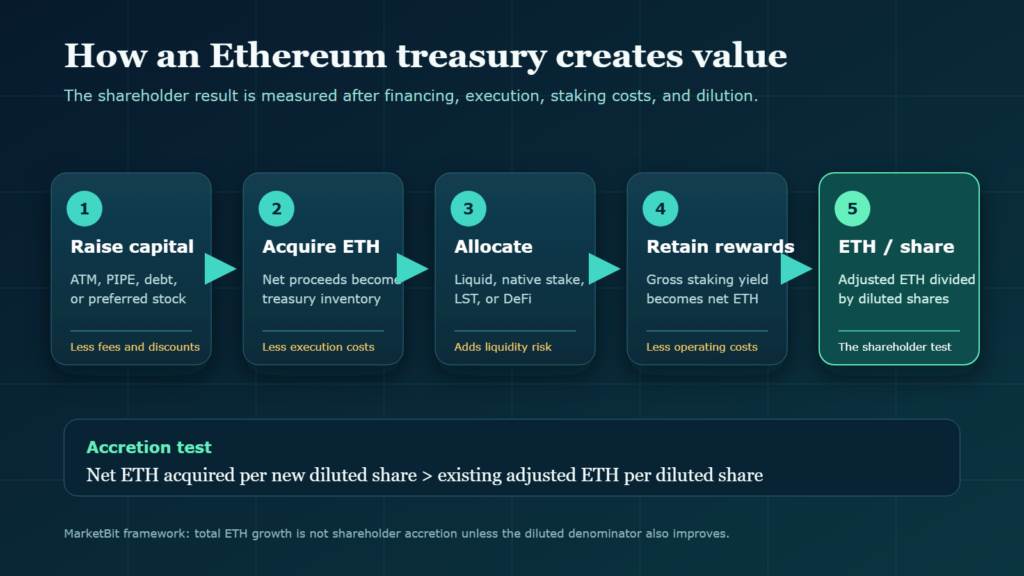
The treasury can create value for shareholders only if financing, execution and pledge produce more adjusted ETH after dilution per share, after deducting costs. Total income is first deducted from underwriting and placement costs. The execution process determines how much ETH the remaining cash can buy; treasury allocation determines liquidity; pledge brings rewards and operating costs; and the diluted denominator determines how much per share can be shared.
This is different from passive Bitcoin reserves, as every productive use of ETH creates new liquidity, counterparty, or smart contract paths. Asset background should be included in broader Ethereum analysis; equity results should be part of the filing document.
Four pledge models produce four different liabilities
The label "Pledged ETH" is too broad for equity analysis. Companies may control verifying node credentials, outsource infrastructure, hold redeemable liquidity pledged tokens, or deploy the token into another protocol. Economic gains may look similar, but withdrawal rights and loss paths are substantially different.
Pledge Mode | Asset and Reward Structure | Liquidity and principal risk
Native, self-operating: The company holds the verification node ETH, controls the withdrawal certificate, and directly obtains consensus and execution rewards. Liquidity depends on verification node exit and withdrawal processing; key management, forfeiture, uptime and operating costs are borne by the company.
Native, third-party infrastructure: ETH remains owned by the company, but the verification node is operated by an external provider; rewards are earned after deducting service fees. Online withdrawal paths still apply, but increase the risks of provider, fees, credential control and server failures.
Liquidity pledge: LST represents the claim to pooled pledge ETH, and the reward is reflected through token balance or exchange rate growth. Tokens may be traded before redemption, but the market value may deviate from the redeemable ETH; there are smart contract, unanchoring, provider and concentration risks.
Re-pledge or DeFi deployment: ETH or LST is put into another protocol to earn pledge rewards plus incentive or application benefits. Liquidity depends on multiple contracts and exit mechanisms, adding layered forfeiture, oracle, smart contracts and governance risks.
Native pledges maintain the clearest relationship with ETH, but still require secure withdrawal certificates and reliable infrastructure. Ethereum's pledge withdrawal process distinguishes regular reward withdrawals from complete verification node exits, so liquidity cannot be inferred from apparent positions.
If a third-party operator is used, the application document should clarify who controls the withdrawal certificate, collects fees, and bears the forfeiture event. Liquidity pledges can keep capital available in the DeFi market, but must disclose the ETH value and redemption assumptions for redemption based on estimates. Re-pledge improves revenue by adding another layer of failure.
Governance determines who can move or risk ETH
Board policies should clarify the transfer of promoters and independent approvers, maintain the separation of custody, pledge and accounting responsibilities, and clarify who controls withdrawal certificates. Liquidity reserves, provider concentration, allowed LSTs, collateral and DeFi limits, provider replacement rights, forfeiture liability, insurance exclusions, and exception reporting mechanisms should also be defined.
ETH per share is the core denominator of shareholders
Apparent positions may rise, but claims per shareholder may fall. Fully diluted shares should be used instead of the underlying shares: warrants, prepaid warrants, restricted stock units, convertible bonds, and new issues of shares may change the outcome.
Adjusted ETH equivalent = liquidity native ETH + native pledged ETH + estimated redeemable ETH represented by LST-ETH owed, borrowed or with a priority claim
Adjusted diluted ETH per share = adjusted ETH equivalent/assumed diluted shares
Pledged ETH remains an asset, but should be shown separately because other parties may have a priority claim. Therefore, another liquidity indicator is useful:
Unburdened liquidity per diluted share ETH = ready-to-use, unpledged ETH /hypothetical diluted shares
When new share financing is used for acquisitions, the direct thickening test is:
Net ETH per newly diluted share> Existing post-diluted adjusted ETH per share
Passing the test means that the transaction has a mechanical thickening effect at the time of delivery. This does not prove that stocks are cheap or pledges are profitable, but it can prevent the growth of total positions from concealing dilution.
mNAV determines whether the capital flywheel can last
When the stock price exceeds the diluted adjusted NAV per share and the net income is sufficient to purchase enough ETH to pass the thickening test, additional ordinary shares may have a thickening effect. Under the condition of continued discounts, additional ordinary shares are sold claims at a price lower than the current value of each share.
Adjusted NAV vested in common shares = ETH and other liquid assets-debt and preferred stock claims at fair value
mNAV = Market value of common shares/Adjusted NAV vested in common shares
mNAV is a threshold for financing, not a proof of quality. A premium may reflect expected pledge income or speculation; a discount may reflect debt, illiquidity, governance or dilution.
Investment exposure comparison
Direct ETH: Price exposure plus pledge rewards (when the owner operates or commissions pledge). There are no share dilutions, mNAVs or company management fees, but the owner controls custody, pledge, liquidity and sell timing.
Spot or pledged products : Price exposure and pledge income after deducting product fees when authorized. There are redemption, custodian and market time limits; promoter, fee and product structure risks; there is no additional flywheel from Treasury.
Ethereum Treasury Stock : The company's ETH exposure, pledge income and potential increase in ETH per share achieved through capital raising. Additional shares may have a thickening or diluting effect, and shares may be traded at prices above or below NAV; investors also bear governance, custody, salary, debt, preferred stock claims and execution risks.
Net pledge contribution is not superficial APY
Agreement APY is just the starting point. Shareholders receive the remainder after deducting direct costs and ETH sales, while dollar debt may force a cash conversion.
Net pledge retention ETH = Total ETH rewards-Provider and verification node fees denominated in ETH-ETH sold to cover pledge related cash costs-realized pledge losses and penalties
Net pledge cash contribution = cash proceeds of realized rewards-verification node and provider fees-custody, Insurance and security expenses-Pledged salary and compliance expenses-Taxes and taxes attributable to incentives
Retained ETH can improve ETH/share without covering cash expenses; when additional issues exceed incentives, positive cash contributions may coexist with a decline in ETH/share.
An iShares review of the Ethereum pledge mechanism pointed out that rewards vary with the amount, activity and method of online pledge. Therefore, forecasts require date-based balances, expenses and realized revenue.
SharpLink: Before using ETH/shares, check native ETH, LsETH and weETH.
SharpLink reported in its second quarter 2026 filing that it held 888,938 ETH as of August 3: of which 634,255 were native ETH, 181,748 were estimated to be redeemed from LsETH, and 72,935 were estimated to be redeemed from weETH. The document defines ETH concentration as the total ETH held per 1,000 basic equivalent shares outstanding, rather than per ETH.

SharpLink is a useful reporting case because it reports native and liquidity pledge exposures separately, rather than presenting all positions as one undifferentiated ETH balance. Source: SharpLink
Native ETH is listed separately from LsETH and weETH, which converts on an estimated redeemable basis. Rewards that have been embedded in this conversion cannot be credited again. Based on the second quarter definition, basic equivalent shares outstanding include ordinary shares plus shares issuable under nominal price prepaid warrants.
The second quarter filing also reported pledge income of US$11.611 million for the quarter and US$22.662 million in pledge income for the first half of the year. The six-month third-party asset manager and custody fees are approximately US$2.026 million and US$627,000 respectively, which are recognized separately as operating expenses.
BitMine: Verifying node size does not eliminate operating burdens
BitMine shows the other side of the model: at very large scales, pledges can become the main source of operating income. Its May 2026 prospectus stated that as of May 25, approximately 4.7 million ETH (accounting for 87% of its positions) were pledged through MAVAN. The disclosed annualized gross return rate is approximately 2.5% to 4.0%, and the estimated annualized pledge income is approximately US$276 million.
BitMine's size makes pledges an important part of the company's revenue, but annualized gross income still needs to be reconciled against realized revenue, provider fees and company debt. Source: BitMine
For the three and six months ended February 28, realized revenue was US$10.201 million and US$11.181 million, respectively, accounting for approximately 84% of the six-month revenue. The same filing reported $24.09 million in ETH option premium income over three months, which should not be mixed into the recurring pledge economy. BitMine's quarterly filing later reported $56.924 million in pledge and verification revenue for nine months and classified provider fees as cost of sales.
A BitMine investor discussion in July 2026 questioned whether pledge revenue covered broader operating burdens. This is just an investor's interpretation, not evidence of profit, but it points to the right test: realized pledge income minus direct costs, company expenses and financing debt.
Balance sheet analysis: Not every ETH unit has the same availability
Treasury analysis should rebuild assets based on economic conditions. A "total ETH" figure masks emergency liquidity, contract risk and previous claims on common stock.
Balance sheet components | Valuation and Liquidity Treatment | Evidence required for filing documents
Liquidity Native ETH: When unpledged and transferable, ETH equivalents and immediate liquidity are included. Wallet or escrow balances, ownership and transfer restrictions.
Native Pledged ETH: Included in ETH equivalents, but excluded from immediate liquidity until the withdrawal time is determined. Verify node balances, withdrawal vouchers, exit policies and queue risks.
Liquidity pledged tokens: Valued based on supportable estimated redeemable ETH; included in liquidity only after market depth and redemption discounts. Token quantity, conversion rate, market depth and redemption path.
ETH for re-pledge or DeFi deployment: Use supportable recoverable value and exclude immediate liquidity. Agreements, smart contracts, withdrawals, forfeiture and loss clauses.
Pledged ETH: Included as an encumbered asset, but excluded from unencumbered immediate liquidity. Collateral agreement, trigger conditions and priority claims.
Debt and preferred stock claims: Not counted in ETH; applicable preferred claims are deducted when assessing the value of common shares. Principal or liquidation preferences, coupons or dividends, maturity dates and settlement terms.
Dilute securities: Only the denominator of diluted shares is included, not ETH value or liquidity. Warrants, convertible bonds, prepaid warrants, stock awards and conversion conditions.
Asset coverage measures the adjusted ETH behind diluted claims. Liquidity coverage tests whether cash plus no burden ETH can meet operating costs, interest, preferred stock dividends and collateral needs without forced sales or discounted financing. This is particularly important when crypto-related stocks are falling faster than their underlying ETH.
Stress testing of BitMine model based on application documents
BitMine disclosed that as of May 25, approximately 4.7 million ETH items were pledged, with an annualized gross return rate of 2.5% to 4.0%. Multiply these two reporting inputs to arrive at the range of gross income before deducting provider fees, custody, salaries, taxes, penalties or ETH sold to meet cash obligations.
Submission inputs or calculations| Low-yield scenarios| High-yield Scenario
Pledge ETH| 4,700,000 ETH |4,700,000 ETH
Annualized gross return| 2.5% |4.0%
Calculate annualized gross income| 117,500 ETH |188,000 ETH
Less: Provider and verification node fees| Not quantified separately in reference snapshots| Not quantified separately in the cited snapshot
Less: Custody, Salary, Insurance, and Taxes| Not quantified separately in reference snapshots|
Net retention of ETH is not quantified separately in the cited snapshot| Cannot derive from gross return alone| The annualized forecast of approximately US$276 million in
filings that cannot be derived from gross return alone is an estimate of day-to-day running rates based on its pledge activity and market assumptions. The $11.181 million in pledge revenue recognized in the six months ended February 28 is historical accounting results from earlier deployment periods. The two should be checked against each other and should not be seen as a direct comparison covering the same balances, ETH prices and operating windows.
The downside test then asked how lower rewards, delayed withdrawals and dollar debt could change net retention. BitMine also said preferred stock dividends are expected to come from pledges, options strategies and additional capital raising, while warning that these sources may be insufficient. If new share financing is needed during the mNAV discount period, the financing must still pass the net ETH addition test per share.
Fair value gains are different from cash flow capabilities
ETH price changes may dominate gains without sales, and pledge rewards may be recognized before conversion to U.S. dollars. Cash will still be required for payroll, custody, providers, interest and preferred stock distributions, so differences may arise between fair value gains and operating liquidity.
Please consider separately the adjusted diluted ETH per share, net pledge retained ETH and cash after recurring debt. Broader crypto market coverage explains the asset cycle; filings show whether it improves claims for common shareholders.
Conclusion
An Ethereum Treasury company is a financing operation structure, not an exchange-traded wallet. Its quality depends on how efficiently net income is converted into ETH, how much pledge value remains after deducting costs, and whether ETH per adjusted diluted share increases.
SharpLink demonstrates why native ETH, LST and post-dilution denominator need to be checked. BitMine shows why verifying node size still requires liquidity, cost and financing testing. Asset composition, net pledge contribution and economic indicators per share must be reported together.
Frequently Asked Questions
What are the most useful indicators for Ethereum Treasury?
Adjusted diluted per share ETH is the best starting point because it relates treasury growth to the shareholder denominator. Unburdened liquidity ETH per share and net pledge contribution should be considered simultaneously to avoid mistaking productive but illiquid balances for available cash.
Should liquid pledged tokens be counted in ETH?
When the conversion method and redemption path are disclosed, they can be counted as an estimated redeemable ETH equivalent. However, it should be listed separately because smart contracts, market prices, providers and withdrawal risks are different from native ETH.
Will higher pledge rates always increase shareholder value?
No. Gross gains may be offset by provider fees, custody fees, taxes, ETH sales, operating costs or dilutions. The relevant results are net retained ETH and net cash contribution per diluted share, rather than the advertised annualized rate of return.
Why may fair value profits differ from operating cash flows?
Fair value accounting records changes in the market value of ETH without requiring an actual sale. Corporate expenses and financing obligations still require cash, so accounting income and cash available for operations or distribution may move in different directions.
























