Exchange Ranking
 Top Exchanges
 24h Volume Ranking
 Popularity Ranking
 Exchange BTC Balance
 Proof of Reserves
 Decentralized Exchanges
 Funding Rate
 Funding Heatmap
 Liquidation Data
 Max Pain
 Long/Short Ratio
 Whale L/S Ratio
 Binance/Okex/Huobi L/S
 Bitfinex Margin L/S
 ETF Tracker
 Solana ETF
 XRP ETF
 Hong Kong ETF
 Bitcoin Treasuries
 Crypto Reversal
 Ethereum Reserves
 HyperLiquid Wallet Analysis
 Hyperliquid Whale Watch
 Large Transactions
 On-chain Movement
 Bitcoin ROI
 Stablecoin Market Cap
 Options Analysis
 News
News Articles
 Economic Calendar
 Features
 Wallet
 Contract Calculator


 Security
 Collections
 Watchlist
 Following
 BTC
BTC The bitcoin whale, which has been sleeping for more than ten years, suddenly woke up: 1,260 BTC units were transferred, with potential profits of nearly 100 million US dollars.
Long-term holders have recently regained their activity in the bitcoin market. A wallet that had been dormant for more than a decade suddenly transferred more than 1,260 bitcoins (BTC) worth more than $100 million. The transaction follows the re-emergence of another extremely ancient Bitcoin position, highlighting a significant increase in activity in wallets that have gone through multiple major market cycles without being touched.
According to data shared by Galaxy Research, on Sunday, September 6, after 10.2 years of silence, 1,260.78 bitcoins were transferred, with a valuation of approximately US$100.63 million. On-chain data shows that the coins were originally received on July 9, 2016, when Bitcoin was trading at close to $652. 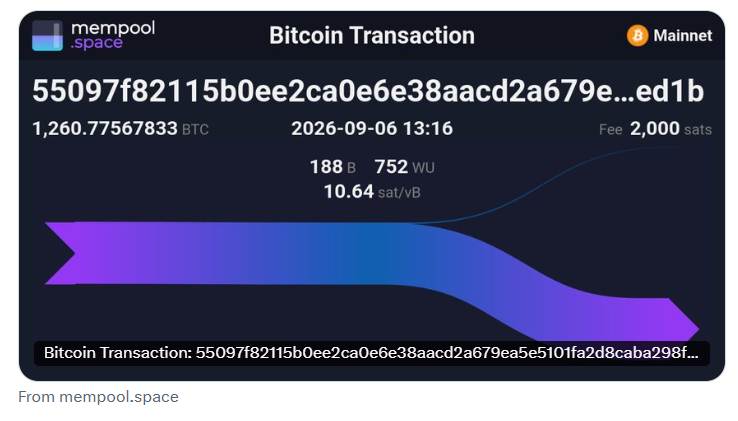
This transfer is recorded in block 965770. According to the company, these Bitcoin positions generated estimated profits of approximately US$99.64 million. According to its data, the wallet's average cost basis is approximately US$652 per Bitcoin, achieving a gain of approximately 12,122% over the entire holding period.
It is worth noting that this movement does not necessarily mean that the "giant whale" has sold his position. Bitcoin can be transferred between wallets for security, custody or other purposes without having to be sent to an exchange. However, due to the age and size of the inventory, the transfer is significant. The giant whale bought Bitcoin when asset prices were only a tiny fraction of current valuations and has experienced multiple bull markets, crashes and major changes in the cryptocurrency industry.
The deal also adds to the flow of activity involving older bitcoins. According to a tweet from blockchain tracking company Whale Alert, another entity transferred approximately 600 bitcoins, worth approximately $48 million, through a separate transaction after more than 16 years of inactivity. The coins were dug up in March 2010, and each of the 12 addresses received a block reward of 50 bitcoins. 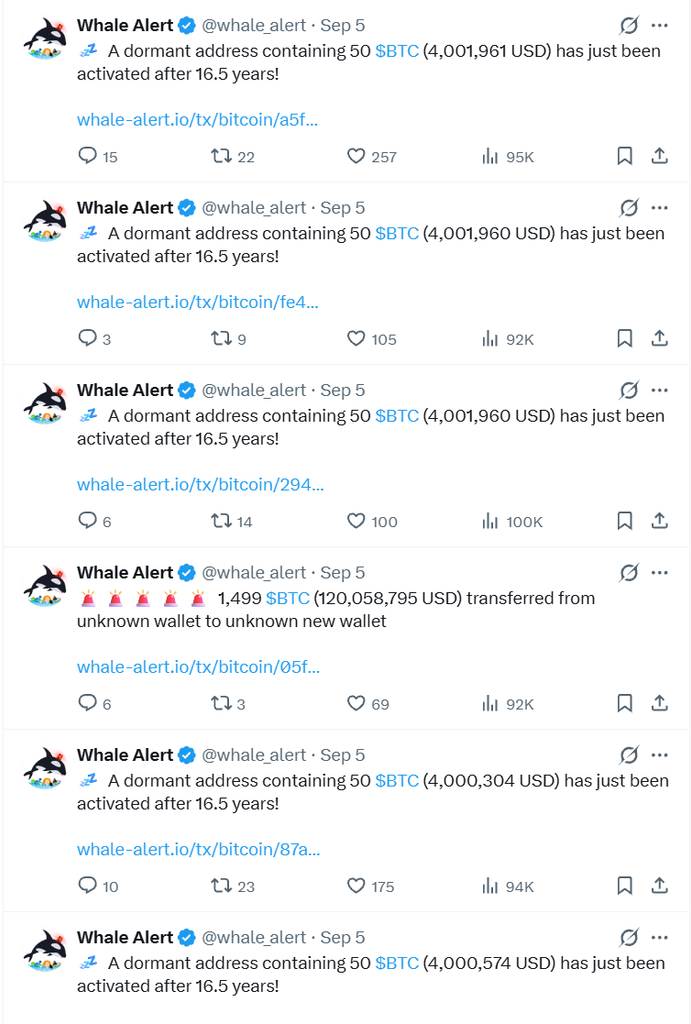
The age of the 600 bitcoins initially sparked speculation that the coins might be related to Bitcoin founder Satoshi Nakamoto because they were dug up while he was still active. However, after examining the sources of all 12 block rewards, the company found no evidence linking these rewards to Satoshi Nakamoto.
One of the transfers of 600 bitcoins occurred in blocks before the others, a pattern that analysts pointed out may represent a test transaction before moving the remaining coins. Still, these two incidents highlight that early Bitcoin was still largely controlled by long-term holders. Although the movement of sleeping coins does not automatically translate into selling pressure, large transfers attract close attention from traders because holders with huge profits have greater flexibility to realize gains.
For the 1,260 bitcoin giant whale, the difference between the original acquisition cost and today's valuation is particularly alarming. An original position worth about $820,000 has grown to more than $100 million in wealth, demonstrating the extraordinary returns available to Bitcoin holders who have survived more than a decade of market volatility.
As of press time, Bitcoin was trading at US$77,353, down 0.89% in the past 24 hours.