Exchange Ranking
 Top Exchanges
 24h Volume Ranking
 Popularity Ranking
 Exchange BTC Balance
 Proof of Reserves
 Decentralized Exchanges
 Funding Rate
 Funding Heatmap
 Liquidation Data
 Max Pain
 Long/Short Ratio
 Whale L/S Ratio
 Binance/Okex/Huobi L/S
 Bitfinex Margin L/S
 ETF Tracker
 Solana ETF
 XRP ETF
 Hong Kong ETF
 Bitcoin Treasuries
 Crypto Reversal
 Ethereum Reserves
 HyperLiquid Wallet Analysis
 Hyperliquid Whale Watch
 Large Transactions
 On-chain Movement
 Bitcoin ROI
 Stablecoin Market Cap
 Options Analysis
 News
 Articles
 Economic Calendar
 Features
 Wallet
 Contract Calculator


 Security
 Collections
 Watchlist
 Following
 BTC
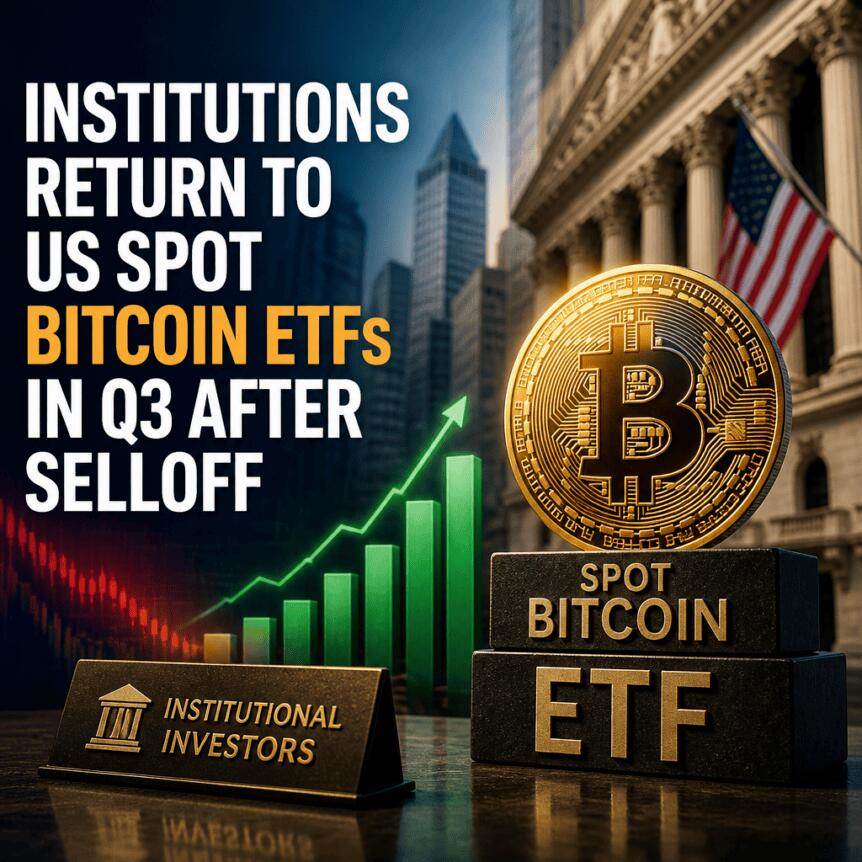
Re-enactment of the U.S. sput Bitcoin ETF in the third quarter
According to the 13F document analysed by Galaxy Research, in the third quarter, the institutional investors increased their holdings of the United States post Bitcoin Exchange traded product (ETP) open input. After three consecutive quarters of net sales, the fund managers collectively increased their holdings in the third quarter by an amount of 49,229 Bitcoin, an increase that not only offsets the total reduction of 47,054 Bitcoin in the previous three quarters, but also boosts the overall declaration to a record high.
The data show that the total number of Bitcoin held by the declared institutions was 356,491, the highest level identified by Galaxy Research in its data concentration.
Core elements
- The third quarter of the post Bitcoin ETF-related 13F document shows that after three consecutive quarters of holding net outflow, the market showed a net buy-in.
- In the third quarter, the filing agency had 49,229 more assets, compared with a combined reduction of 47,054 Bitcoin in the previous three quarters.
- The general declaration rose to 356,491 Bitcoin, which recorded the period covered by Galaxy Research.
- Galaxy Research noted that consultants and wealth management platforms contributed about half of the net increase, with Wells Fargo, the largest single agency.
- Despite the accumulation in the third quarter, more recent data on ETF flows suggest that market dynamics again weakened between October and November.
13F documents in the third quarter show a return to trend accumulation
Galaxy Research’s analysis of the quarterly 13F document – a mandatory time disclosure by the United States’ executive investors – indicates a significant reversal of behaviour in the third quarter. In its report, Alex Thorn, the company’s global research director, states that the accumulation of the quarter has been concentrated in a relatively limited group of large institutions, rather than in a wide range of small institutions.
Thorn also emphasizes that half of the net increase in the share of the spot Bitcoin ETF comes from consultancy and wealth platforms. This is crucial for investors to interpret the data: while the 13F documents do not measure the day-to-day flow of funds, they help to reveal how the hold stock is being configured through different distribution channels – in particular, to reveal whether the position is being routed through the mainstream wealth management infrastructure.
In support of this view, Galaxy Research reported that the number of managers who disclosed spot Bitcoin ETF positions for the first time had increased for the first time in three quarters, by 191, to 2,166 file managers.
Which institutions have the highest growth and their signal significance
The Bank of Rich Countries (Wells Fargo) showed the largest increase in filing hold, equivalent to 14,636 Bitcoin, making it the largest producer of Galaxy Research’s spot Bitcoin TP. Other institutions that achieved significant growth include Brevan Howard, Bank of America, Millenium Management, and Jane Street.
Galaxy Research data sets also show concentration in key ETF products. According to Galaxy, the iShares Bitcoin Trust Fund in BelackRock is the lead warehouse for 13F filers, which is equivalent to 232,453 Bitcoin.
Together, Galaxy Research states that these two funds account for 77 per cent of the total number of Bitcoin held by all filing entities. This concentration is consistent with the current way of obtaining spot Bitcoin exposure: most of the agency's participation flows through a few major instruments.
In another comment related to the early rotation of the 13F report, the Bitwise analyst Camran Khosravi told Cointelegraph that preliminary readings showed that long-term holders had a growing share in the root of the spot Bitcoin ETF investor base. The implication for market participants was that the increased percentage of hold by managers who appeared to hold rather than deal might reduce the likelihood that investors would quickly release exposure – although the 13F document was still a quick-forward picture and did not reveal the pace of transactions between the filing dates.
ETF funds flowed and then weakened.
A record third-quarter institutional hold contrasts with the subsequent pressure on the United States of America’s spot Bitcoin ETF to sell. Bitcoin ETF funds to tracker TFTC reported that the month of October was $515 million, compared to the year-on-year cumulative net outflow of $2.9 billion for the window period from November 2026 to the present.
Early in October, André Dragosch, the research director of Bitwise, described the sale as related to a “short-term risk-averse environment” rather than a structural change in institutional sentiment, as reported by Cointelegraph.
This combination – the third quarter of the stronger 13F declaration cumulatively followed by the subsequent months of outflows – highlights important differences for investors. The 13F document reflects the hold held by the manager under the disclosure rule at the end of the period, while the ETF funds flow to tracker measures fund inflows and outflows that occur at a given date.
Why is it important to keep a record and focus on the future?
For market observers, the most operational element of Galaxy Research findings is not just an increase in hold, but a net increase that reverses the early trend of declared sales and involves a return of the broader regulatory base to the spot Bitcoin ETF exposure in the third quarter of 2026. Nevertheless, the re-emergence of outflows after the third quarter suggests that the institutional landscape may be more complex than a single “buy-in” narrative.
Investors should be concerned about whether the subsequent 13F rounds confirm that long-term holders continue to accumulate - or whether the pattern of outflows in October and early November suggests that the increase in the third quarter was mainly a medium-term repositioning exercise followed by new pressure on sales.