Exchange Ranking
 Top Exchanges
 24h Volume Ranking
 Popularity Ranking
 Exchange BTC Balance
 Proof of Reserves
 Decentralized Exchanges
 Funding Rate
 Funding Heatmap
 Liquidation Data
 Max Pain
 Long/Short Ratio
 Whale L/S Ratio
 Binance/Okex/Huobi L/S
 Bitfinex Margin L/S
 ETF Tracker
 Solana ETF
 XRP ETF
 Hong Kong ETF
 Bitcoin Treasuries
 Crypto Reversal
 Ethereum Reserves
 HyperLiquid Wallet Analysis
 Hyperliquid Whale Watch
 Large Transactions
 On-chain Movement
 Bitcoin ROI
 Stablecoin Market Cap
 Options Analysis
 News
 Articles
 Economic Calendar
 Features
 Wallet
 Contract Calculator


 Security
 Collections
 Watchlist
 Following
The US Senator has called for the extension of Stablecoin's "safe harbour" protection to state-level regulation distributors
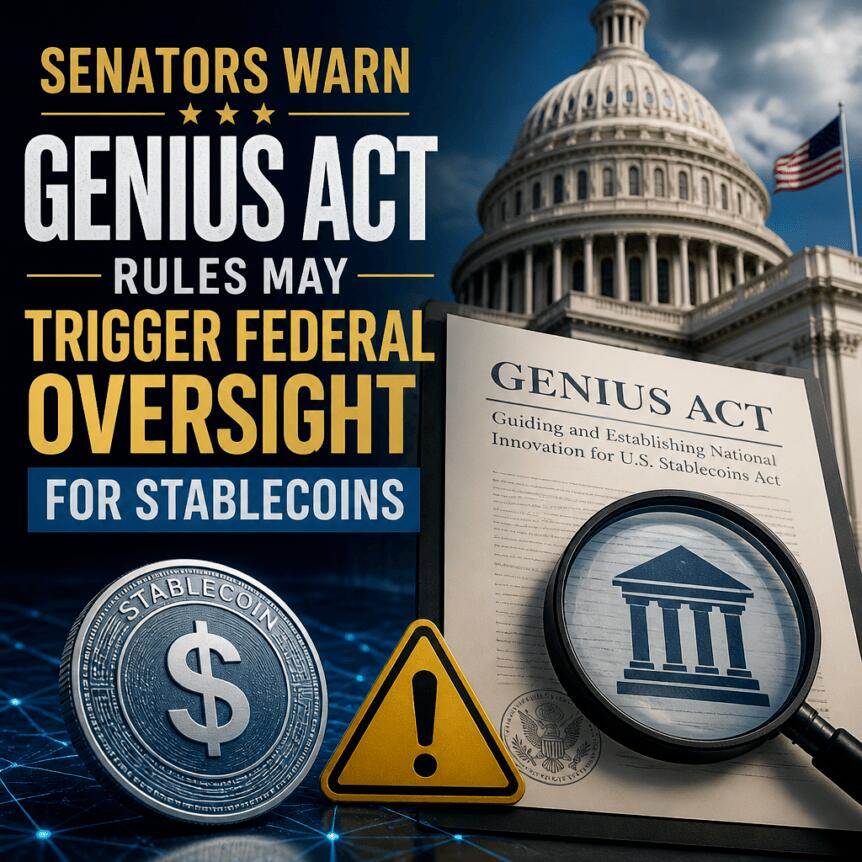
The United States Congress is moving towards a more targeted approach in moving forward with the legislation. Six bipartisan senators wrote to finance ministers Scott Bessent, requesting the Treasury to extend the proposed “safe harbour” protection measures to the publishers of the acceptance of state-level regulation. Senators Cynthia Lummis and Kirsten Gillibrand, as well as Angela Alsobrooks, Kevin Kramer, Pete Ricketts and Mark Warner, warned in their letters that the current framework of the GENNIUS Act might inadvertently induce enterprises to seek federal approval rather than continue to accept state-level regulation.
The legislator noted that the Ministry of Finance proposal would provide operational certainty to some issuers with pending federal applications and exemptions granted by the agency of regulation, but would deprive enterprises that accept state-level regulation of equal relief measures. It was argued that such unequal treatment could weaken the legislative intent of the bill to retain substantive state participation as enterprises planned compliance for the forthcoming deadline for regulation.
Core elements
- Six bipartisan senators urged the Ministry of Finance to extend the protection of the proposed GENIUS “safe harbour” to the issuer of state-level regulation.
- The Senator indicated that current practice might provide an incentive for enterprises to pursue federal licences rather than comply with the requirements of the state-level framework.
- The letter stated that the supervision of the Money Supervisory Authority (OCC) could be the destination of enterprises seeking clarity.
- The legislator hopes that the “safe harbour” will cover distributors in those states that are expected to establish a framework of eligibility by 18 January 2028.
"safe harbour" not extended to state level regulation
In the letter, the senators cited the protection measures proposed by the Ministry of Finance against certain issuers who hold pending federal applications and have been granted exemptions by the agency of regulation. They described the proposal as a “safe harbour” mechanism designed to reduce the uncertainty of compliance by those market participants.
They argue, however, that the distributors who accept the state-level regulation — that is, those who intend to operate through the state-level regulation channels that meet the eligibility requirements of the GENIUS Act — will not be able to obtain the same form of operational certainty under the same proposal.
According to the senators, this asymmetry is crucial, because the compliance planning of the STablecoin issuers is highly sensitive to regulation consistency, certification processes, and timelines. When enterprises lack comparable certainty, they may choose a path that appears to reduce the risk of future disruptions to their operations – even if the states are prepared to qualify under the law, this may push them away from state-level regulation.
Concerns about incentives and the OCC
The core warning of the senators is that the Treasury proposal may change the behaviour of the issuer in a way that conflicts with the legislative intent. In their letter, they wrote that the issuer “may be motivated to seek greater operational clarity under federal approval” and highlighted the Monetary Supervisory Authority (OCC) as a potential way to achieve such clarity.
In their view, such an outcome would be “contrary to our intention to draft this legislation.” The logic behind it seems simple: if the federal licence provided for more direct certainty, then business rationally might have preferred that path — even if they could have accepted state-level regulation, according to the criteria of the GENNIUS Act.
This is a major political and policy tension of concern. The GENIUS Act is structured around a hybrid approach that allows certain issuers to operate under qualified state supervision (subject to the threshold and conditions of the Act).
Why is it so important that the node on January 18th, 2028?
Senators have asked the Ministry of Finance to extend the “safe harbour” to distributors operating in the counties with a framework of eligibility expected to be in place by 18 January 2028. They argue that this would reduce uncertainty during the certification review, which they consider to be particularly relevant for enterprises that are trying to comply during the transition period.
This is of great importance to the enterprise planning for hosting, reserve management and compliance operations. In an environment where issuers can be located, regulation certainty can affect technical deployment and legal structures, especially where the certification process may take time and the issuer must ensure that compliance is maintained at the time the rules become effective.
By focusing on areas that are expected to become eligible states by that date, senators are in fact proposing that the Ministry of Finance adjust transitional protection measures to ensure that the acceptance of state-level regulation is not disadvantaged during the period of the eligibility framework.
With $10 billion threshold
In order to understand the context of this letter, the GENIUS Act usually allows a publisher with outstanding balance of $10 billion or less to operate under the supervision of a qualified state level, and beyond that threshold is exempted. This distinction is intended to define which entities can remain within the state level framework and which may need to follow different regulation paths.
In other words, while the GENIUS Act envisages state-level supervision of specific subdivisions of the market, the actual regulation experience of the issuer may still depend on how the Ministry of Finance constructs transitional “safe harbour” protection measures during the certification period.
As previously reported, legislators and regulation agencies have been working on the details of the implementation of the GENIUS Act. The new letter from the senators was a follow-up to the June appeal to the Ministry of Finance to retain state-level participation and clarify the certification process.
The Senators' current message indicates that they consider the current proposal to be inadequate in terms of protection for distributors who accept state-level regulation, at least during the period of time when the process of certification is still being finalized by the cantons and enterprises.
Industry questions: Will more “safe havens” change behaviour?
Some industry observers have questioned whether the expansion of the broader “safe harbour” will have a substantial impact on the decision-making of the issuer. Kevin Wysocki, the policy director of the Anchorage Digital, has suggested that he doubts how different the broader “safe harbour” would be.
Wiesoski argues that the choice of federal regulation by the issuers may be due to the risk that they will be forced to replace the regulation agency if their circulation exceeds the $10 billion threshold. He admits that there is an exemption clause, but his broader view is that companies may still prefer the path that reduces the possibility of moving from a regulation to another agency due to a change in size.
This perspective highlights the potential gap between legislative intent and operational incentives. Even if issuers who accept state-level regulation receive additional transitional protection, they may choose federal licences if they believe that their growth increases the probability of overcoming the threshold of changing their status.
This makes the Senate's letter more than just a symbolic request: it implicitly raises the question of whether the “safe harbour” is the right tool for retaining state-level participation rights, or whether broader structural factors — such as a threshold-based regulation mechanism — will continue to drive distributors towards federal regulation.
As the Ministry of Finance considers the senators’ requests, market participants should focus on two points: whether the Treasury will substantially expand the “safe harbour” coverage for the recipients of state-level regulation distributors, and how the final rules and the certification timetable will interact with the $10 billion threshold for recasting distributors’ obligations. The answer will determine not only the risk of compliance during the transition period, but also the type of oversight model that the issuer considers to be more stable as it expands.