Exchange Ranking
 Top Exchanges
 24h Volume Ranking
 Popularity Ranking
 Exchange BTC Balance
 Proof of Reserves
 Decentralized Exchanges
 Funding Rate
 Funding Heatmap
 Liquidation Data
 Max Pain
 Long/Short Ratio
 Whale L/S Ratio
 Binance/Okex/Huobi L/S
 Bitfinex Margin L/S
 ETF Tracker
 Solana ETF
 XRP ETF
 Hong Kong ETF
 Bitcoin Treasuries
 Crypto Reversal
 Ethereum Reserves
 HyperLiquid Wallet Analysis
 Hyperliquid Whale Watch
 Large Transactions
 On-chain Movement
 Bitcoin ROI
 Stablecoin Market Cap
 Options Analysis
 News
 Articles
 Economic Calendar
 Features
 Wallet
 Contract Calculator


 Security
 Collections
 Watchlist
 Following
 BTC
 ETH
Updated Advisory Opinion of the United States Commodity Futures Trading Commission (CFTC): Partially covered by regulation market operators with Bitcoin, Ethereum and payment-type stablecoin
According to an official announcement issued on Monday, 23 November 2026, a new advisory opinion from the United States Commodity Futures Trading Commission (CFTC) indicated that certain market operators subject to regulation could use Bitcoin, Ethereum and the payable stockcoin to meet financial resource requirements covering at least 12 months of operating costs.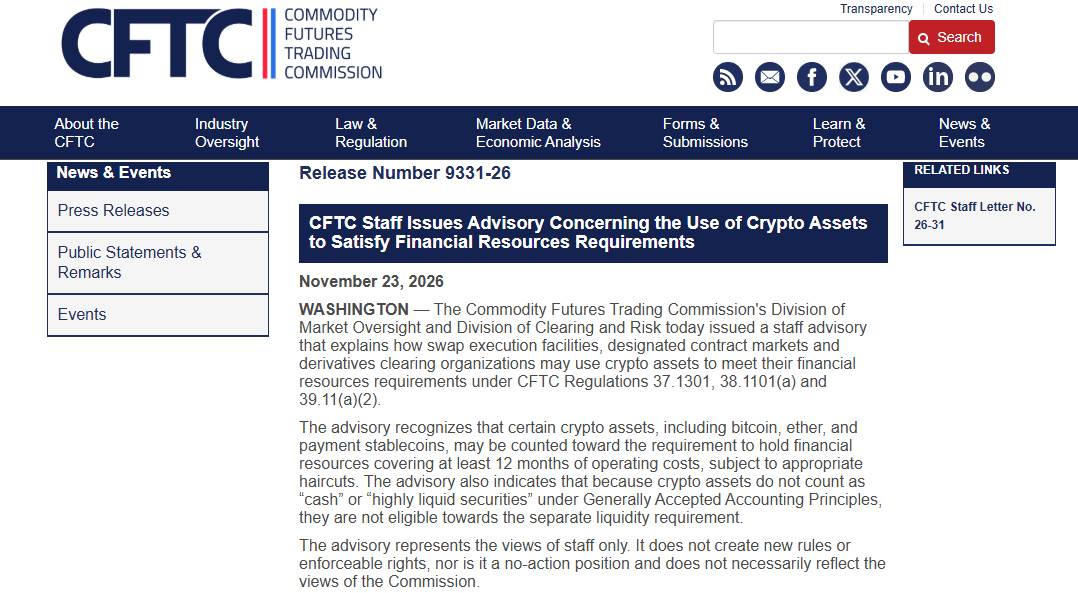 This encrypted news update explains what has changed, which subjects have been affected and which provisions remain unchanged.
Core elements
- CFTC staff indicated that Bitcoin, Ethereum and the payment type stockcoin might be included in the financial resources rules of the specific market subject to regulation.
- Cryptocurency, which is included in this way, will face a “discount” (Haircuts), i.e. a discount on its market value.
- This is a staff member ' s point of view and is not a new rule; and a separate mobility requirement is not included in the scheme.
What are the provisions of the CFTC advisory for encrypted stocks?
The advisory, issued jointly by the Market Division and the Risk Division, explained how the secret implementation facilities (SEFs), the designated Futures Markets (DCMs) and derivatives organization (DCCOs) held encrypted assets.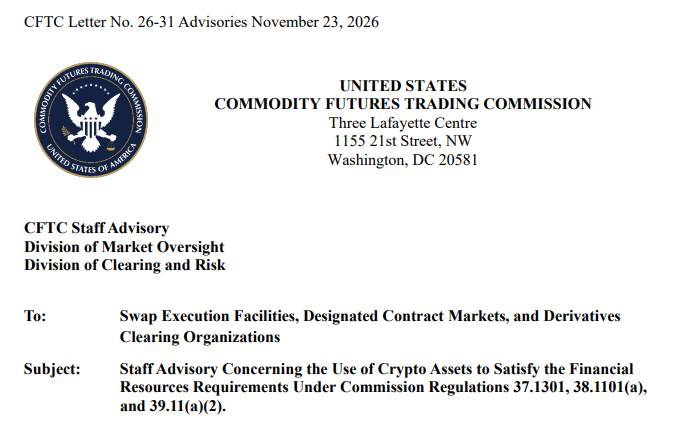 In accordance with articles 37.1301, 38.101(a) and 39.11(b) of the Federal Regulations published on the CFR website, these institutions must maintain sufficient resources to ensure that they can operate for at least 12 months, Bitcoin, Ethereum and the payment type stablecoin are explicitly listed as assets to be included in the buffer period of 12 months.
How does the discount mechanism for Bitcoin, Ethereum and stablecoin work?
A “discount” is a discount imposed on the market value of the asset, and is therefore included below the price shown on the screen, which protects the security of the institution when the price falls. In a simple example (the rate used by the CTC is not the actual rate), if an institution holds a coin worth $100 and applies a discount rate of 20 per cent, the institution is only able to obtain a credit line of $80.
The CFTC advisory notes that an appropriate discount rate is applicable to encrypted assets.
Why is cryptocurrence not included in the liquidity requirement?
The advisory notes that, according to GAAP, encrypted assets are not “cash” or “high-liquid securities” and therefore do not meet the requirements of the separate liquidity requirement.
This means that the institution can use cryptocurency to meet its 12 months of financial resource requirements, but still has to hold other assets to meet liquidity rules. This distinction is one of the most useful details of the entire document for those who are concerned with the dynamics of stablecoin regulation.
Is the CFTC advisory opinion a new rule?
No. The advisory opinion represents the views of staff members only, does not create new rules or confer enforceable rights. Moreover, as the CFTC itself states in its bulletin, it does not constitute a “no-action” position, and does not necessarily reflect the views of the Commission itself. Those words that describe it as “full approval” ignore these limitations, so it is essential to read the original text before sharing it.
What does this mean for the encryption market and the Bitcoin holder?
The advice of the CTC provides more clarity to the regulation-based exchange and liquidation agencies on how to hold reserves, and places Bitcoin and Ethereum in the same framework of discussion as the payment-type stockcoin. The advice is addressed to market entities subject to regulation, not individual traders, so ordinary users do not need to change the way they hold cryptocurrency. Any person interested in encrypting regulation news may wish to see whether the committee itself will follow up on the subject, although no such steps have been announced.
Conclusions
The CFTC advice allows certain regulation markets to include Bitcoin, Ethereum and the payment type stockcoin in the 12-month operating cost, subject to the application of a discount rate. However, this is only a staff member ' s view, not a new rule, and does not apply to the liquidity requirement.