
 Exchange Ranking
 Top Exchanges
 24h Volume Ranking
 Popularity Ranking
 Exchange BTC Balance
 Proof of Reserves
 Decentralized Exchanges
 Funding Rate
 Funding Heatmap
 Liquidation Data
 Max Pain
 Long/Short Ratio
 Whale L/S Ratio
 Binance/Okex/Huobi L/S
 Bitfinex Margin L/S
 ETF Tracker
 Solana ETF
 XRP ETF
 Hong Kong ETF
 Bitcoin Treasuries
 Crypto Reversal
 Ethereum Reserves
 HyperLiquid Wallet Analysis
 Hyperliquid Whale Watch
 Large Transactions
 On-chain Movement
 Bitcoin ROI
 Stablecoin Market Cap
 Options Analysis
 News
News Articles
 Economic Calendar
 Features
 Wallet
 Contract Calculator


 Security
 Collections
 Watchlist
 Following
Key Insights
Galaxy Digital lowered the probability of passage of the CLARITY Act to 10%.
Members of the Senate will resume on September 14, but there is limited time for deliberation.
stablecoin rewards and ethics clauses remain major points of controversy.
Probability plummets: Senate window narrows
Alex Thorn, director of digital research at Galaxy, said the company has lowered the probability of passage of the CLARITY Act to 10%. He pointed out that lawmakers will face extremely limited working hours when they return to Washington, and stressed that the bill needs to initiate immediate procedural action and continue to occupy the agenda.
According to the daily schedule of the U.S. Senate, members will resume on September 14. Reuters reported that the Senate has only 14 scheduled meeting days before adjourning for the October election. Majority Leader John Thune had moved a closing debate motion before the August recess, setting September 15 as the procedural vote day.
Prior to this downgrade, Galaxy Digital has lowered the probability of passage of the bill many times. Thorne's latest assessment reflects the unresolved negotiating deadlock rather than the results of an official congressional vote. Therefore, although the bill has not been completely shelved, the feasible path has been greatly narrowed.
Procedural and policy obstacles coexist
The Senate Banking Committee advanced the draft legislation with a vote of 15 to 9 on May 14. The committee said the bill then entered the full Senate review stage. The draft text describes a federal regulatory system that covers digital goods, securities rules, illegal financial activity and decentralized finance. 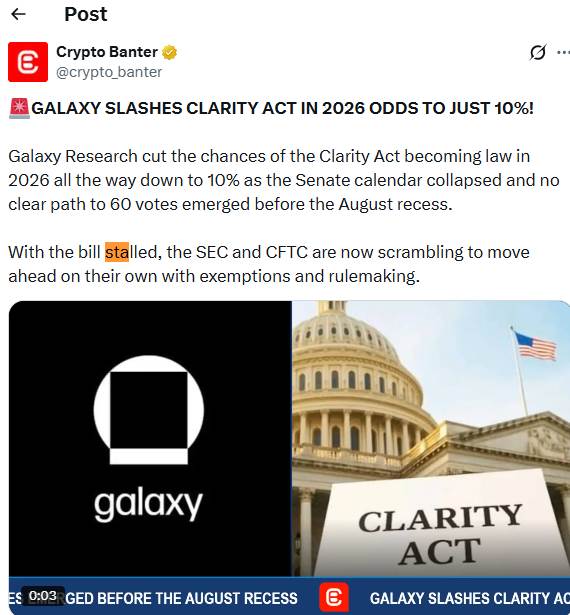
Senate Banking Committee Chairman Tim Scott said the May vote was the result of months of consultation with regulators and lawmakers. Committee records show that all Republicans and two Democrats support the bill's advancement. Reuters identified the two Democratic supporters as Ruben Gallego and Angela Alsobrooks. Both men are involved in a broader safeguards negotiation that will take place before the bill is passed by a full vote.
To pass the full Senate, members still need to clear procedural obstacles. Reuters reported that a vote on the closing debate motion on September 15 requires the support of at least 60 senators to limit the debate. Even if the vote is successful, amendment debates and other procedural steps will still be required before final adoption.
Policy differences have also not been resolved. Reuters reported that Democratic lawmakers seek stricter ethical enforcement and stronger anti-money laundering provisions. Some Republican lawmakers have called for strengthening community bank deposit protection measures before the bill is passed.
Part of the controversy over the ethics clause is the issue of federal officials running cryptocurrency businesses. Reuters reported that the current draft text would restrict such activities, but Democratic lawmakers seek stronger enforcement powers. The outcome of these negotiations will determine whether supporters can muster the votes needed to close the debate motion.
stablecoin controversy adds complexity to regulatory negotiations
stablecoin rewards are another source of resistance. The American Bankers Association and other banking industry groups are urging senators to tighten regulation of income-like incentives. In a May 8 letter, they said such incentives could draw deposits away from banks and weaken banks 'ability to lend.
Cryptocurrency companies hold the opposite position. Reuters reported that industry representatives believe that broad stablecoin reward restrictions are anti-competitive. The disagreement has left lawmakers looking to balance banking interests with crypto companies seeking more flexible product designs.
Banking disputes directly affected the votes of the bill. Reuters reported that some Republican senators said they would not support the bill without stronger community bank protections. Rebecca Romero Rainey, CEO of the Independent Community Bankers Association of America, said banks will continue to pressure lawmakers to highlight the risk of deposit losses.
The committee's draft also proposes a broader crypto regulatory framework beyond the scope of stablecoins. These include bringing digital asset intermediaries into the scope of supervision of the Bank Secrecy Act and regulatory provisions involving decentralized finance. The draft also retains the power of the U.S. Securities and Exchange Commission (SEC) to exercise immunity under existing securities laws.
SEC Chairman Paul Atkins has previously proposed an alternative regulatory path. In March, Atkins said the proposed exemption rules would draw heavily on congressional work on the bill. He described the measures as initial steps in establishing a broader market structural framework.
September 15 will usher in a critical test
Industry pressure continues to ferment before the recess. The group Support Cryptocurrency said more than 200 organizations are urging Senate leadership to advance the bill. The coalition called for a full Senate review amid an increasingly tight election-year schedule.
The next measurable test will come on September 15, when the Senate considers a closing debate motion. Reuters said if 60 votes were not obtained, the bill could effectively be shelved this year. Even if it passes, further action will be needed by the Senate and resolving competing policy demands.
























