
 Exchange Ranking
 Top Exchanges
 24h Volume Ranking
 Popularity Ranking
 Exchange BTC Balance
 Proof of Reserves
 Decentralized Exchanges
 Funding Rate
 Funding Heatmap
 Liquidation Data
 Max Pain
 Long/Short Ratio
 Whale L/S Ratio
 Binance/Okex/Huobi L/S
 Bitfinex Margin L/S
 ETF Tracker
 Solana ETF
 XRP ETF
 Hong Kong ETF
 Bitcoin Treasuries
 Crypto Reversal
 Ethereum Reserves
 HyperLiquid Wallet Analysis
 Hyperliquid Whale Watch
 Large Transactions
 On-chain Movement
 Bitcoin ROI
 Stablecoin Market Cap
 Options Analysis
 News
News Articles
 Economic Calendar
 Features
 Wallet
 Contract Calculator


 Security
 Collections
 Watchlist
 Following
Microsoft (MSFT) is one of the world's largest technology companies, playing an important role in the introduction of computers into daily life, and its business scope has now expanded to include artificial intelligence and cloud computing. The Microsoft story, which started with products such as Windows and Office, has evolved over the past few decades into a vast technology ecosystem that spans diverse platforms such as Azure, Xbox, LinkedIn and Copilot. In particular, the company's accelerated investment in artificial intelligence has made Microsoft occupy an important position during the reshaping period of the technology industry. As a result, MSFT stock is not only seen as a traditional technology stock, but also as a large company benefiting from the growth of cloud computing and artificial intelligence.
When was Microsoft (MSFT) founded and how did it grow?
The foundation of Microsoft was laid on April 4, 1975 by Bill Gates and Paul Allen. The two were focused on developing software for emerging personal computers. The company's first important product was the BASIC programming language developed for the Altair 8800 computer. Early on as a small software company, Microsoft grew rapidly with the popularity of personal computers. In 1981, MS-DOS was used in IBM's personal computers, which became an important turning point for the company. Then in 1985, the first version of Windows came out, further strengthening Microsoft's position in the PC software market. Microsoft went public in 1986. Over the years, the company's revenue from software products such as Windows and Office has made it one of the most powerful companies in the technology industry. However, to understand Microsoft's structure today, you need to look beyond the Windows era. In recent years, the company has shifted its focus to cloud computing, enterprise software and artificial intelligence. This transformation, accelerated by Satya Nadella as CEO, significantly changed Microsoft's business model.
What businesses does Microsoft (MSFT) do?
Today's Microsoft (MSFT) does business in multiple different technology areas. The company's products include operating systems, office software, cloud services, artificial intelligence tools, game platforms, professional Social networks and network security solutions. Microsoft's business can be roughly divided into three main segments: the productivity and business processes segment includes products such as Microsoft 365, Teams and LinkedIn; the smart cloud segment includes Azure and various server services; and the more personal computing segment covers Windows, Xbox, Surface and search services and other products. This structure has brought significant diversity to Microsoft. The company not only sells products to consumers, but also provides enterprise software and cloud infrastructure to a broad customer base, from small businesses to the world's largest companies. In particular, the growth of Azure has brought important changes to Microsoft's revenue model. In addition to traditional software licensing, subscriptions and cloud services have become important sources of support for companies 'continued revenue generation.
What products and services does Microsoft (MSFT) provide?
Microsoft's product line is quite broad, but grouping the company's most important products into several categories helps understand its overall architecture. Windows, one of Microsoft's most well-known products, is used as the operating system for personal computers. It forms the basis of the company's long history in the desktop computer market and also occupies an important position in the enterprise space. Microsoft 365 integrates applications such as Word, Excel, PowerPoint, Outlook and Teams and is one of the basic software packages used in an enterprise's daily business processes. With cloud architecture, users can access their files and applications from different devices. Azure is Microsoft's cloud computing platform, through which enterprises can access servers, storage, data analysis, artificial intelligence and various enterprise services. Azure is also at the heart of Microsoft's artificial intelligence strategy. Copilot is Microsoft's family of generative artificial intelligence tools that are integrated into different products such as Microsoft 365 applications, Windows, and software development tools. Xbox is at the heart of Microsoft's gaming ecosystem, including Xbox game consoles, Game Pass subscriptions and PC game services. Through the acquisition of Activision Blizzard, important game brands such as Call of Duty, World of Warcraft and Candy Crusher have also been included under Microsoft. LinkedIn is a professional Social networks platform acquired by Microsoft in 2016. It plays an important role in job posting, professional connections, recruitment and training services. Although these products each target different markets, Microsoft is increasingly building an ecosystem that connects them to each other.
Why is artificial intelligence so important to Microsoft?
When assessing Microsoft's current position in the technology market, artificial intelligence cannot be ignored. The company's strategic cooperation and investment with OpenAI have given it significant advantages in the field of generative artificial intelligence. Microsoft combines OpenAI technology with Azure infrastructure while embedding Copilot products into its own ecosystem. In this way, artificial intelligence not only exists as a stand-alone product, but also becomes a technology integrated into Word, Excel, Teams, GitHub and other Microsoft services. This strategy is also reflected in the company's financial results. Microsoft reported revenue of $90 billion in the quarter ended June 30, 2026, with revenue increasing 18% year-on-year, operating profit of $40.6 billion and net income of $35.8 billion. Growth in Azure is one of the key indicators of the importance of Microsoft's artificial intelligence investment. Because training and running artificial intelligence models require a lot of computing power, the need for cloud infrastructure creates important opportunities for Microsoft. However, investment in artificial intelligence also brings high costs. Data center, chips, energy and infrastructure investments require large amounts of capital. Therefore, for Microsoft, the key lies not only in the growth of artificial intelligence revenue, but also in how efficiently this growth can be transformed into profits in the long run.
What is Microsoft (MSFT) stock?
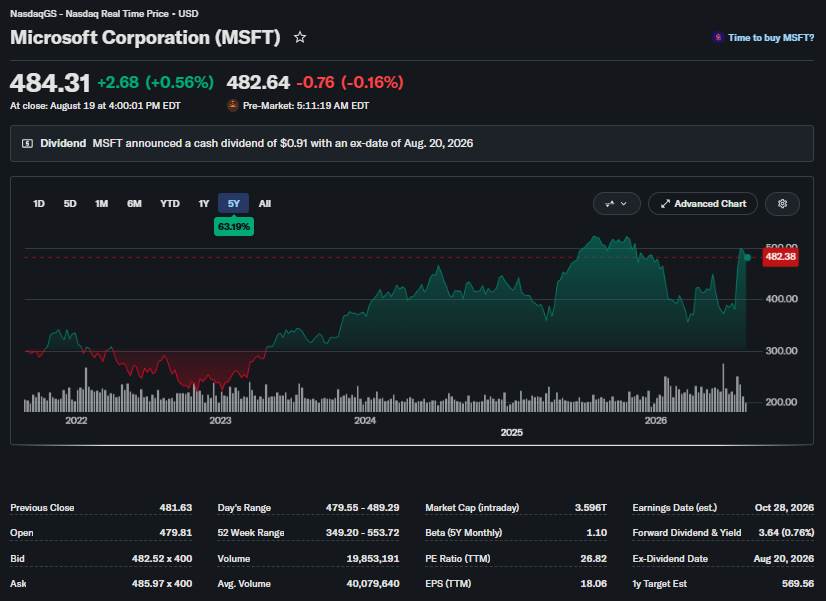
Microsoft's public stock is traded on the Nasdaq Stock Exchange under the symbol MSFT. The company went public in 1986 and has since become one of the most well-known technology stocks in the world. In the investment community, MSFT is often regarded as one of the "blue chips" that represents large, mature technology companies. The company's strong cash flow, extensive customer base and diversified revenue sources make it one of the assets of concern to long-term investors. However, Microsoft stock is not without risk. High growth expectations may affect stock valuations. Lower-than-expected return on investment in artificial intelligence, slowing Azure growth, increased competition in the technology industry and regulatory pressure are all areas that MSFT needs to focus on. In particular, Microsoft's high spending on artificial intelligence is one of the issues that investors need to pay attention to. Despite the company's strong growth story, the market has largely priced future growth, which may make expectations more important in stock performance.
Why is Microsoft's financial structure important?
One of the characteristics that distinguishes Microsoft from many other technology companies is that its revenue does not rely solely on a single product. Mature products such as Windows and Microsoft 365 provide stable revenue, while Azure, artificial intelligence and enterprise services constitute the company's future growth areas. In the quarter ended June 30, 2026, Microsoft achieved revenue of US$90 billion, demonstrating the company's size; the net profit of US$35.8 billion announced during the same period also showed that the company has high profitability. Therefore, when evaluating MSFT, rather than just focusing on stock prices, it makes more sense to simultaneously track indicators such as Azure growth, Microsoft 365 subscriptions, artificial intelligence revenue, capital expenditures, and profit margins.
Who are on the Microsoft (MSFT) management team?
The most important person in Microsoft's current transformation is Satya Nadella. Nadella took over as CEO in 2014 and has focused more on cloud computing and artificial intelligence in the company's strategy. Under Nadella's leadership, Microsoft has transformed from a Windows-centric technology company to a broader technology platform that expands Azure and enterprise cloud services. Cooperation with OpenAI and investment in artificial intelligence are also important parts of this strategy. The other two CEOs in the company's history are co-founders Bill Gates and Steve Ballmer. Gates served as CEO from the company's inception to 2000, while Ballmer led the company from 2000 to 2014. Microsoft has come to this day not only due to the contribution of the CEO, but also due to the efforts of an extensive management team and thousands of engineers. Especially professional capabilities in the fields of artificial intelligence, cloud infrastructure, network security and enterprise software are an important part of the company's competitive advantage.
What are the highlights of the future of Microsoft (MSFT)?
Three themes will be particularly important for Microsoft's growth in the future: Azure, artificial intelligence, and the enterprise software ecosystem. How much revenue a company can make from its artificial intelligence investments will be the primary issue that investors pay close attention to. The popularity of Copilot, the increase in artificial intelligence workloads on Azure, and enterprise customers allocating more budgets for artificial intelligence solutions could create important opportunities for Microsoft. On the other hand, competition with Google, Amazon, Apple and new companies in the field of artificial intelligence is also becoming increasingly fierce. Microsoft's large-scale data center investment and artificial intelligence spending require us to closely track cost dynamics while focusing on growth.
























