
 Exchange Ranking
 Top Exchanges
 24h Volume Ranking
 Popularity Ranking
 Exchange BTC Balance
 Proof of Reserves
 Decentralized Exchanges
 Funding Rate
 Funding Heatmap
 Liquidation Data
 Max Pain
 Long/Short Ratio
 Whale L/S Ratio
 Binance/Okex/Huobi L/S
 Bitfinex Margin L/S
 ETF Tracker
 Solana ETF
 XRP ETF
 Hong Kong ETF
 Bitcoin Treasuries
 Crypto Reversal
 Ethereum Reserves
 HyperLiquid Wallet Analysis
 Hyperliquid Whale Watch
 Large Transactions
 On-chain Movement
 Bitcoin ROI
 Stablecoin Market Cap
 Options Analysis
 News
News Articles
 Economic Calendar
 Features
 Wallet
 Contract Calculator


 Security
 Collections
 Watchlist
 Following
 KAS
KAS Kaspa has been under huge price pressure over the past few months, but different changes have occurred around the network this week. KAS prices have risen nearly 20% since August 19, a trend that comes as new data provides preliminary insights into the actual use of the Kaspa Toccata upgrade.
Internet activity provides several interesting data. Covenants have begun to be created on Kaspa's first-layer network, Igra has processed tens of thousands of transactions, and miners appear to have migrated to software versions after Toccata without major network disruption.
After months of decline, the price chart has also changed. KAS has broken through a downward wedge since April, although several resistance levels remain between current prices and a stronger recovery.
Kaspa Toccata upgrade records contract and Layer 2 network activity seven weeks after activation
BSCN shared data from Kaspalytics to provide early usage of Toccata approximately seven weeks after activation. The following data details the activity in the past 24 hours:
1,196 transactions creating contracts were recorded on the Internet. More than 2,700 contract outputs have been created on the Kaspa first-layer network. Nine zero-knowledge precompiled transactions were verified using Groth16 and R0 Success certificates. Approximately 54,000 Igra transactions were processed during the same period. Approximately 1,900 KRC inscription transactions were recorded. 86% of recent blocks come from node version 2.0.1, a version after Toccata.
Contracts allow additional conditions on how tokens will be spent in the future. This gives developers greater flexibility to create programmable trading rules directly on Kaspa.
Zero-knowledge activities are still on a small scale. Only nine zero-knowledge precompiled transactions were recorded during this period, so this part of Toccata appears to be in its early stages of use.
Igra provides the largest activity data in the protocol mentioned by the BSCN. The EVM-compatible Layer 2 network anchored on Kaspa processed approximately 54,000 transactions, much higher than the approximately 1,900 transactions associated with the KRC inscription.
Kaspa's Toccata upgrade has been used seven weeks after activation. Seven weeks later, the upgraded new mechanism is already visible. Kaspalytics counts 1,196 transactions creating contracts and more than 2,700 contract outputs in the past 24 hours...
Mining data also provides useful background on network transitions. 86% of recent blocks came from node version 2.0.1, indicating that most of the observed block production has migrated to software versions after Toccata.
This data is important because Kaspa Toccata upgrades can now be evaluated based on actual network usage. The next question is whether contracts, zero-knowledge proofs and second-layer network activity can continue to grow in the coming months.
Kaspa Calls links recent KAS developments with Winklevoss theory
Kaspa Calls provides a more speculative explanation of some of the recent developments surrounding the project. The analyst linked several incidents and believed they could point to institutional interest in Kaspa.
Part of this theory involves the brothers Gemini and Winklevoss. Kaspa Calls pointed out that Gemini recently mentioned Kaspa after years of not discussing it publicly. The analyst compared this development to Zcash and Cypherpunk Technologies. Kaspa Calls pointed to the company's significant investment in ZEC and its known exposure to Zcash supply and mining.
The theory also involves several other developments:
Kaspa Calls mentioned a meeting in January 2026 involving Kaspa founder Yonatan Sompolinsky and Zcash team members. BitGo is integrating Kaspa, which could provide the infrastructure needed for large companies that want to own or use KAS. Coinbase offers KAS perpetual contracts, although KAS spot trading is not currently available. A large KAS wallet known as "Wallet 1" has become the focus of community discussions about potential institutional fundraising. Kaspa Calls suggested that Wallet 1 might belong to the Winklevoss brothers.
This last connection is still a theory rather than confirmed information. The information provided does not determine who controls Wallet 1. Therefore, Gemini's mention of Kaspa, BitGo integration, Coinbase's derivative support, and unidentified wallets can all be monitored and should not be assumed to be controlled by the same party.
ItsFrank explains why Kaspa is still an interesting proof-of-work project
ItsFrank focuses on a more fundamental issue: Kaspa's place in the proof-of-work network. Bitcoin puts blocks into a single chain. Kaspa uses GHOSTDAG to allow parallel-generated blocks to coexist, and then sorts them through its BlockDAG structure.
ItsFrank pointed out several characteristics that he is optimistic about Kaspa:
The current Kaspa network processes 10 blocks per second. Proof of work security remains at the heart of the protocol. The BlockDAG architecture allows parallel blocks to coexist. A fair start structure means no pre-mining or venture capital allocation. Open source development ensures that network code remains publicly accessible. Real-time settlement remains one of Kaspa's main technical goals.
Kaspa's future technology roadmap makes throughput issues particularly interesting. ItsFrank mentioned the possibility of achieving the goal of 100 blocks per second in the 2027 upgrade discussed in the Kaspa document.

Why is Kaspa still one of the most interesting proof-of-work projects? Kaspa is taking a very different approach than Bitcoin. Instead of forcing blocks into a single chain, it allows parallel blocks to coexist through the GHOSTDAG consensus and is sorted as a BlockDAG...
Higher throughput does not in itself guarantee greater KAS requirements. ItsFrank points to smart contract adoption rates, developer activity, actual network usage, competition from fast proof-of-stake networks, and mining economics as areas worth paying attention to.
His core question is straightforward. Bitcoin proves that proof of work can support decentralized digital currencies. Kaspa is testing whether the same security model can run fast enough to support real-time digital infrastructure. Toccata now provides an important real-world test for the idea.
KAS prices break through a four-month decline wedge after a nearly 20% rebound
Network dynamics occur at an interesting time for KAS prices. Kaspa prices have continued to rise over the past two days and have risen nearly 20% since August 19. KAS is currently trading at around $0.029, having rebounded from recent lows near $0.025.
Looking at the KAS price chart, the rally has pushed Kaspa above the downward wedge that has dominated price movements since April. The breakthrough ended a structure that lasted about four months.
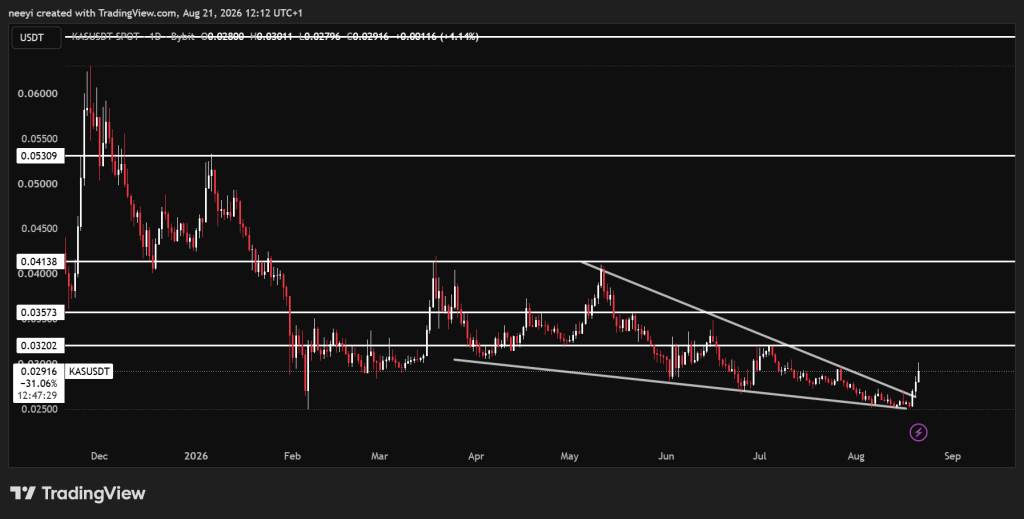
The next test appeared almost immediately around $0.03. KAS prices must gain a firm foothold above this region to make breakthroughs and have room for further development. A successful breakthrough of $0.03 will bring $0.035 into the spotlight. Kaspa could then face another major test around $0.04.
The broader structure still needs to be cautious because despite a recent rebound of 20%, KAS is still below important resistance areas. Breaking through the wedge improved short-term trends, but prices still need to be confirmed above these resistance levels.
The current Kaspa price trend leaves three main resistance levels that need attention:
0.03 Dollar: This is the direct resistance level and the first major test after a wedge break. $0.035: Clearing $0.03 could put the next area of resistance within reach. 0.04 Dollar: Breaking through this level could provide more room for KAS to continue to rise in the coming weeks.
Failure to clear earlier resistance levels will weaken the case for a breakthrough. Recent trends have changed the short-term technical landscape, but KAS has not cleared enough resistance levels to establish a broader bullish structure. This difference makes the next few trading days important. Kaspa now has what it has lacked since its April decline: a breakthrough from a declining wedge, accompanied by measurable activity with the latest network upgrades.
Frequently Asked Questions
Does Kaspa coin have a future? Kaspa (KAS) has a viable future with its unique BlockDAG architecture and proof-of-work security model, but its long-term success will largely depend on developer adoption of the upcoming smart contract ecosystem and broader market demand.
How much will Kaspa be worth in 2030? By 2030, analysts estimate that Kaspa (KAS) could be worth between a conservative $0.03 to an optimistic $3.10 or even higher, depending on the speed of adoption and macroeconomic conditions. Because it is a highly volatile utility token, the long-term forecast range is wide.
























