Exchange Ranking
 Top Exchanges
 24h Volume Ranking
 Popularity Ranking
 Exchange BTC Balance
 Proof of Reserves
 Decentralized Exchanges
 Funding Rate
 Funding Heatmap
 Liquidation Data
 Max Pain
 Long/Short Ratio
 Whale L/S Ratio
 Binance/Okex/Huobi L/S
 Bitfinex Margin L/S
 ETF Tracker
 Solana ETF
 XRP ETF
 Hong Kong ETF
 Bitcoin Treasuries
 Crypto Reversal
 Ethereum Reserves
 HyperLiquid Wallet Analysis
 Hyperliquid Whale Watch
 Large Transactions
 On-chain Movement
 Bitcoin ROI
 Stablecoin Market Cap
 Options Analysis
 News
 Articles
 Economic Calendar
 Features
 Wallet
 Contract Calculator


 Security
 Collections
 Watchlist
 Following
 POL
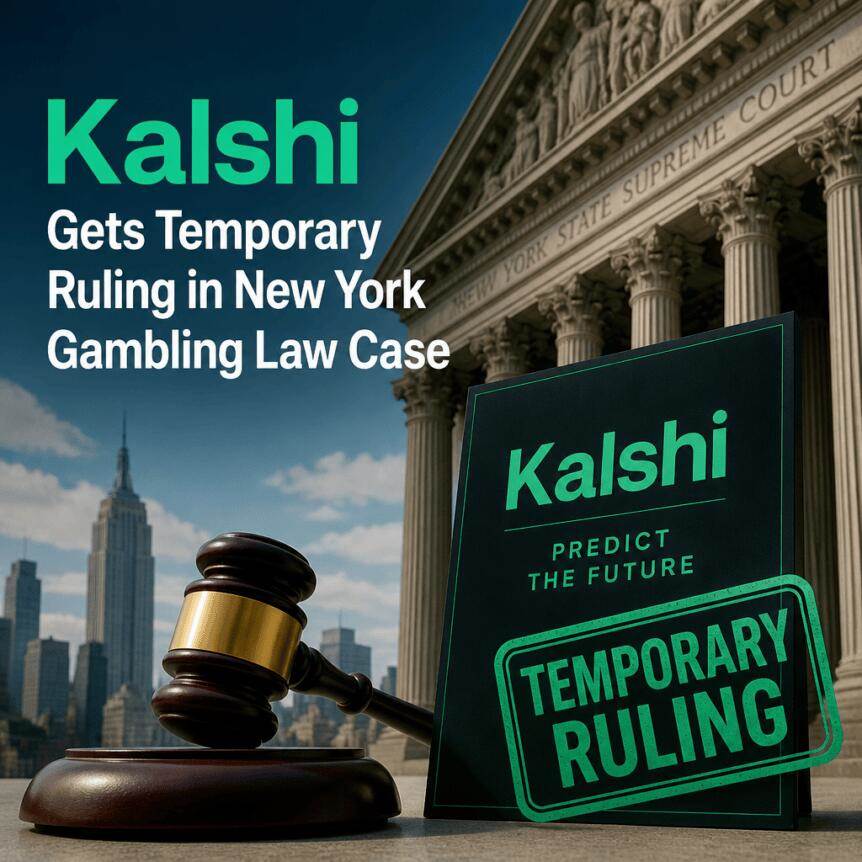
The New York state judge denied the temporary restraining order, and Kalshi's business is not blocked.
A New York state judge denied the Attorney General’s request for an interim restraining order (TRO) against the forecast market operator, Kalshi. This ruling has enabled the company to continue to provide its event Futures services in New York.
Kalshi confirmed this decision to the media through the Company Communications Manager, Elisabeth Diana. Diana indicated that the judge recognized that the case involved “complicated issues” such as derivatives and federal priority, which would remain at the centre of the case follow-up process.
Key points
- The temporary restraining order was rejected:The New York State judge denied the Attorney-General ' s application for an interim restraining order, which allowed Kalshi to maintain the status quo in New York State during the disputed period.
- Fundamental issues remain outstanding:The Court ' s order did not resolve the core legal issue, namely whether the Kalshi incident should be governed by the New York State Gaming Regulations.
- The preliminary injunction hearing is approaching:The case will enter the preliminary injunction hearing phase early in January this year, when the Court may consider imposing restrictions on Kalshi ' s activities in the state.
- User age review:The debate on potential restrictions for users between the ages of 18 and 20, scheduled for 30 November, was prompted by concerns raised by the state of New York regarding the legal minimum age of 21 years for sports games.
The legal controversy continued, and the application for an interim injunction was denied.
Although the Attorney General sought prompt court intervention, the dismissal of the interim restraining order meant that Kalshi was not currently prohibited from continuing to provide the incidents in New York State. Diana’s comments interpreted the ruling as a recognition by the court of the existence of an unsolvable issue of Issues — and, in particular, Kalshi’s status of regulation — and the State’s attempts to regulate or limit the relationship between its products.
It is important that the refusal of a temporary restraining order is not the final decision on the merits of the case. The broader conflict remains unresolved: should the Kalshi Futures, designed around the results of the real world, be managed as a derivative under federal supervision or should they be seen as a gambling activity subject to the New York State framework?
Timetable to move towards preliminary injunction hearings and age review of users
At this stage, the Court will assess whether the events in the state of New York should be restricted until the final outcome of the case, pending the commencement of the preliminary injunction hearing, which is expected to take place in early January, after the Monday ruling.
The court has previously set another procedural step: the court's retrial on 30 November. It is expected that this hearing will focus on restrictions that may affect users aged 18 to 20. The judge raised concerns about the minimum age of 21 for the New York State Sports Fair, which may affect how Kalshi constructs access to certain markets or geographical fences, depending on the options put forward by the parties and the final court order.
For Kalshi, these intermediate steps are a real test of the speed at which regulation risks are translated into specific compliance constraints — although the company can continue to operate during the interim restraining order phase.
New York State gambling charges are being met by a federal regulation plea by Kalshi.
The dispute began in July this year with a lawsuit filed by the state of New York against Kalshi. According to a summary of the report, the state accused Kalshi of operating an illegal, unlicensed gambling business by providing a number of events linked to sports, elections, and other results.
The lawsuit followed the New York State Lottery Commission’s order of suspension and termination in October 2025. Kalshi challenged the State’s powers in the Federal Court to assert its status as a derivative exchange subject to federal regulation, leaving its events within the jurisdiction of the Commodity Futures Trading Commission (CFTC).
This tension between the Federation and the Länder is a recurrent theme in the forecast market. It also creates uncertainty for the participants: even if a product is legally available within a framework of regulation, state enforcement may change the extent of available markets and access eligibility.
In August, CFTC warned that the New York State’s requested restraining order could affect Kalshi’s ability to provide information about events nationwide, in part because the exchange had its location in the state. The agency also stated that New York State was in the process of recovering more than $36 billion in damages.
Extensive pressure on the forecast market in New York State.
Kalshi is not the only forecast market operator facing law enforcement efforts in the state of New York. Earlier, there were reports that the state sued Polymarket in September of this year for providing illegal sports fairs.
In another federal proceeding cited by Reuters, United States District Judge Lorna Schofiel rejected an urgent request by CFTC to prevent the state of New York from continuing its law enforcement case against Kalshi. This development shows that the federal regulation agency failed to prevent the state from trying – at least during the emergency phase – to move forward through its own courts.
For market operators, these overlapping legal process signals suggest that the pattern of regulation remains fragmented. Federal oversight does not automatically exempt predictive market platforms from state-level scrutiny, and vice versa. As a direct practical consequence, operators may continue to operate during litigation, but may face increasing pressure to comply with state-specific conditions, including court-ordered access and product restrictions.
Looking ahead, the focus may be on court action at the preliminary injunction hearing stage in early January, and whether the discussion on 30 November will lead to narrower rules on who can trade or participate in certain markets. In the courts’ solution of deeper priority issues and the classification of derivatives and gambling, the projected market for New York State may remain in legal turmoil – access may depend on how judges interpret the boundaries between federal regulation and state law enforcement.