
 Exchange Ranking
 Top Exchanges
 24h Volume Ranking
 Popularity Ranking
 Exchange BTC Balance
 Proof of Reserves
 Decentralized Exchanges
 Funding Rate
 Funding Heatmap
 Liquidation Data
 Max Pain
 Long/Short Ratio
 Whale L/S Ratio
 Binance/Okex/Huobi L/S
 Bitfinex Margin L/S
 ETF Tracker
 Solana ETF
 XRP ETF
 Hong Kong ETF
 Bitcoin Treasuries
 Crypto Reversal
 Ethereum Reserves
 HyperLiquid Wallet Analysis
 Hyperliquid Whale Watch
 Large Transactions
 On-chain Movement
 Bitcoin ROI
 Stablecoin Market Cap
 Options Analysis
 News
News Articles
 Economic Calendar
 Features
 Wallet
 Contract Calculator


 Security
 Collections
 Watchlist
 Following
Fair use and data ownership in AI training: copyright boundaries from the Anthropic settlement
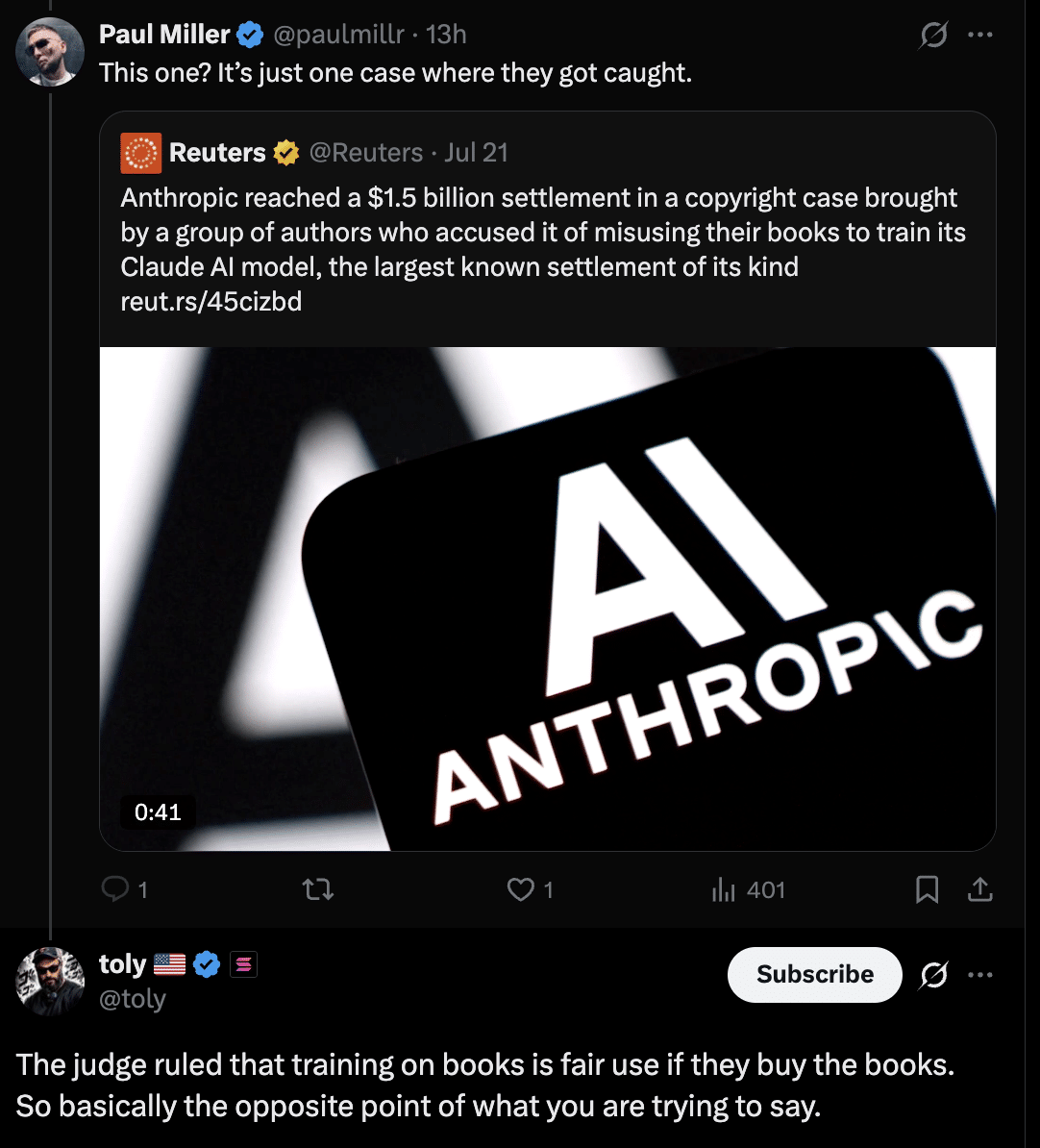
Solana co-founder Anatoly Yakovenko believes that AI companies should usually be allowed to use information that people voluntarily publish online for training. His comments came after Anthropic's $1.5 billion copyright settlement was approved, the largest known copyright settlement in U.S. history, involving claims for books used to train the company's Claude chatbot. Although Yakovenko's comments were brief, they touched on one of the most critical legal issues facing the AI and blockchain industries: where are the boundaries of fair use and where does copyright liability begin?
Why the Anthropic case transcends an AI company
Yakovenko pointed out that the court had previously ruled that AI training on legally obtained books may constitute fair use, and he believed this ruling supported AI learning from public information. However, his interpretation only covered part of the court's review. The Anthropic lawsuit became a reference because it distinguished AI training from how training materials were obtained. U.S. District Judge Araceli Martínez-Olguín approved the settlement after a previous ruling made clear that using legally obtained books for model training may be fair use, and storing millions of pirated books in centralized libraries raises independent copyright issues. The settlement resolved claims involving hundreds of thousands of works, but did not overturn the distinction. This also explains why many legal observers view the case as a guide for developers on how to collect data before training begins.
From fair use to data ownership: AI companies are fighting a larger copyright war
Anthropic is one of several AI developers facing copyright lawsuits from authors, publishers and media organizations. Similar disputes involving OpenAI, Meta and other AI companies are still pending in U.S. courts, and the Anthropic case became the first major settlement. OpenAI continues to defend claims filed by The New York Times and other publishers;Meta is suing major academic publishers and authors over books allegedly used to train Llama; and Google is facing a new lawsuit alleging that its Gemini used copyrighted works for unauthorized training. The legal focus has changed over the past year. While early public debate focused on whether AI-generated content copied existing works, the current lawsuit raises different questions: Is training data licensed? Is it legal to purchase? Do you crawl from public websites? Copying from an unauthorized repository? All of this is critical because U.S. copyright law considers multiple factors when assessing fair use, including the purpose of use, the nature of the copyrighted work, the amount of use, and the impact on the original market. Courts are applying these principles on a case-by-case basis, rather than developing general rules that cover all data sets or training methods. This means that future compliance may require both recording data sources and improving model performance.
What Yakovenko's comments mean for blockchain
Yakovenko has not announced any AI products, partnerships or Solana plans. Even so, his comments point to the intersection between blockchain infrastructure and AI governance. If courts continue to distinguish between legal sources and improperly obtained training data, the need for systems that can verify sources, ownership, and licensing records before information enters the AI dataset may increase. This is an area where blockchain technology already has practical advantages. An untamperable ledger can create an auditable record of when digital content was created, its owner, and whether it was licensed for commercial use. Blockchain is not meant to replace copyright law, but could become a tool to prove compliance, as regulators and courts require AI developers to increase transparency. Conversely, if courts end up adopting broad fair use interpretations of publicly available online materials, the commercial need for a comprehensive licensing system for certain categories of content may be reduced.
(Image link omitted here)
From fair use to data ownership: The next round of court rulings may affect AI for years to come
The Anthropic settlement closed a chapter but left many unsolved mysteries. As the case was settled, the Court of Appeal has not yet issued a final national interpretation on how fair use applies to all forms of AI training. Future litigation involving different data sets, different acquisition methods, and different business models may result in narrower or broader legal standards. For AI companies, this uncertainty explains why many companies continue to seek license agreements while arguing for fair use in court. Relying solely on the outcome of litigation brings legal and commercial risks, and negotiating permission can reduce these risks. For blockchain developers, this debate presents different opportunities. As AI models consume larger and larger data sets, tools that can verify ownership, permissions, and affiliation may become more valuable, no matter which party ultimately wins in court. As a result, Yakovenko's comments have an impact beyond Solana itself. They reveal a larger industry question: how to balance innovation and intellectual property in an era when AI systems are trained with massive amounts of digital information.
Conclusion
The rational use of AI training now focuses on both innovation and accountability. Anatoly Yakovenko's defense of AI learning from public content conforms to an interpretation of U.S. copyright law, but the Anthropic settlement shows that courts attach equal importance to how training data is obtained. As lawsuits against multiple AI developers continue, future rulings could shape licensing practices, data governance, and the role blockchain may play in verifying ownership and origin in the AI ecosystem.
Glossary
Fair use: Legal rules that allow limited unauthorized use of copyrighted material in certain circumstances.
Data source: A document that records the origin of the data and how it was collected or transferred.
Basic Model: A large AI model that is trained on large data sets and can adapt to multiple tasks.
Copyright infringement: Unauthorized use or copying of protected creative works.
Blockchain: A distributed digital ledger used to securely record transaction and ownership information.
FAQs on the rational use of AI training
Why did Anatoly Yakovenko comment on the rational use of AI training?
He believes that AI companies should generally be allowed to learn from information that people voluntarily publish online, citing fair use principles.
Does the Anthropic settlement legalize AI training?
Incomplete. The settlement resolved one lawsuit while the court is still assessing how copyright law applies to different datasets and methods of obtaining training material.
Why is blockchain relevant?
If AI developers are required to prove the source of training data, blockchain systems can record ownership, permissions, and data sources transparently and tamper-proof.
(The reference source is hidden here)
























