
 Exchange Ranking
 Top Exchanges
 24h Volume Ranking
 Popularity Ranking
 Exchange BTC Balance
 Proof of Reserves
 Decentralized Exchanges
 Funding Rate
 Funding Heatmap
 Liquidation Data
 Max Pain
 Long/Short Ratio
 Whale L/S Ratio
 Binance/Okex/Huobi L/S
 Bitfinex Margin L/S
 ETF Tracker
 Solana ETF
 XRP ETF
 Hong Kong ETF
 Bitcoin Treasuries
 Crypto Reversal
 Ethereum Reserves
 HyperLiquid Wallet Analysis
 Hyperliquid Whale Watch
 Large Transactions
 On-chain Movement
 Bitcoin ROI
 Stablecoin Market Cap
 Options Analysis
 News
News Articles
 Economic Calendar
 Features
 Wallet
 Contract Calculator


 Security
 Collections
 Watchlist
 Following
 ADA
ADA Cardano ADA News: 2026 $ADA Recovery Road and Outlook
This week, the ADA hit US$0.1966, the highest level since July 4, before falling back to around US$0.1933, down 0.44% today. The Cardano ADA news update also revealed an intriguing detail: Despite rising prices, the network has lost 7,070 non-empty wallets in the past two months (according to Sanitation Intelligence).
Cardano ADA News: Why this week's market rebound occurred
According to CoinMarketCap data, the market value of $ADA has risen nearly 25.03% in the past week, making $ADA one of the strongest gainers in the volatile altcoin market. The current price is $0.196, up 0.45%. 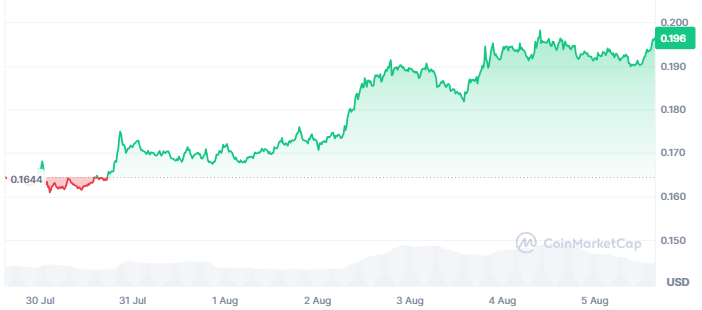
Based on real-time data, the current market overview is as follows:
Market value: US$70.5 billion, down 0.46% on the day
24-hour trading volume: US$397.14 million, down 45.74% from the previous day
Fully diluted valuation: US$8.69 billion
Circulation supply: 36.5 billion ADA, the maximum supply is 45 billion
Historical high price: US$3.10 on September 2, 2021
Historical low price: US$0.01735 on October 2, 2017
Subsequently, CoinMarketCap data showed that the weekly increase of the blockchain has cooled to 18.2%, with a monthly increase of about 5%.
In today's Cardano ADA News, big players drove most trends.
How the whale accumulation model drives ADA price changes
According to CoinCodex tracking data, large wallets holding $100 million to $1 billion in ADA have recently increased by more than $240 million in ADA. Small wallets operated in the reverse direction, and the number of non-empty wallets dropped to 4.62 million, a decrease of 7,070 from two months ago.
This divergence explains price changes. When small holders sell or leave the market, large wallets absorb supply, tighten free circulation, and push prices up even as the number of total holders declines.
This rebound comes after a difficult period in early 2026. Prior to this, the closure of analytical and NFT platforms, governance frictions, and weak activity relative to the size of the market had pushed the ADA down to the mid-range of US$0.15 before recovery began.
Major development update for Cardano: Ecosystem dynamics this month
Development work is advancing in sync with price trends in Cardano ADA news.
Van Rossem hard fork (protocol version 11) will be launched on the main network around July 18, 2026. This is the first major upgrade driven entirely by on-chain governance and involves DReps, pledge pool operators and the Constitutional Council.
Recent developments in the ecosystem:
The Ouroboros Leios public test network named Musashi Dojo has been running since June, with continuous updates to block certification and memory pool design
Mithril continues to make progress in recursive circuit work and smaller certificate size
Pyth Integration now offers a free one-year Pro API key with no upper limit for use and is suitable for institutional-level price data sources
Project Catalyst has launched a new ADA pilot fund of approximately $2.5 million, focusing on stablecoins, identities and programmable tokens.
The broader work includes LayerZero interoperability testing and continuous updates of node tools related to Plutus V4
How Charles Hoskinson views Cardano in 2026
Cardano founder Charles Hoskinson pointed out in a recent speech that The formal approach is one of the core strengths of the $ADA network. He believes that artificial intelligence has caused serious security risks throughout the industry, and only protocols based on strict verification can stand the test of time. 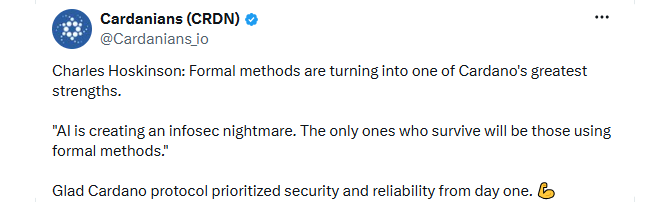
Overall, Hoskinson views blockchain as a long-term project built around security, decentralization, research and practical utility. He went on to describe the platform as a third-generation blockchain that aims to solve the blockchain trilemma through its Ouroboros proof-of-stake and extended UTXO model.
At the same time, Hoskinson also acknowledged the challenges faced by ecosystems. Given the weak $ADA price performance (far from its peak), governance frictions and criticism from the broader cryptocurrency market, he said the chain needed to "change its approach."
In recent comments, he believes that Cardano's biggest challenge is no longer technology, but recognition and brand image.
Cardano Roadmap Next step: Moving towards higher throughput levels
Through Leios and the broader Dijkstra era upgrades and deployments, capacity expansion remains a core focus. Leios introduces endorsement blocks and parallel verification. According to the Input Output study (ecosystem products), throughput estimates range from several times current capacity to 65 times, depending on the configuration and deployment phase.
Short-term roadmap steps:
Continue to conduct adversarial testing on the public test network and continue to adjust parameters
Promote mainnet-ready candidate versions based on formal specification work
The initial goal of the Dijkstra era hard fork phase is set for the end of 2026
Conservative mainnet activation, and then gradually increase capacity
to track the chain. The real test lies in whether Leios and related upgrades can be translated into daily use and deeper liquidity, because accumulation alone cannot break through current ceilings without stronger fundamental support.
























