
 Exchange Ranking
 Top Exchanges
 24h Volume Ranking
 Popularity Ranking
 Exchange BTC Balance
 Proof of Reserves
 Decentralized Exchanges
 Funding Rate
 Funding Heatmap
 Liquidation Data
 Max Pain
 Long/Short Ratio
 Whale L/S Ratio
 Binance/Okex/Huobi L/S
 Bitfinex Margin L/S
 ETF Tracker
 Solana ETF
 XRP ETF
 Hong Kong ETF
 Bitcoin Treasuries
 Crypto Reversal
 Ethereum Reserves
 HyperLiquid Wallet Analysis
 Hyperliquid Whale Watch
 Large Transactions
 On-chain Movement
 Bitcoin ROI
 Stablecoin Market Cap
 Options Analysis
 News
News Articles
 Economic Calendar
 Features
 Wallet
 Contract Calculator


 Security
 Collections
 Watchlist
 Following
 ADA
ADA  INJ
INJ Cardano had a calm day, but the undercurrents surged
Cardano had a calm day. ADA prices have fallen about 1% in the past 24 hours, and trading volume has also dropped 35%. But by lengthening the timeline, the situation is much better than it was a few weeks ago. Cardano has climbed back to 13th place in the cryptocurrency rankings, surpassing Stellar, Chainlink and Monero. In the past seven days, its price has risen by 19%, making it one of the best performing among the mainstream currencies.
So, what you see is short-term weakness, but there is a stronger trend underneath. This makes people think: Where will ADA prices go by 2027? To find answers, we asked three artificial intelligences-DeepSeek, Claude, and Grok-to chart possible paths. We provided them with Cardano's roadmap, the growth of its ecosystem and the broader market. Here are the answers they give.
The Cardano ecosystem continues to expand beyond price volatility
Prices are just part of the Cardano picture. The network itself is quietly being laid out, and these layouts may have an important impact many years from now. People in the community say the project is starting to look different. More applications are coming online, tools for real-world finance are growing, and infrastructure is constantly improving. Founder Charles Hoskinson has been calling for Cardano to tell a new story. He said Cardano can still do things that other blockchains cannot match.
In addition, work to connect Cardano to other networks is also going on behind the scenes. For example, Cardano and Injective are now connected via the IBC protocol on the test web. This means that ADA and INJ can be transferred between the two systems. If this feature works successfully on the main network, it may bring cross-chain mobility and open up new DeFi possibilities.
Next is the governance aspect. This has always been a hot topic. Proposals to restructure the treasury and ongoing community debate have sparked mixed reactions. Some see this as a necessary change, while others are concerned about the way decisions are made.
Cardano's roadmap may become the biggest driver of ADA prices
Before 2027, Cardano will usher in a series of major upgrades. The first is the Dijkstra era, a series of fundamental changes designed to make the web faster and make smart contracts easier to build. Then there's Ouroboros Leios, the next major upgrade of Cardano's consensus-building mechanism. They have written more than 700,000 lines of code for this purpose. Currently, the upgrade is in the test network stage, and the launch of the main network is still under planning.
There is also Midnight, a privacy-focused sidechain. Later in 2026, they plan to issue NIGHT tokens to ADA pledgers. This may prompt more people to lock in their tokens and participate. Interoperability is also planned. They are working with LayerZero to connect Cardano to more than 160 other blockchains. This will open up a wider world for developers and users.
DeepSeek AI forecast: If all goes well, ADA prices may reach US$4 by 2027.
DeepSeek AI gave the most optimistic forecast, but this is based on the premise that everything goes well for Cardano. In a best-case scenario, ADA prices could reach $3.00 to $4.00 by 2027. To achieve this goal, Dijkstra upgrades such as nested transactions and linear Leios need to be online on time and truly increase network speeds. LayerZero Connect must also become a true bridge for capital inflows, bringing some of the more than 400 compatible assets to Cardano. Midnight and Night token airdrops will attract more people to pledge, which may keep selling pressure low when the next bull market comes.
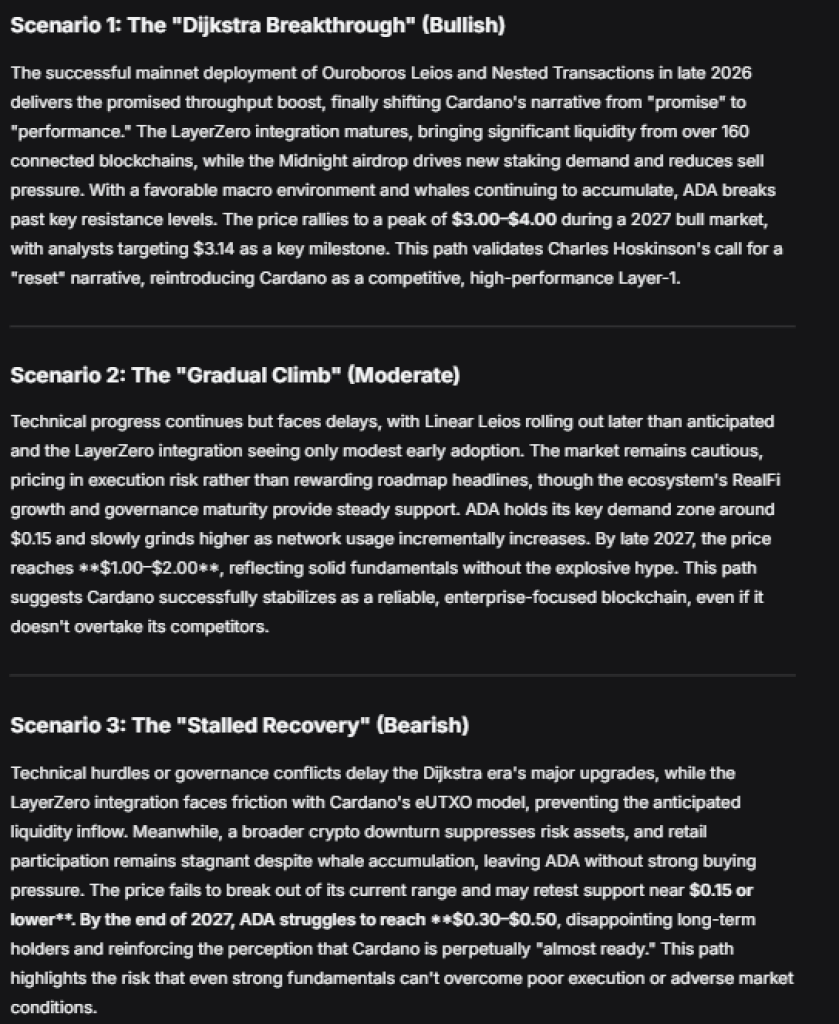
If the situation was more general, such as prices between $1.00 and $2.00, progress would be slower. The upgrade takes longer than expected and the adoption of LayerZero will be delayed. But ecosystems will still grow through real-world financial and business use cases. Even so, ADA prices will still follow Bitcoin's trend. The worst-case scenario is for prices below $0.20. This could happen if the governance battle becomes fierce, Leios encounters technical obstacles, LayerZero fails to attract users, and the entire cryptocurrency market collapses again.
Grok AI believes execution will determine ADA prices
Grok AI also focused on Cardano's roadmap, but the numbers it gave were more conservative. Its benchmark forecast is that ADA prices will be between $0.45 and $1.10 by the end of 2027. This assumes that the Dijkstra upgrade is launched in the next few years, Leios does increase network speeds, Midnight brings more privacy-first applications, and cross-chain work through LayerZero and Injective connections is gradually attracting developers and funding. Grok also believes large players will continue to increase their holdings of tokens until retail investors return.
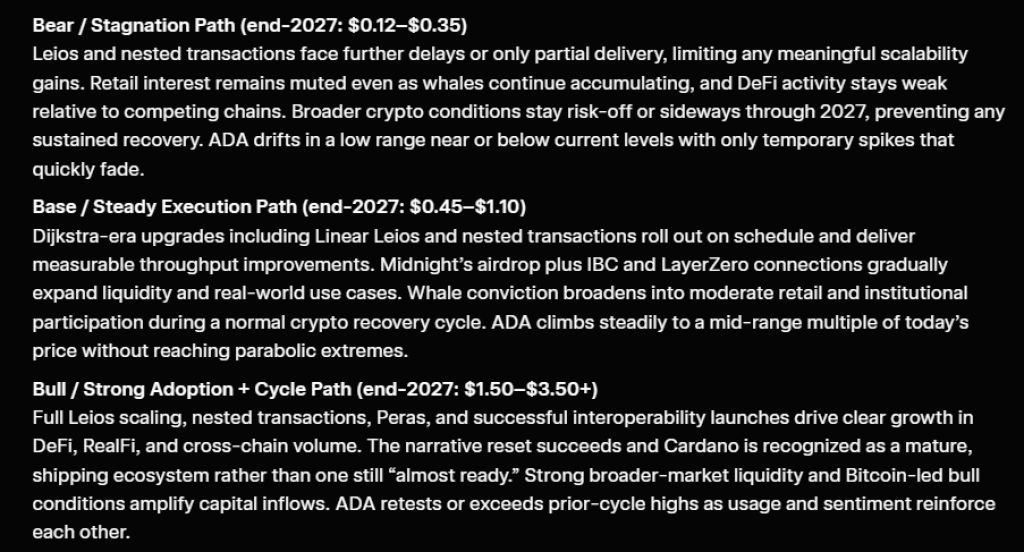
In bull markets, prices can reach US$1.50 to US$3.50, which almost requires everything to go well. Leios needs to be fully launched, interoperability must work on multiple chains, and both DeFi and RealFi need to take off. And the entire cryptocurrency market must be in a strong upward trend to push money back into Layer 1 networks like Cardano. A bearish view lowered Cardano prices to $0.12 to $0.35. This happens when technology work slows, governance battles scare people away, DeFi on Cardano remains insignificant compared to Solana or Ethereum, and the broader economic environment suppresses riskier assets such as cryptocurrencies.
Claude AI gives the most conservative Cardano price forecast
Claude AI is the most cautious of the three. It pays close attention to the risks of actually getting all of this work done. Its benchmark forecast is for ADA prices to be between $0.25 and $0.45 by 2027. This assumes that Leios, LayerZero, Midnight and other parts of the roadmap do not experience major disasters as they move forward. This alone will help rebuild trust after years of people saying Cardano was too slow. But even so, Claude believes ADA prices will only follow other parts of the cryptocurrency market, rather than lead the market.
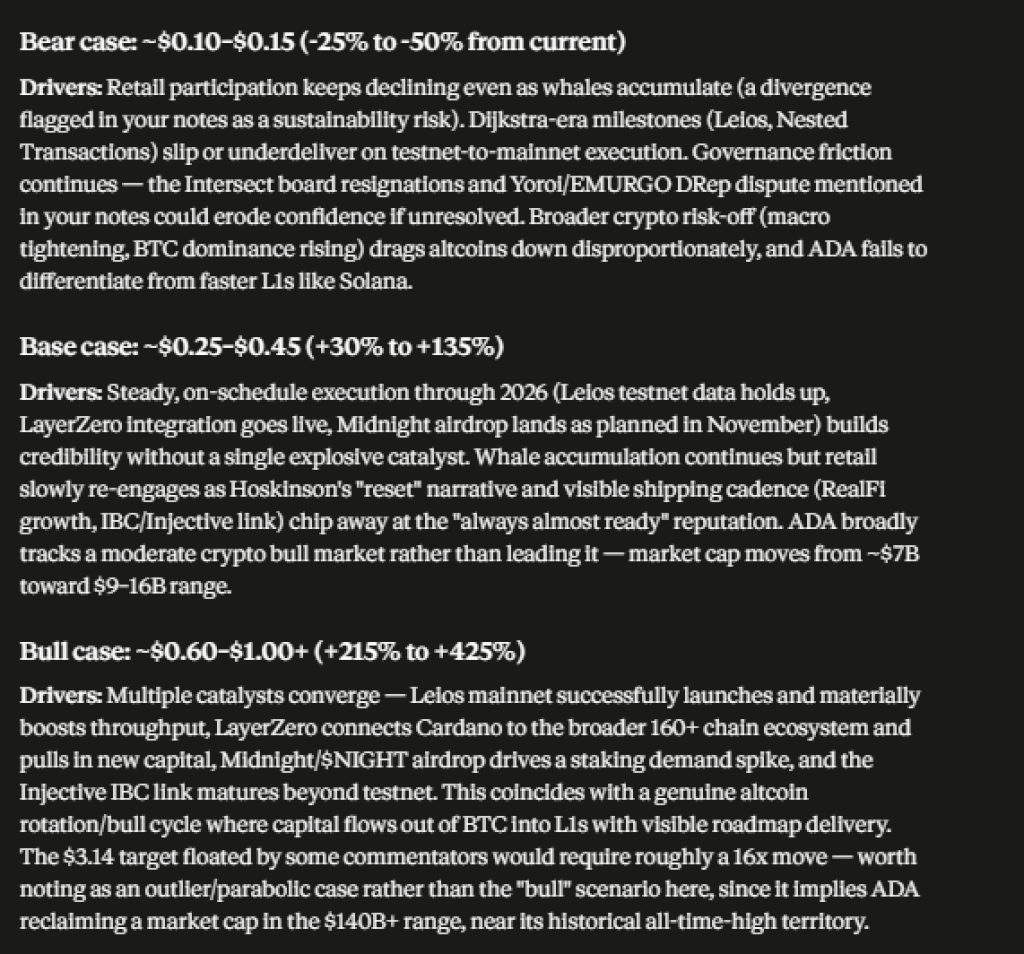
In the best case, prices range from US$0.60 to US$1.00, and all links fit perfectly. The upgrade started smoothly, LayerZero opened the door to more than 160 blockchains, Midnight attracted more people to pledge through NIGHT airdrops, and institutions began to pay attention because Cardano did prove its scalability. Claude did point out that a higher number like $3.14 means the ADA is close to its old historical market value peak. Possible, but unlikely. A worst-case scenario would reduce Cardano prices to $0.10 to $0.15. This happens when governance struggles continue to drag on, retail investors remain discouraged even as big players accumulate, roadmap deadlines continue to be delayed, and Bitcoin sucks up all the funds that might otherwise have gone to altcoins.
However, Cardano has one of the boldest roadmaps. Scalability, privacy, cross-chain work-all of these are yet to be achieved. Whether prices can meet the goals set by these artificial intelligence boils down to one thing: delivery. It is not a commitment, but delivery, adoption, and performance in the market environment in the next few years.
FAQs
How much will Cardano (ADA) be worth in 2027?
The artificial intelligence model gives a wide range of predictions. In a bull market scenario, DeepSeek AI expects ADA to reach $3.00 to $4.00, Grok AI believes prices can reach $1.50 to $3.50 if acceleration is adopted, and Claude AI predicts its bull market target of $0.60 to $1.00. Their benchmark forecasts range from $0.25 to $2.00, depending on the success of delivery of the Cardano roadmap and the performance of the broader cryptocurrency market.
Can Cardano (ADA) reach US$3 by 2027?
Yes, but this requires several main catalysts to function simultaneously. DeepSeek AI and Grok AI believe that if upgrades like Ouroboros Leios are successfully launched, LayerZero and IBC integrations attract new liquidity, Midnight expands adoption, and the cryptocurrency market enters a strong bull cycle, the ADA may reach or exceed $3. Claude AI believes it is possible for prices to exceed $3, but sees it as an unlikely outcome.
Is Cardano a good investment for the next bull cycle?
Cardano has several upcoming catalysts, including the Dijkstra roadmap, Ouroboros Leios, Midnight and LayerZero integrations, which could improve its scalability, interoperability and network adoption. Whether ADA can perform well in the next bull cycle will depend on the successful execution of these upgrades and the continued growth of users and developers across the ecosystem.
























