Exchange Ranking
 Top Exchanges
 24h Volume Ranking
 Popularity Ranking
 Exchange BTC Balance
 Proof of Reserves
 Decentralized Exchanges
 Funding Rate
 Funding Heatmap
 Liquidation Data
 Max Pain
 Long/Short Ratio
 Whale L/S Ratio
 Binance/Okex/Huobi L/S
 Bitfinex Margin L/S
 ETF Tracker
 Solana ETF
 XRP ETF
 Hong Kong ETF
 Bitcoin Treasuries
 Crypto Reversal
 Ethereum Reserves
 HyperLiquid Wallet Analysis
 Hyperliquid Whale Watch
 Large Transactions
 On-chain Movement
 Bitcoin ROI
 Stablecoin Market Cap
 Options Analysis
 News
 Articles
 Economic Calendar
 Features
 Wallet
 Contract Calculator


 Security
 Collections
 Watchlist
 Following
 BTC
 DOGE
 ETH
 SOL
 TRX
 XRP
Macro variables rekindled, and the encryption market was divided.
With the US Treasury’s rate of return breaking the 5% mark, and with the possibility of further tightening monetary policy rising again, the cryptocurrency market today is shattering against the backdrop of a weakened risk bias. The re-emergence of macro variables is seen as the biggest current market event, as it simultaneously shakes the market’s discount rate and liquidity expectations, with an impact that transcends the particular good or profit of a single currency.
The Governor of the Federal Reserve Bank of Cleveland recently stated that if the inflation continues to spread, it will not preclude a much larger measure of rate hike. Meanwhile, the price of gold has fallen to a low level over the past year, bond yields have risen, and funds are shifting to defensive configurations, and multiple signal overlaps have increased market prudence.
Market shocks and asset performance
Bitcoin has fallen by 0.28 per cent in the last 24 hours, and the transaction price is near $64,534. Although the drop has been modest, under interest rate pressure Bitcoin, a representative risk asset, is the first to be pressurized, a phenomenon that deserves special attention.
The reverse of Ethereum rose by 0.54 per cent, reporting $1,826. The relative strength of Ethereum was maintained compared to Bitcoin, suggesting that the market response was not comprehensive risk avoidance, but closer to a selective rotation.
The main attcoin performance was mixed. Ripple rose by 0.32%, Solana (Solana) by 1.93%, Tron by 1.20%, Hyperliquid by 5.07%, and Dogcoin by 0.06%. The total failure of large currencies showed no signs of a collapse, meaning that, despite the macrowind, the market's risk preference for attcoin was not completely abated.
In terms of market share, Bitcoin’s share has fallen to 59.22%, a decrease of 0.20 percentage points from the previous day; Ethereum’s share has risen to 10.18%, an increase of 0.04 percentage points. This release of funds is a signal of fragmentation from single-held Bitcoin to parts attcoin and Etheeum.
Structural change and derivative data
At present, the total of cryptocurrency is $21.04 trillion, and the 24-hour trade volume is $72,553.5 million.
Derivatives traded $73,184.3.2 million, an increase of 20.08 per cent over the previous day, and the fact that the market had not experienced significant volatility and the derivatives market had been the first to react indicated that participants were extremely sensitive to interest rate movements.
The size of the liquidation over the past 24 hours was $202.34 million, of which short options represent 56.92 per cent. As it is not a decline, long positions are frustrated, suggesting that the market has failed to break up all day, more as a result of the shock.
Bitcoin and Etheneum have a high concentration of the amount of $89.37 million and $61.84 million, respectively. The concentration of the core assets is high, reflecting the fact that large, index-grade currencies are active in short-term directional games.
The DeFi (DeFi) plate totals $65.4 billion, with a turnover of $11,190.1 billion, or 9.66 per cent. In volatile markets, chain assets are warming up in tandem with short-term liquidity markets.
This represents a 9.18 per cent increase in transactions of $75,635.7 million. This shows that both the watch and the working capital are active, and that the market is a place where buy-in waits and short-term responses coexist.
Institutional resource flows and policy developments
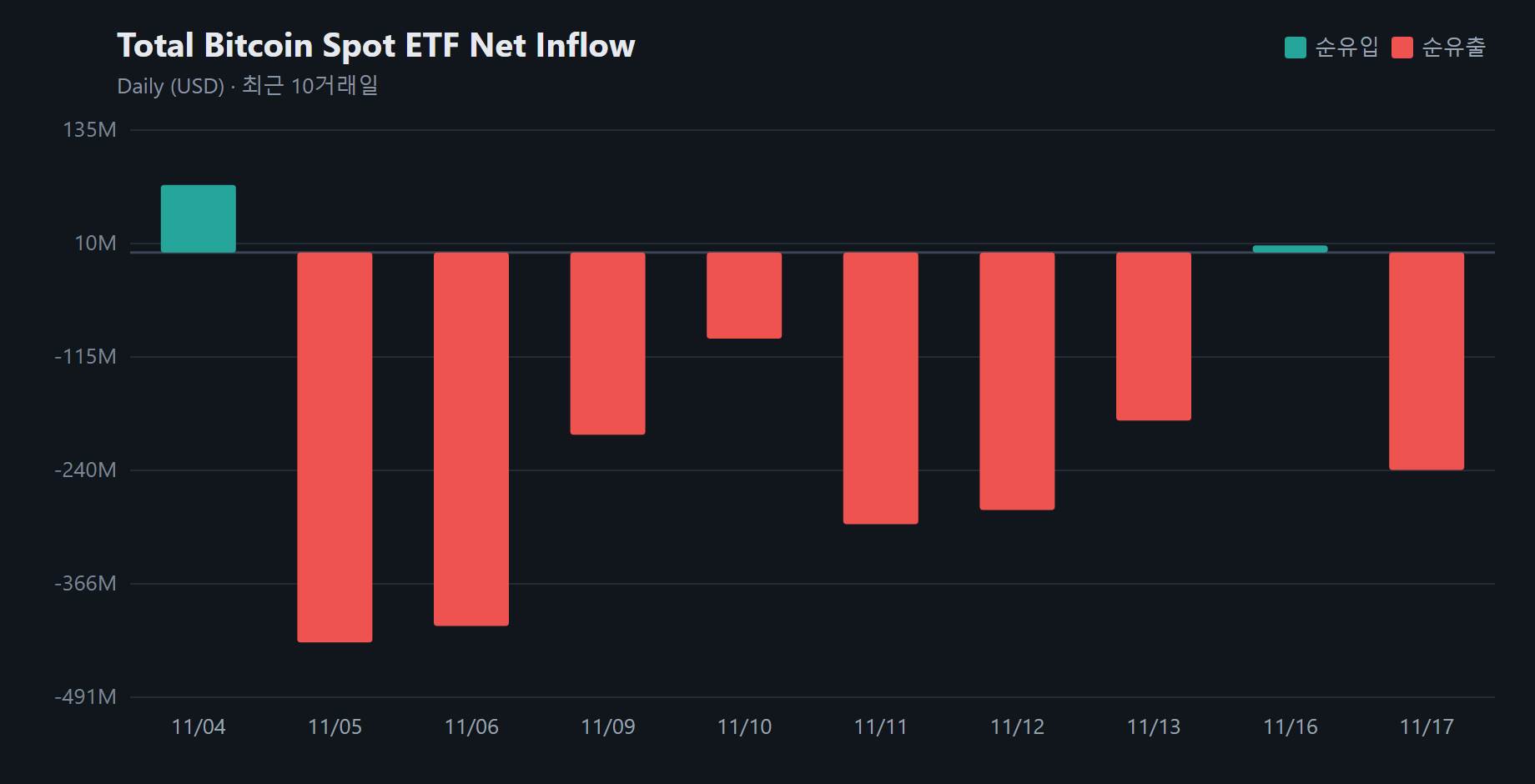
In terms of institutional funding, according to data at the end of the third quarter, Goldman Sachs and Millenium Management hold approximately $128 million and $121 million, respectively. Even under macro-austerity pressures, the institutional base is expanding, validating long-term demand.
Moreover, the Bank of America has increased its share in the iShares Bitcoin Trust Fund, which is consistent with this logic. But, given that it is the end-of-quarter data, it is more evidence of structural acceptance of expansion than an instant catalyst that can immediately reverse the direction of today’s market.
In the domestic market, the Korean dollar deposit balance of Upbit and Bithumb has been reduced by 2.51 trillion won over the past nine months. However, the number of Bitcoin and Ethereum that clients are hosting is increasing, indicating that investors prefer to hold coins rather than cash.
The KB securities have completed testing the full process of issuing, clearing, and paying dues of blockchain and monetized bonds. The co-founders of Binance have revealed that the exchange has no right to unfreeze accounts frozen at the request of law enforcement agencies.
Summary
The core variable of today’s market is the expected rise in interest rates and further contraction in the United States, with pressures that have exceeded the impact of the scale of mobility. Under this pressure, however, the market has also witnessed the fragmentation of funds to Ethereum and atcoin, as well as the trend of institutions to expand their holdings through the ETF.