Exchange Ranking
 Top Exchanges
 24h Volume Ranking
 Popularity Ranking
 Exchange BTC Balance
 Proof of Reserves
 Decentralized Exchanges
 Funding Rate
 Funding Heatmap
 Liquidation Data
 Max Pain
 Long/Short Ratio
 Whale L/S Ratio
 Binance/Okex/Huobi L/S
 Bitfinex Margin L/S
 ETF Tracker
 Solana ETF
 XRP ETF
 Hong Kong ETF
 Bitcoin Treasuries
 Crypto Reversal
 Ethereum Reserves
 HyperLiquid Wallet Analysis
 Hyperliquid Whale Watch
 Large Transactions
 On-chain Movement
 Bitcoin ROI
 Stablecoin Market Cap
 Options Analysis
 News
 Articles
 Economic Calendar
 Features
 Wallet
 Contract Calculator


 Security
 Collections
 Watchlist
 Following
 BTC
Standard: USDT linkage resilience rating maintained at the lowest level and high-risk reserve asset share increased
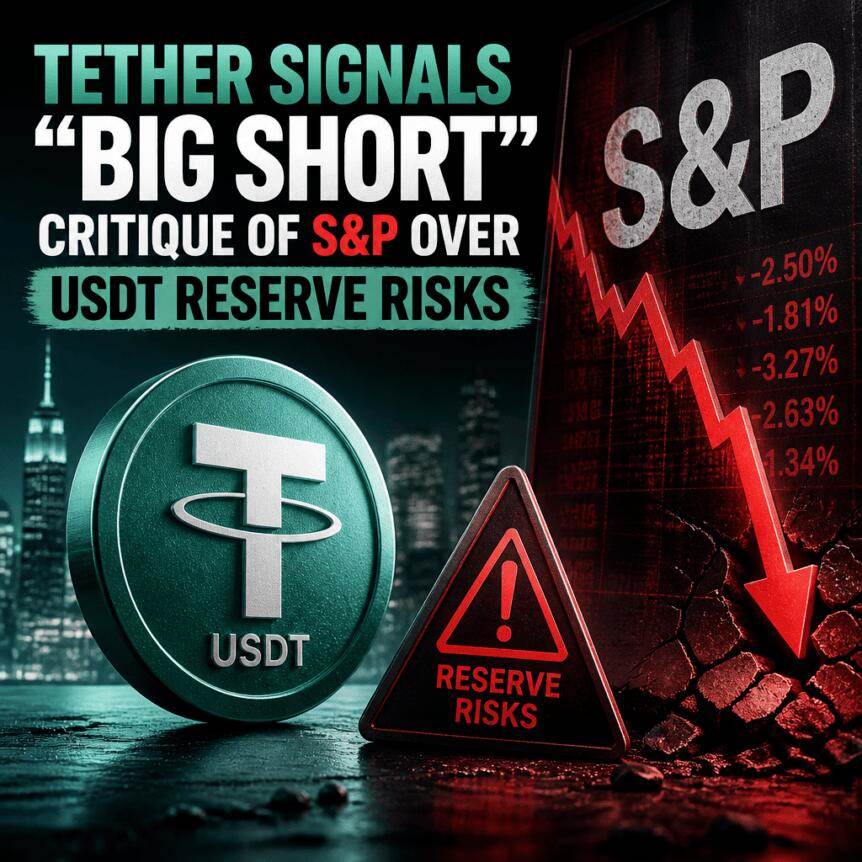
The S&P Global Ratings keep Tether's USDT stablecoin bonding at the lowest level of the “stablecoin stability table” and warn that the share of more risky reserve assets in token support systems is increasing.
In a report released on 18 November, the PTP gave USDT a five-point rating (i.e., “weak”) on “maintenance of dollar-linked capacity”, which is consistent with the November 2025 rating. The focus of this update is no longer limited to recent linkage performance, but rather focuses more on the composition of reserves and how regulation safeguards affect downside risk.
Core elements
For the second year in a row, the standard benchmark set the USDT linkage maintenance assessment at five points (“weak”), mainly because of concerns about the level of its reserve risk and its governance structure.
According to the pamphlet, as at 30 September, high-risk warehousing, including gold, Bitcoin, open shares, secured loans and corporate bonds, had risen to 28 per cent of reserves, compared with 24 per cent a year earlier.
It highlighted the structural deficiencies in the supervision of the stock hosting and segregation requirements by the digital asset regulation agency of El Salvador since Tether ' s relocation in January 2025.
The rating methodology points to limitations in audit transparency: the standard indicates that the audited material provided by Tether and the details of the trustee/trading counterparty were not made public in a manner that allows for full independent validation.
Reserve structure leads to continued low rating of linkage resilience
The pamphlet reports focus on the core issue: whether USDT’s supporting assets may fall in value during stress periods, thereby undermining the ability to fully mortgage. The report warns that if high-risk silos are “marked down”, there may be under-collateralization in USDT.
In the Tther Reserve Report Date (30 September), quoted in the Standard, the high-risk reserve portfolio accounted for 28 per cent of USDT flows, compared with 24 per cent a year earlier, indicating that reserve assets were gradually moving towards assets that might be more volatile than cash-based instruments.
Despite this, the standard rating does not reflect a reassessment below the bottom line of its scale. The agency stated that its assessment was “not below 5”, and therefore did not adjust the score after more weaknesses had been identified.
In addition, Tether ' s 30 September reserve report, confirmed by BDO, indicated that its assets were approximately $191.5 billion and its liabilities were $183.5 billion, implying an excess of assets of approximately $7.95 billion at the time.
Tether challenged the basic premise of the rating framework in his correspondence with the media, arguing that the pamphlet’s concerns stemmed from methodological rather than actual company reserves. Tether also cited the movie The Big Postes, as a way to argue the broader view that traditional systems could collapse during stress periods.
El Salvador's regulation rule is referred to as inadequate protection.
According to the Bill, additional weaknesses relate to the country ' s reserve monitoring safeguards, which were relocated to El Salvador in January 2025. The report identifies the El Salvador National Digital Asset Commission (CNAD) as the agency responsible for regulation of the country ' s Tether operations.
According to the pamphlet, the CNAD framework requires that 70 per cent of the reserves must be held in assets that can be used within 30 days. In Tether’s view, the rule is too broad, as it allows for relatively high-risk assets such as gold, Bitcoin and loans to be included in the reserve basket.
The report also notes that there appears to be a lack of requirements for the segregation of reserve assets. The pamphlet states that, contrary to the expected practice in the United States and Europe, there is no publicly available information on how the USDT reserve position is isolated from the corporate risk as a whole.
This distinction is crucial for investors and market participants, as the risk of stablecoin lies not only in the existence of reserves at a given date, but also in the ability to access and protect these assets when market conditions deteriorate.
Audit transparency continues to limit independent validation
Audit and disclosure practices are another focus of the latest assessment of the Standard. As mentioned in earlier reports, in August 2026 KPMG confirmed its unqualified opinion on Tether 2025's accounts, which was the first “full independent audit” which Tether had indicated in support of his financial statements.
However, it argued that the failure to disclose audited statements and audit reports reduced its ability to verify the lower level of information. The agency also stated that the reserve report did not list the custodians and counterparties holding Tether assets.
In addition, it notes that Tether’s attestations/assurances are still issued on a quarterly basis, while other stablecoin distributors usually issue monthly updates of reserves. For traders relying on frequent transparency signals, differences in reporting frequency affect the speed at which market-based stocks are measured.
It also stressed that, despite its downgrade in 2025 and its objections, the linkage stability rating remained the same at five points. In its report of 18 November, it concluded that Tether had maintained a “good price stability history” over the past 12 months, but that the rating remained low owing to continuing structural problems rather than short-term linkage behaviour.
Outlook for the future
Market concerns are whether future reserve disclosure and audit transparency will address the specific loopholes identified by the markers – in particular the visibility of reserve isolation, the named counterparty/custodian, and the frequency of comprehensive information disclosure. Until these issues are clarified, and as the composition of the USDT reserve evolves, the lowest-level linkage resilience assessment of the markers will likely continue to be the headlines.