Exchange Ranking
 Top Exchanges
 24h Volume Ranking
 Popularity Ranking
 Exchange BTC Balance
 Proof of Reserves
 Decentralized Exchanges
 Funding Rate
 Funding Heatmap
 Liquidation Data
 Max Pain
 Long/Short Ratio
 Whale L/S Ratio
 Binance/Okex/Huobi L/S
 Bitfinex Margin L/S
 ETF Tracker
 Solana ETF
 XRP ETF
 Hong Kong ETF
 Bitcoin Treasuries
 Crypto Reversal
 Ethereum Reserves
 HyperLiquid Wallet Analysis
 Hyperliquid Whale Watch
 Large Transactions
 On-chain Movement
 Bitcoin ROI
 Stablecoin Market Cap
 Options Analysis
 News
 Articles
 Economic Calendar
 Features
 Wallet
 Contract Calculator


 Security
 Collections
 Watchlist
 Following
 ARB
Arbitrum Network Structure and Data Availability Mechanism
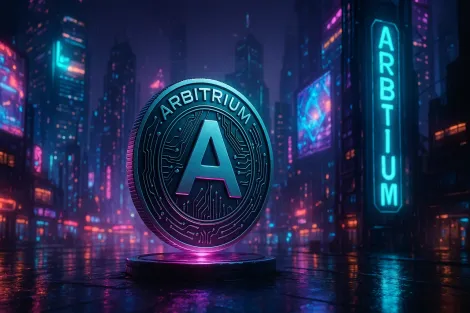
Arbitrum is a blockchain extension platform based on Ethereum, which currently operates a number of networks, including Arbitrum One and Arbitrum Nova. These networks use different data availability programs. The governance of the project is managed by ArbitrumDO, whose original currency, RB, is a key tool for decision-making.
Network type: Arbitrum One and Nova
The Arbitrum One, an Optimistic Rollup network, handles transactions outside the EtheumMainnet, and subsequently sends transaction data back to Etheium to achieve scalability. This setting provides an independent implementation environment that allows users to enjoy lower transit rates and faster trading, while ensuring security through Ethereum's consensus mechanism.
By contrast, Arbitrum Nova is built as the AnyTrust chain. Nova does not publish all transaction data to Ethereum, but relies on a dedicated data availability committee to protect and validate data under the chain. The two networks differ in technical design, especially in the way transaction data are stored and validated.
Users should carefully verify which of their Wallet or application supports the Arbitrum network, since the wrong transfer of funds between incompatible chains may result in permanent inaccessibility of assets.
Explanation of terms: Committee on Data-Avilability Committee
This refers to a group of trusted entities that are responsible for ensuring the accessibility and validity of the data on transactions under the chain and for providing a balance between the decentralized of the blockchain network and its scalability.
ARB Currency and Governance Mechanism
ARB token is a digital asset that meets the ERC-20 criteria and serves as a governance tool only within the ArbitrumDAO.
The Arbitrum Foundation, which supports the protocol development, reports that, as of 17 August 2026, some 92.30 billion ARBs had been unlocked or held by the DAO Treasury, and that the remaining 770 million tokens remained in line with the original attribution schedule. The last attribution token will be released in March 2027.
Holders can be directly involved in the governance process, but it needs to be noted that the total supply of ARBs may increase, as, under the constitutional proposal, a maximum of 2 per cent of the new tokens can be forged per year.
For information purposes, according to UTC time 20:21, 18 November 2026, CoinGecko shows that the ARB price is 0.1273 US$ and the market cap is about $891 million, with a circulation supply of about 7 billion.
Activity and development
Arbitrum Foundation states that in the first half of 2026, the network activity exceeded 478 million transactions, and the GDP of the ecoussystem system reached $206 million. The stockcoin transfers exceeded $70 billion per month, and DAO revenues reached $6.19 million.
DefiLlama records show that the total lock value of Arbitrum DeFi program (TVL) was $1.303 billion as of 18 November 2026. At that date, the stockcoin market cap on Arbitrum was $4.05 billion, with over 91,700 active addresses and 1.32 million transactions processed in the past 24 hours.
These statistics reflect the growth and adoption of the platform, but token prices and network usage per se do not predict future value or user needs.
Recent upgrades and new chain releases
On 20 August 2026, Arbitrum One implemented the ArbOS 61 Elara upgrade, which increased the smart cap fourfold through its Stylus system, and introduced new compliance and cost customization tools for the dedicated chain.
On November 9, 2026, Arbitrum announced that it was on line Elysium in Mainnet. Elysium was developed by Kinetiq using the Arbitrum platform to settle transactions on HyperEVM and to display modularization and customization of Arbitrum technology using the HYPE token as a Gas fee.
Explanation of terms: HyperEVM
A high-performance, Ethelium-compatible virtual machine designed to optimize trade throughput and reduce costs in the application of decentrazed.
Previously, security pauses activated by the new Stylus Futures on Arbitrum One were still under review because of the reported gaps related to chain operations. A governance proposal is seeking approval for a limited security audit and for the re-activation of Futures, noting that the incident did not harm user funds.
Advantages, risks and applicability
The potential advantages of Arbitrum include lower transhipment rates, higher throughput rates, and flexibility to create a custom-set dedicated chain. However, users are exposed to risks such as technological complexity, governance uncertainty, and continued price volatility of tokens.
The Arbitrum network may attract researchers interested in the Ethereum extension solution, or seek to replace developers who are in the middle of the mainnet congestion. On the other hand, users who expect a stable return or wish to isolate the blockchain risk may find the ARB inappropriate. Users must always remain aware of the technology, the market, and the regulation challenges when interacting with Arbitrum and its related assets.