Exchange Ranking
 Top Exchanges
 24h Volume Ranking
 Popularity Ranking
 Exchange BTC Balance
 Proof of Reserves
 Decentralized Exchanges
 Funding Rate
 Funding Heatmap
 Liquidation Data
 Max Pain
 Long/Short Ratio
 Whale L/S Ratio
 Binance/Okex/Huobi L/S
 Bitfinex Margin L/S
 ETF Tracker
 Solana ETF
 XRP ETF
 Hong Kong ETF
 Bitcoin Treasuries
 Crypto Reversal
 Ethereum Reserves
 HyperLiquid Wallet Analysis
 Hyperliquid Whale Watch
 Large Transactions
 On-chain Movement
 Bitcoin ROI
 Stablecoin Market Cap
 Options Analysis
 News
 Articles
 Economic Calendar
 Features
 Wallet
 Contract Calculator


 Security
 Collections
 Watchlist
 Following
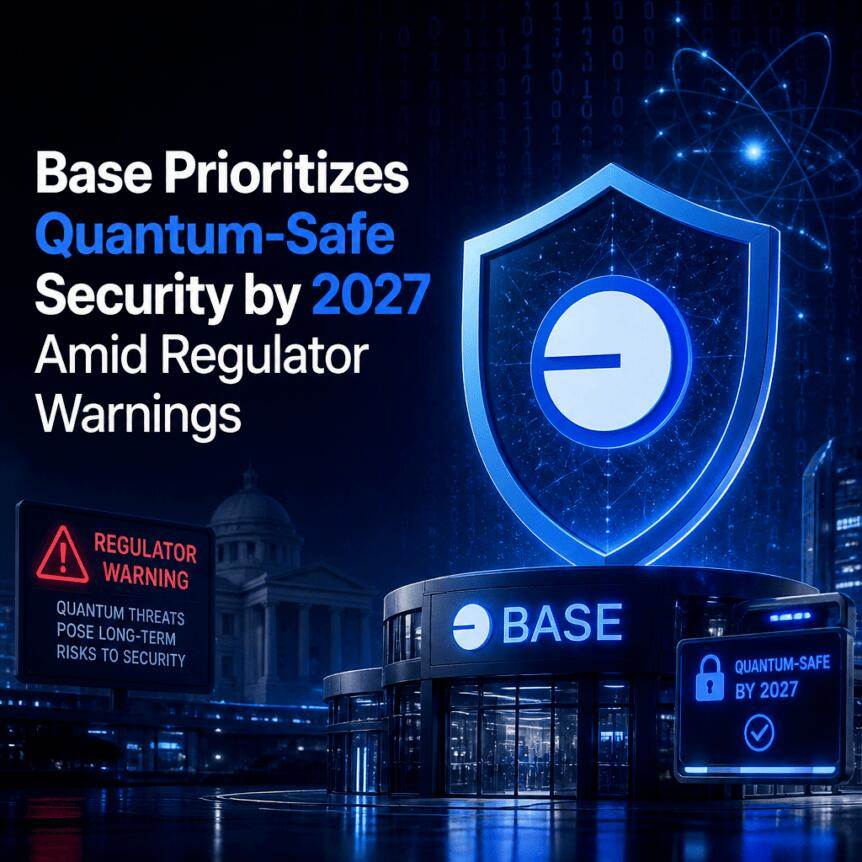
Base integrates quantum security at the core of the 2027 road map in response to future encryption threats
The Ethereum Layer-2 network, supported by Coinbase, is placing quantum security at the heart of its 2027 road map. The initiative aims to better prepare its walklet system for the risk that future quantum computers may undermine current encryption protection.
During the interview, Jesse Pollak, the founder of Base, stated that the upcoming “Everest” upgrade would introduce a new trade format that would provide a “framework” for the subsequent implementation of the antiquant changes. While this effort is not expected to immediately make Wallet resistant, it reflects a broader shift in the industry.
Key points
- Priorities:Base focused on quantum security in 2027 and the work was organized around the upcoming Everest upgrade.
- Technical path:Everest will introduce a new type of transaction called “Base Transports” to support future Wallet security improvements without forcing users to change their address.
- Existing password:The transaction formats described in EIP-8430 still rely on existing ciphers to provide the basis for subsequent upgrades by separating signatures from signature authentication.
- Regulation alert:Regulation agencies, including the International Organization of Securities and Inspections (IOSCO), have warned that an attack with quantum computing capability may pose a systemic risk and that the coordination process for the security change in blockchain may be extremely complex.
- Other objectives:Pollak also outlined priorities beyond security in 2027, including the expansion of transactions, payments and lending, and increased attention to artificially intelligent “agent” finance.
Everest Upgrade: Path to quantum security wallet
Everest is the next major network upgrade (and its fifth major upgrade) of Base, designed to lay the technological foundations, rather than provide a complete solution in the short term. Pollak emphasizes that Everest alone does not in itself make Wallet resistant. Rather, it should create a flexible structure that allows for the gradual upgrading of security mechanisms over time.
According to Pollak, this upgrade will add a new type of transaction called “Base Transports,” which is expected to support future improvements in how Wallet will secure user funds. “This upgrade of the network does not specifically address the quantum security of these Wallets, but it does establish the necessary framework,” he said.
The Base Transports technical specifications are detailed in EIP-8430. It is worth noting that the current proposal still uses the current password rather than the antiquantular signature. However, its design choice is critical: the transaction format separates the signature mode of the transaction from the signature authentication method. Pollak indicates that this structure is intended to allow the network to introduce new security methods in the future without requiring the user to change its Wallet address.
Base has not yet provided a specific timetable for introducing antiquantular protection after 2027, but it is considered an important priority year for work. Pollock’s presentation shows that the network expects incremental progress — first, to build the foundation, and then to expand the scope of protection gradually as password standards mature and become feasible.
Regulation Agency Warning: Quantities threat may affect the entire financial system
Base’s push is at a time when international agencies continue to warn of long-term risks associated with quantum computing. In a report by the International Organization of Securities Commissions (IOSCO), it was noted that a sufficiently powerful quantum computer could threaten the security of the financial system.
In particular, IOSCO highlighted a practical challenge for the blockchain: security changes may require multi-participants’ coordination, which makes upgrading more difficult than implementation in a more centralized system. The agency also noted that upgrading itself may introduce new security issues, increase costs, or interrupt transactions.
The report also points out another stress point beyond quantum calculations — advances in artificial intelligence that may make cyberattacks more difficult to detect and analyse — and thus defence measures may become more complex even if encryption methods evolve.
In terms of standard-setting, the National Institute of Standards and Technology (NIST) of the United States is actively preparing for the transition to anti-quantic cryptography. In 2024, NIST launched its first three related safety standards and issued further guidance in October 2026. NIST also set 2035 as its main target date for completing the transition to the United States federal system.
Base's 2027 priorities go beyond security upgrades
Pollak’s comments are not limited to quantum security. He also planned Base’s broader objectives in 2027, including expanding transactions, payments, and borrowing. He attributed part of the network’s kinetic energy to the demand for monetized shares, and stated that the weekly trade volume on Base had reached $1 billion.
Another theme in Pollak’s outlook is the growing role of AI agents in financial activity. He described “agent payments” as a trend that emerged in 2026, and suggested that “agent-based finance” could be one of the biggest developments in 2027.
Base’s plan also draws on the operational lessons of its last upgrade cycle. The latest network upgrade, Denim, went online on November 5, reducing the block time from two seconds to 200 milliseconds – a factor that has increased the size of block production by about 10 times. This change has reportedly led to delays in transactions. Pollak says that Base has reviewed events, repaired them, and added additional tests to reduce the probability of similar problems.
For the next phase, Pollak says that the goal is to make future upgrades feel seamlessly connected to users. “Our goal in 2027 is to make the upgrades a ‘sensible’ event. That is, no one will even talk about them,” he says, which emphasizes the importance of stability while innovation.
Observation focus: from infrastructure to land-use
Base’s Everest framework suggests that quantum security will be advanced in phases – first, to adjust the transaction and validation mechanisms, and then to introduce resistance protection when ready for large-scale deployment. Investors and developers should closely follow the details of the implementation of Base after Everest, especially any announcement of when antiquity code science becomes a practical option for Wallet security (not just a forward-looking design target).