Exchange Ranking
 Top Exchanges
 24h Volume Ranking
 Popularity Ranking
 Exchange BTC Balance
 Proof of Reserves
 Decentralized Exchanges
 Funding Rate
 Funding Heatmap
 Liquidation Data
 Max Pain
 Long/Short Ratio
 Whale L/S Ratio
 Binance/Okex/Huobi L/S
 Bitfinex Margin L/S
 ETF Tracker
 Solana ETF
 XRP ETF
 Hong Kong ETF
 Bitcoin Treasuries
 Crypto Reversal
 Ethereum Reserves
 HyperLiquid Wallet Analysis
 Hyperliquid Whale Watch
 Large Transactions
 On-chain Movement
 Bitcoin ROI
 Stablecoin Market Cap
 Options Analysis
 News
 Articles
 Economic Calendar
 Features
 Wallet
 Contract Calculator


 Security
 Collections
 Watchlist
 Following
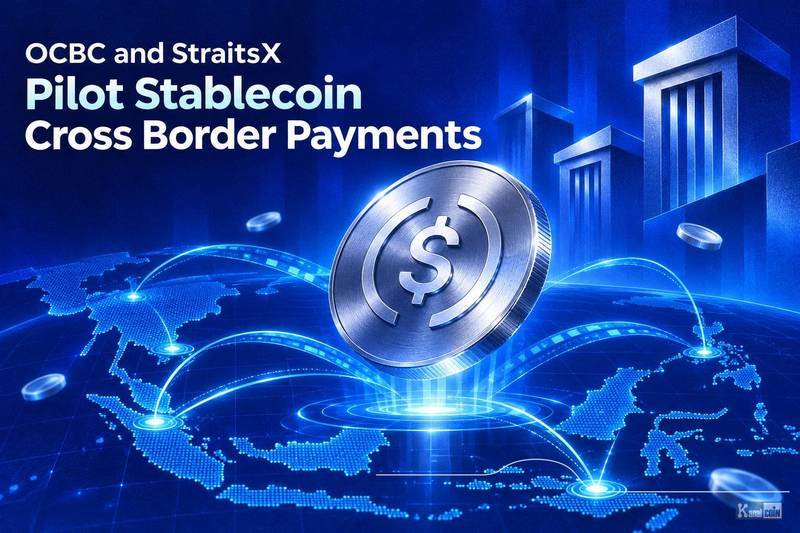
OCBC and StraitsX initiate a cross-border B2B stablecoin payment pilot
On November 23, 2026, the Bank of Chinese Emigrants (OCBC) and StraitsX jointly launched a pilot project on cross-border B2B stablecoin payments. This represents an important step forward in the South-East Asian region in integrating digital asset settlement networks with traditional corporate banking infrastructure.
Details of pilot projects
This pilot combines the StraitsX's blockchain payment infrastructure with the OCBC, creating a payment channel linked to the servicecoin for business customers. Throughout the transaction process, the receiving company is not required to hold or manage any servicecoin. The StraitsX's dedicated Wallet address (DWA) infrastructure handles the statuscoin link for each transaction, including the collection of funds, payment recognition, chain compliance, reconciliation and settlement.
NTT DOCOMO Asia is the first company to participate in the pilot. It is reported that the first real-time payment originated in Japan and was settled to the OCBC account on the same day, even after the normal Japanese currency cut-off date. This case highlights the advantages of a stockcoin network operating 24 hours a day, proving its real value in overcoming the traditional bank cut-off time.
StraitsX holds a major payment agency (MPI) licence issued by the Singapore Finance Authority (MAS) and issues two types of regulation-enabled stanticoin: XSGD linked to the Singapore dollar and XUSD linked to the United States dollar. Both stablecoin were issued under Singapore's stablecoin distribution framework, providing the project with a clear basis for many of the same types of cross-border experiments that are lacking.
“Stablecoin can efficiently transfer value across borders, but an enterprise still needs a simple way to receive and manage these payments in its existing financial operations.” — According to Tianwei Liu, CEO and co-founder of StraitsX.
Carmen Chan, Deputy Minister, Global Trading Bank of the OCBC, defined the Bank’s involvement as exploring ways to superimpose, rather than replace, the service payments of stablecoin. She indicated that collaboration with StraitsX enabled the Bank to explore how payments based on stablecoin could be integrated with traditional banking services.
Why test stablecoin for cross-border settlement
The traditional B2B cross-border payment agency route has currency cut-off windows and high billing costs. By contrast, the network is running 24 hours a day. As a result, NTT DOCOMO Asia’s payments are still complete after the yen deadline, and are considered a key point of proof for this pilot, not a minor technical note.
The pilot was designed notably conservative. By de-routing the clearing path back to standard OCBC accounts, StraitsX and OCBC are designed to attract corporate finance teams that do not wish to manage the flow of cryptocurrency walklet, private Key or stablecoin. The DWA model completely abstracts the blockchain layer from the end of the enterprise. Singapore is increasingly focusing on this “hidden” infrastructure in the business environment, a trend that can also be seen in the country's broader regional initiative, which is about to integrate blockchain into existing business processes.
StraitsX and OCBC are both involved in the BLOOM initiative launched by MAS in October 2025, which aims to develop the application of the monetized bank deposits and the stablecoin network. On 19 November 2026, the four days before the pilot was announced, StraitsX, OCBC and Slag Chartered Bank completed the validation of the concept of interoperability of monetized deposits under Project BLOOM, respectively.
The MAS' BLOOM initiative is essential for the institutional framework. Without the licensed issuer of the stockcoin, which operates under a clear framework, most corporate finance teams and their legal departments will not be involved in such a pilot.
Future focus
The current pilot is designed to be narrow: there is only one participant, a payment corridor, and a bank as a gold channel. Key disclosures that determine the broader implications of the initiative include: what additional payment corridors are supported in addition to Japan-Singapore; whether the dollar-linked stablecoin XUSD will be activated outside of XSGD for the B2B stream in dollar terms; and what is the failure rate in large-scale applications.
The significance of the Japanese corridor is not just that of a single customer, NTT DOCOMO Asia. A viable corridor that can settle a stablecoin from Japanese yen to a Singapore bank account without artificial foreign exchange intervention will be a commercially meaningful product for Japanese enterprises with subsidiaries in ASEAN.
For the South-East Asian market, the significance of the model lies in part in its structural characteristics: it uses a Singapore-owned stablecoin issuer and a Singapore bank as anchors, which is consistent with the way in which MAS constructs a regional payment infrastructure through a licensed broker rather than a decentrized protocol. If the pilot is expanded, the problems facing regional exchanges and financial institutions will focus on which banks in Indonesia, the Philippines, Thailand, and Malaysia can perform a gold-like OCBC-like function, and whether local regulation agencies in these jurisdictions will accept MAS-licented stockcoin as a compliance clearing tool.
A timetable for wider deployment has not yet been announced. Before any commercial roll-out, the scope, compliance requirements and operational parameters of the pilot need to be assessed, and both companies will position the current phase as an exploratory one.
Summary of core points
- Pilot partners:StraitsX (MAS holder stablecoin issuer, issue XSGDD/XUSD) and OCBC launched the cross-border B2B stablecoin payment pilot on 23 November 2026.
- Operational mechanisms:The DWA infrastructure of StraitsX handles stablecoin integration and compliance; the OCBC provides a gold route to enable the business recipient to receive funds in existing bank accounts without direct access to digital assets.
- To be completed:The pilot is in an early single-participant phase, involving NTT DOCOMO Asia; support corridors, large-scale settlement design, participant range and business roll-out decisions are yet to be established.