
 Exchange Ranking
 Top Exchanges
 24h Volume Ranking
 Popularity Ranking
 Exchange BTC Balance
 Proof of Reserves
 Decentralized Exchanges
 Funding Rate
 Funding Heatmap
 Liquidation Data
 Max Pain
 Long/Short Ratio
 Whale L/S Ratio
 Binance/Okex/Huobi L/S
 Bitfinex Margin L/S
 ETF Tracker
 Solana ETF
 XRP ETF
 Hong Kong ETF
 Bitcoin Treasuries
 Crypto Reversal
 Ethereum Reserves
 HyperLiquid Wallet Analysis
 Hyperliquid Whale Watch
 Large Transactions
 On-chain Movement
 Bitcoin ROI
 Stablecoin Market Cap
 Options Analysis
 News
News Articles
 Economic Calendar
 Features
 Wallet
 Contract Calculator


 Security
 Collections
 Watchlist
 Following
 BNB
BNB  BTC
BTC  DOGE
DOGE  ETH
ETH  HYPE
HYPE  SOL
SOL  TRX
TRX  XRP
XRP Ethereum ETF inflows strengthen, ETH outperforms Bitcoin
This week, Ethereum ETF inflows strengthened as Ethereum continued to outperform Bitcoin and almost all other major cryptocurrencies. The latest improvement in U.S. spot Ethereum ETF demand coincides with Ethereum becoming the only large-cap digital asset to record significant gains at the weekly level, while the broader market is mostly flat or weakening. Market and chain data show that a recovery in institutional interest and an increase in online activity have supported recent momentum, but individually, neither of these two factors can fully explain this trend. The latest data also shows that new ETF demand is concentrated among BlackRock's products rather than being widely spread across the market.
What market trends does the Ethereum ETF fund inflow reveal?
Ethereum ETF capital inflows have recovered after a difficult period of sustained outflows, indicating that institutional participation in spot Ethereum investment products is heating up again. As of July 15, the SoValue report showed that the daily net inflow of the U.S. spot Ethereum ETF was US$53.83 million, and the cumulative net inflow reached US$11.07 billion. 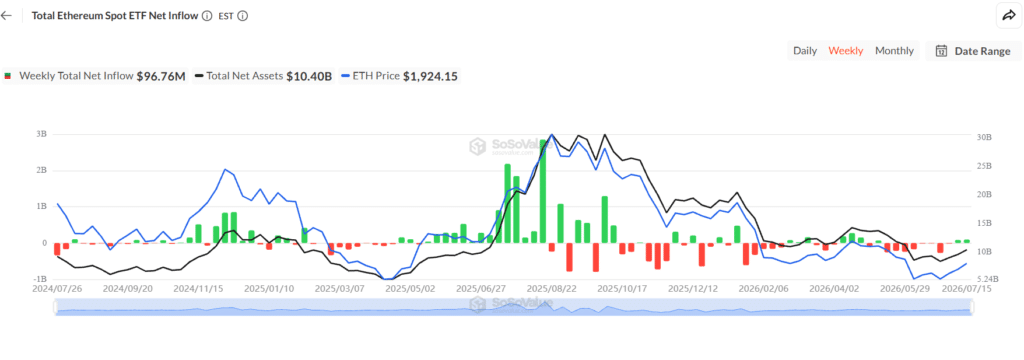
Total transaction volume reached US$538.44 million, and total net assets were US$10.4 billion. Recovery momentum accelerated this week. The U.S. spot Ethereum ETF attracted $96 million in the first three trading days, surpassing the previous week's $84 million. Previously, there was a large outflow of funds at the end of June, including a withdrawal of US$82 million on June 25. Coinglass also reported that on July 15, there was a net inflow of 28,500 ETH in the spot Ethereum ETF. Due to differences in reporting methods and deadlines among different data providers, the total is expected to fluctuate slightly, but both data sets point to improvement in capital flows.
Why does ether perform better than the broader crypto market?
This week, Ethereum was unique among the large-cap cryptocurrency markets, as most major digital assets gained limited or fell. Ethereum is currently trading at approximately $1,910.88, up 2.25% in the past 24 hours and 9.15% in the past 7 days. Its market value is approximately US$230.55 billion, and its 24-hour trading volume is approximately US$12.38 billion. 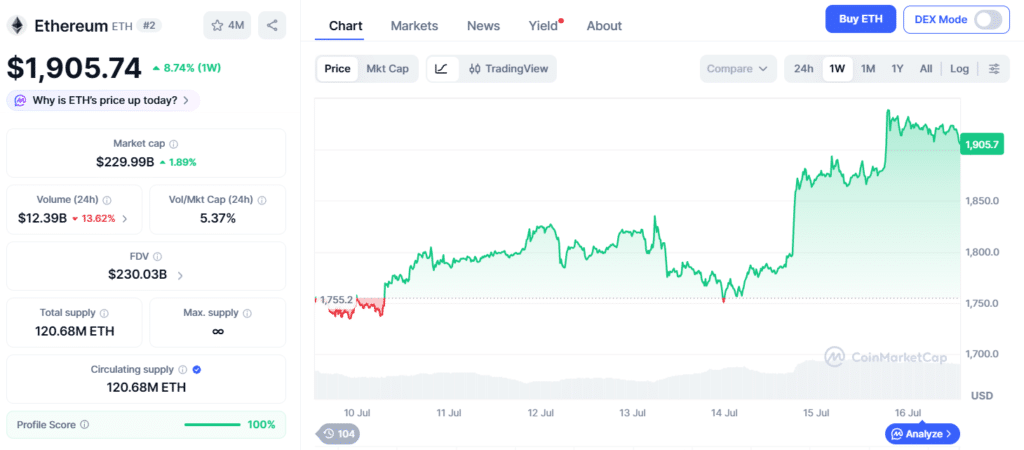
Bitcoin is currently trading at approximately $64,182.10, down 0.63% in the past 24 hours, but still up 1.99% in the past week. Its market value is approximately US$1.28 trillion, and its daily trading volume is US$26.38 billion. Outside of Bitcoin, the broader market generally weakened. Solana fell 3.04% to $75, and the weekly line remained down. TRON fell to $0.32, a weekly decline of 2.38%, while Hyperliquid's HYPE token fell to $65.70, a weekly decline of 3.53% over the same period. XRP, BNB and Dogecoin all recorded gains of just over 2% this week, accounting for only a small portion of the increase in Ethereum. Although weaker U.S. inflation data supported the broader market earlier this week, available market data suggests this is not a major factor in the relative strength of Ethereum.
Why did BlackRock's funds receive most of the new allocations?
Ethereum ETF inflows are still concentrated in BlackRock's products rather than reflecting the extensive participation of all issuers. Of the $53.8 million that entered the U.S. spot Ethereum ETF on Wednesday, BlackRock's ETHA accounted for $45.3 million. BlackRock's smaller ETHB fund attracted another $4 million, leaving less than $5 million divided among the remaining eight spot Ethereum ETF products. Gray's original Ethereum Trust continues to face pressure. The fund charges a management fee of 2.5%, while BlackRock only charges 0.25%, and has accumulated outflows of approximately US$5.3 billion since its launch. The distribution of capital inflows suggests that institutional demand remains selective in the near term, with investors leaning towards specific ETF products rather than broadly allocating funds to the entire industry.
What other factors have supported the recent momentum of ether?
The inflow of funds from the Ethereum ETF is a contributing factor to Ethereum's recent strength, but it is not the only factor supporting demand. Robinhood Chain, a Layer-2 network launched by brokers on July 1, settles transactions on Ethereum and uses Ethereum to pay Gas fees. The network's daily decentralized exchange transaction volume has exceeded US$800 million, with memin trading accounting for most of the activity. This growing online activity, along with improved ETF funding flows, has become an additional source of demand for ether, providing broader support for assets 'recent outperformance.
Why does Bitcoin present a different situation?
Despite the high volatility of short-term funds, the ETF market for Bitcoin is still much larger. As of July 15, the SoValue report showed that the daily net inflow of U.S. spot Bitcoin ETF was US$107.8 million, and the cumulative net inflow reached US$51.14 billion. Total net assets were US$78.47 billion, and daily transaction volume reached US$1.58 billion. 
Coinglass reported that as of July 16, the daily net inflow of Bitcoin ETF was US$107.7 million, or approximately 1660 BTC, and the cumulative net inflow reached US$51.58 billion. However, recent capital flow patterns remain unstable. The U.S. spot Bitcoin ETF recorded an outflow of US$424 million on July 13 and returned US$181 million the next day, indicating that short-term positions are adjusting rather than continuing to accumulate. At the same time, Nansen's blockchain data showed that despite tensions in the Middle East, outflows of funds from exchanges remained stable and there was no significant transfer to stablecoins. The funding rate is also close to neutral, indicating that the leveraged long positions that led to the June liquidation event have been basically cleared. Bitcoin's current dominance stands at 58.2%, underscoring its continued leadership in the broader cryptocurrency market despite volatile ETF funding flows.
Conclusion
以太坊ETF资金流入已成为衡量机构兴趣重燃的重要指标,但当前市场状况表明,应将其视为一个贡献因素,而非以太币近期跑赢大盘的决定性证据。最新涨幅出现在大多数主要加密货币表现低迷的市场中,这使以太币的上涨成为相对强势的故事,而非广泛的数字资产反弹。资金流入集中于贝莱德的基金、Robinhood Chain作为网络需求新来源的出现,以及比特币尽管ETF活动不均衡但链上行为相对稳定,这些因素共同呈现了一个更平衡的市场视角。机构需求是否会扩展到少数ETF产品之外,并在未来几周保持稳定,将为以太币近期势头的可持续性提供更清晰的指示。
术语表
Gas费:在以太坊上处理交易时支付的费用。
Robinhood Chain:Robinhood基于以太坊构建的Layer-2区块链。
资金费率:多头和空头期货交易者之间交换的费用。
Layer-2网络:一种提高以太坊速度并降低费用的区块链。
现货以太坊ETF:直接投资于以太币的ETF。
关于以太坊ETF资金流入的常见问题
为什么以太坊ETF资金流入在增加?以太坊ETF资金流入增加是因为更多机构投资者正在购买现货以太坊ETF。
Why did BlackRock's ETHA attract most of the capital inflows? BlackRock's ETHA attracted most of the inflows because many investors favored its lower fees.
How does Robinhood Chain support Ethereum? Robinhood Chain supports Ethereum by using ETH to pay Gas fees and settle transactions on Ethereum.
Has Bitcoin ETF also received new investment? Yes, the Bitcoin ETF received new investment, but its daily capital flow fluctuated more.
Will the inflow of funds into the Ethereum ETF affect the price of ETH? Yes, stronger ETF inflows can increase demand and may support ETH prices.
Source
Coindesk
SoSoValue
Coinglass
Coinmarketcap
Coinglass
























