
 Exchange Ranking
 Top Exchanges
 24h Volume Ranking
 Popularity Ranking
 Exchange BTC Balance
 Proof of Reserves
 Decentralized Exchanges
 Funding Rate
 Funding Heatmap
 Liquidation Data
 Max Pain
 Long/Short Ratio
 Whale L/S Ratio
 Binance/Okex/Huobi L/S
 Bitfinex Margin L/S
 ETF Tracker
 Solana ETF
 XRP ETF
 Hong Kong ETF
 Bitcoin Treasuries
 Crypto Reversal
 Ethereum Reserves
 HyperLiquid Wallet Analysis
 Hyperliquid Whale Watch
 Large Transactions
 On-chain Movement
 Bitcoin ROI
 Stablecoin Market Cap
 Options Analysis
 News
News Articles
 Economic Calendar
 Features
 Wallet
 Contract Calculator


 Security
 Collections
 Watchlist
 Following
 ETH
ETH The integration of artificial intelligence and blockchain technology is spawning a new generation of infrastructure projects in the Web3 ecosystem. However, many core issues such as today's data verification, artificial intelligence transparency, scalability, and interoperability between enterprise systems and decentralized networks still need to be resolved.
What does the House Party Protocol (HPP) provide?
House Party Protocol (HPP) stands out as a Layer-2 blockchain project focused on artificial intelligence (AI-native) and aims to provide solutions to these issues. The project is developed based on the Arbitrum Orbit infrastructure and is protected by Ethereum security, leveraging EigenDA for data availability. The project aims to build a modular and scalable infrastructure that suits practical application scenarios by integrating enterprise blockchain infrastructure, artificial intelligence verification systems, data reliability and decentralized applications into an ecosystem.
House Party Protocol (HPP) is an AI-native Layer-2 blockchain infrastructure developed for artificial intelligence applications and the Web3 ecosystem. The project is built on top of Arbitrum Orbit and is secured by Ethereum. At the data availability layer, EigenDA is used. House Party Protocol was transformed from Aergo, an enterprise-level blockchain project, after completing the community governance process in 2025. Under the new architecture, four different projects are integrated into the same ecosystem:
Aergo: Core blockchain infrastructure
Alpha Quark: DeFi and the mobility layer
Booost: Manual authentication and digital identity solutions
W3DB: Data Validation and Data Infrastructure Focusing on Artificial Intelligence
Through this integration, House Party Protocol aims to integrate artificial intelligence and blockchain technology on a common infrastructure.

How does the House Party Protocol (HPP) work?
The goal of House Party Protocol is not just to become a Layer-2 network, but to build an end-to-end data infrastructure with artificial intelligence at its core. The platform integrates processes such as data generation, data verification, artificial intelligence model development, AI model verification, and decentralized application development into the same infrastructure. With this architecture, the goal is to enable enterprise companies and Web3 applications to work together in the same ecosystem.
House Party Protocol (HPP) Vision
House Party Protocol foresees trusted data and decentralized AI systems as the infrastructure of the digital economy of the future. Based on this, the core objectives of the project include:
connecting on-chain and off-chain systems through AI Oracle layer,
improving the reliability of AI output with verifiable data,
creating practical application scenarios in finance, digital identity and asset valuation,
developing AI-native Bridge layer connecting different blockchains. [TAG
In the long run, HPP aims to make AI not just a tool in applications, but directly a core component of blockchain infrastructure.
Building a bridge between artificial intelligence and blockchain
House Party Protocol was developed more than just to connect different blockchains. The project also aims to build a decentralized infrastructure that allows artificial intelligence systems to operate reliably. Under this framework, the system is built on machine-readable data, independently verifiable data sources, transparent artificial intelligence models, auditable algorithms, and interpretable artificial intelligence output.
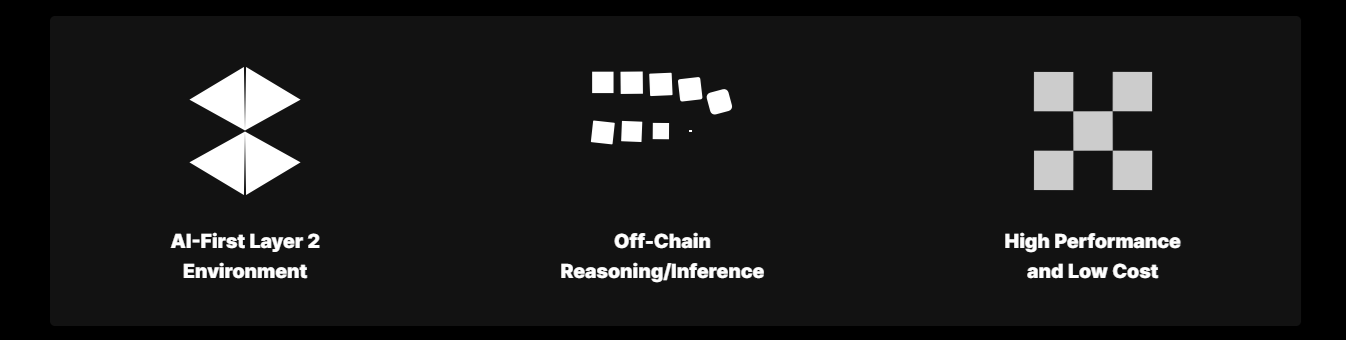
What problems does the House Party Protocol (HPP) aim to solve?
House Party Protocol is designed to provide solutions to a variety of problems encountered in the current AI and Web3 ecosystems. [TAG
Data fragmentation: Decentralized AI systems often have difficulty accessing reliable data sources. In addition, the lack of standards for data collection, labeling, and validation processes across platforms has also hindered the development of AI models. HPP aims to integrate these processes into a common infrastructure.
Scalability: Blockchain is not designed for high-intensity artificial intelligence computing. High costs and latency make real-time AI applications difficult. The House Party Protocol, through its working logic centered on artificial intelligence, aims to manage this load more effectively.
Artificial Intelligence Transparency: Many AI models today operate in a "black box" manner. The source of the data or the way the model makes decisions often cannot be verified. HPP aims to build a more transparent architecture by recording data history and AI processes on the chain.
Compatibility between enterprise systems and Web3: Enterprise companies have difficulty directly using open blockchain networks due to regulations, data security, compliance processes and corporate standards. House Party Protocol aims to build a bridge that connects enterprise infrastructure and decentralized applications.
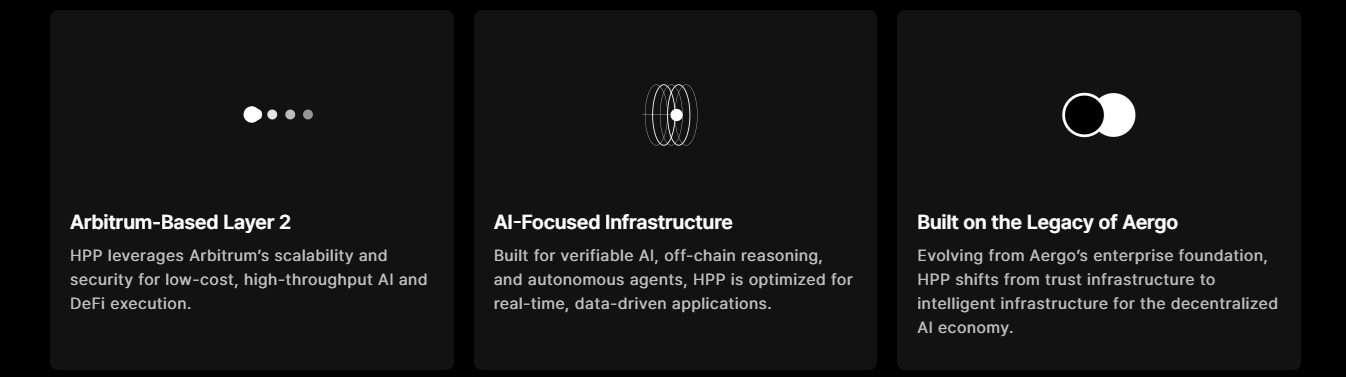
Unified HPP ecosystem
House Party Protocol integrates different solutions under one platform. The ecosystem aims to enable the creation of AI services, data verification, the development of artificial intelligence models, the operation of decentralized applications, and cross-chain data sharing through a single infrastructure. With this architecture, developers aim to have a development environment where they can create applications without relying on different platforms.
House Party Protocol (HPP) AI-Native Bridge Layer
House Party Protocol positions itself as an AI-Native Bridge layer ready for the future of multi-chains. The infrastructure is designed to support interoperability between Aergo Layer-1, Ethereum and Ethereum Layer-2 networks. In addition, new functions such as artificial intelligence-driven security mechanisms and route optimization are planned to be added to the network in the future.

What is the purpose of House Party Protocol (HPP) tokens?
HPP tokens are the core utility and governance tokens of the network. All transactions in the ecosystem are conducted using HPP. The main application areas are as follows:
Online transaction fees: HPP is required to pay transaction fees for AI model operations, AI reasoning operations, smart contract execution, data verification, cross-chain transactions, etc. carried out on the House Party Protocol main network. These fees are used to ensure network security and motivate verifiers.
Access artificial intelligence services using House Party Protocol (HPP): HPP tokens are used to access applications in the ecosystem, such as training datasets, AI-driven asset valuation tools, model verification services, and analysis services. In addition, in HPP-based applications, it is also used as a payment tool in AI processing services, subscription systems, off-chain computing, AI robot services and other solutions.
Developer Economics: House Party Protocol adopts a revenue model based on usage. Developers pay based on the AI services they use, and the revenue generated is distributed among compute nodes, model developers, and data validators. In this way, participants who contribute to the ecosystem will receive financial incentives.

House Party Protocol (HPP) Governance
HPP is also a governance token. Token holders can vote on issues such as the adoption of new AI standards, protocol upgrades, token mechanisms, strategic proposals, and community decisions.
Pledge: HPP is the basis of the pledge mechanism to ensure network security. Especially in the Proof-of-Inference system, data providers, AI model developers, and verifiers need to pledge HPP to participate in the network. Participants who provide correct and reliable services will receive pledge rewards, while token forfeiture may be imposed for participants who fail to fulfill their obligations.
Proof-of-Inference System: One of the eye-catching components of the House Party Protocol is the Proof-of-Inference system. The system checks the accuracy of AI calculations under the chain, verifies the fairness of the results, and improves the reliability of the calculation process. Through this mechanism, it aims to make decentralized artificial intelligence services operate more reliably.
On-chain auditability: AI output, data sets, model results, transaction history, etc. conducted on the platform will be timestamped and recorded on the chain. This structure is designed to provide complete auditability and transparency.
House Party Protocol (HPP) Token Economy Model
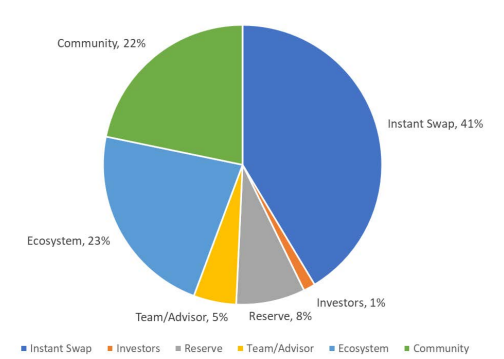
HPP tokens are allocated as follows: Instant Swap 41%, ecosystem 23%, community 22%, reserves 8%, teams and advisers 5%, investors 1%.
Official website
X (Twitter)
White paper
























