Exchange Ranking
 Top Exchanges
 24h Volume Ranking
 Popularity Ranking
 Exchange BTC Balance
 Proof of Reserves
 Decentralized Exchanges
 Funding Rate
 Funding Heatmap
 Liquidation Data
 Max Pain
 Long/Short Ratio
 Whale L/S Ratio
 Binance/Okex/Huobi L/S
 Bitfinex Margin L/S
 ETF Tracker
 Solana ETF
 XRP ETF
 Hong Kong ETF
 Bitcoin Treasuries
 Crypto Reversal
 Ethereum Reserves
 HyperLiquid Wallet Analysis
 Hyperliquid Whale Watch
 Large Transactions
 On-chain Movement
 Bitcoin ROI
 Stablecoin Market Cap
 Options Analysis
 News
 Articles
 Economic Calendar
 Features
 Wallet
 Contract Calculator


 Security
 Collections
 Watchlist
 Following
 BTC
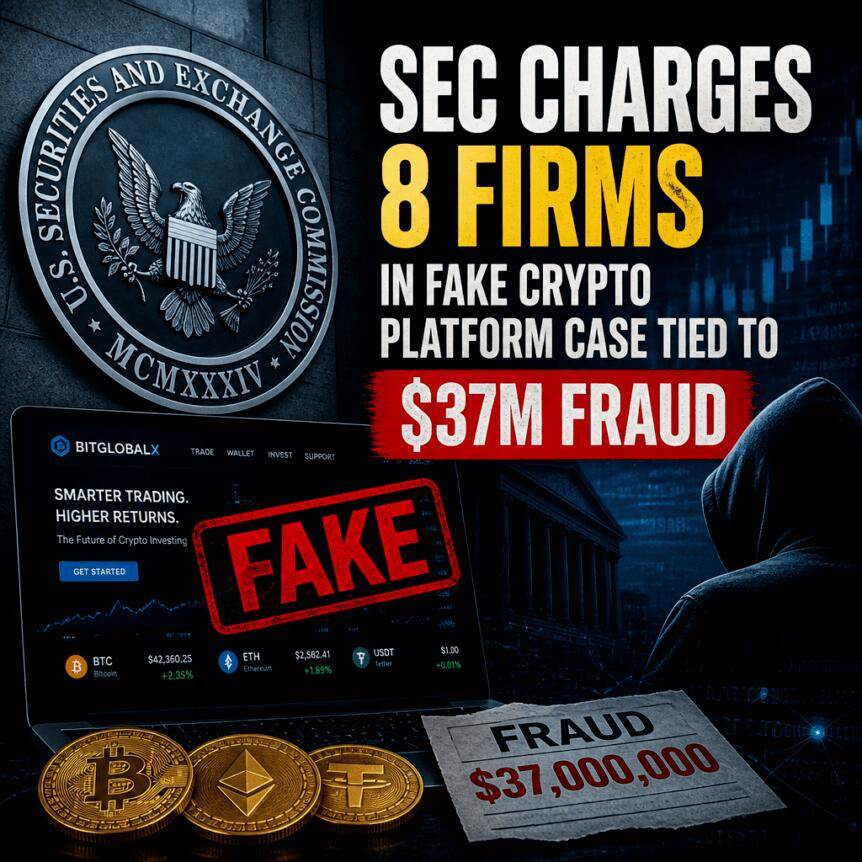
The United States Securities and Exchange Commission charged eight Colorado entities with alleged fraud of $37 million.
The United States Securities and Exchange Commission (SEC) has filed a fraud suit against eight entities located in Colorado, accusing them of having planned a fraud against an investor involving over $37 million. According to SEC, the defendant disguised as an investment adviser and a trade representative, and then induced the victim to deposit the money into a false platform of cryptocurrency.
In a press release released on Thursday, the SEC described a multi-stage process: fraudsters first provided guidance on stock trading and then persuaded victims to transfer money to a website disguised as a real exchange. The SEC also noted that people abroad could play a central role in this, using social media advertisements to recruit victims into private chat groups.
Key points
- Fraud:The SEC alleged that the defendant had stolen over $37 million from United States investors through false investment advisory services and cryptocurrency trading platforms.
- Queue mode:According to the authorities, the victims were introduced into private chat groups, where the fraudsters initially used the stock exchange as a bait, and then led the victims to the counterfeit cryptocurrency “exchange” deposit.
- Forgery of compliance materials:The scheme relies, alledly, on forged compliance documents, including forged “SEC certificates” and false declarations submitted to various regulation agencies.
- Characterization of conduct:This behaviour is characterized by the SEC as a fraud model based on impersonation, consistent with previous investor warnings regarding investment frauds conducted through chat groups.
Alleged Operating Mechanisms of Fraud
The SEC indictment focuses on the details of the operation of the alleged scheme. The Agency states that the defence has packaged itself as an investment adviser or a representative of the Cryptocurrency Asset Trading Platform - the SEC - describing it as a disguise for the purpose of extracting funds from investors.
The prosecution's allege fraudster uses social media advertisements to attract potential victims and to transfer the dialogue to online private chat groups. According to the SEC, in these groups, the fraudsters initially offered stock exchange advice. Subsequently, the jargon changed: the victims were encouraged to transfer funds to the so-called “cryptocurrency platform”. SEC notes that these platforms are not real exchanges, but rather front stations built for theft.
To enhance credibility, the SEC allege defendant created a false “SEC certificate” and submitted seemingly legitimate documents, including submissions to the SEC, the Financial Regulation Authority (FINRA) and the Financial Crimes Enforcement Network (FINCEN). The agency also claims that individuals located abroad may operate a crucial part of the activity.
Replacement of consultants and platforms over time
SEC alleges that the fraud did not operate through a single, fixed brand. On the contrary, the fraud went through four successive “advisers-platforms” combinations between August 2024 and May 2026. The Commission states that the operators switch between these combinations every few months. This strategy makes it more difficult to detect, disrupt or trace the fraud to a single entity.
This “rotational pairing” approach is important for investors, as it shows that the name and platform of the public may change, while the bottom line of tactics is consistent. In practice, if a fraud updates its apparent identity, this may affect the specs of the victims or intermediaries to detect dangerous signals.
The subject of the SEC suit.
According to SEC, the eight entities prosecuted were:
- Advisor WeChat Capital
- Tech Brokerage Assembly Alliance Ltd.
- HB Wealth Advisors
- IdeaCrypto Exchange LLC
- Convergent Wealth Advisors Inc.
- RealSimple Crystal Exchange Inc.
- Associated Wealth Advisors Ltd.
- Essential Cripto Exchange
The SEC framework emphasizes that these enterprises alleged as a public face of broader impersonation and deception. By linking the actions to the human image of similar consultants and the cryptocurrency platform, the SEC indicated that the scheme exploited investors ' shared expectations of market access.
Why does the SEC think this fits a broader pattern of fraud?
The case also coincides with the previous SEC investor alerts on group chat fraud. In a December 2025 Investor.gov bulletin, the Commission warned that fraudsters are increasingly using investment-related group chats to promote fraud programmes – often by impersonating financial professionals and taking advantage of confidence dynamics in private communities.
In its announcement on Thursday, the SEC’s law enforcement leadership reinforced the subject. Laura D’Allaird, the head of the SEC’s network of law enforcement and emerging technology units, stated that the agency continued to pursue and expose fraudulent investment schemes that preyed on American investors, adding that the public could report such programmes through the SEC’s online portal.
For readers, the lesson is not only that this particular case involves a false crypcurrency exchange. The SEC's description — social recruitment through advertising, the transfer to private chat groups, the upgrading of investment dialogues that initially appeared “legal” to deposit requirements, and the attempt to forge legitimacy — captures the replicable structures that fraud can follow.
The momentum of enforcement and follow-up developments that investors should be concerned with
More extensive SEC enforcement activities provide additional background information. The study cited by Cornerstone Research shows that in the 2026 fiscal year, the Commission initiated 348 enforcement actions, down 23.7 per cent from 456 the previous year, while in the 2025 calendar year, 13 actions related to cryptocurrency were initiated, down from 33 in 2024.
Despite the fact that the number of cases related to cryptocurrency has decreased in comparison, the Agency continues to carry out targeted cases that combine network-style recruitment tactics, impersonation and market disguise strategies. In this case, the SEC’s allegations include both operating processes (from recommendations to deposits to false platforms) and the falsification of compliance signals.
Investors interested in this area should focus on the mechanisms described by the SEC: whether communication was sent to a private group, whether the “platform” visit appeared only after preliminary transaction discussions, and whether any of the legitimate regulation of the paper had verifiable independent information support, rather than only a cut-off, certificate, or document provided by the other party. As the case moves forward, the key next development is probably how the SEC confirms alleged’s participation abroad, and how the rotating consultant-platform structure is linked to specific controls and communications.