Exchange Ranking
 Top Exchanges
 24h Volume Ranking
 Popularity Ranking
 Exchange BTC Balance
 Proof of Reserves
 Decentralized Exchanges
 Funding Rate
 Funding Heatmap
 Liquidation Data
 Max Pain
 Long/Short Ratio
 Whale L/S Ratio
 Binance/Okex/Huobi L/S
 Bitfinex Margin L/S
 ETF Tracker
 Solana ETF
 XRP ETF
 Hong Kong ETF
 Bitcoin Treasuries
 Crypto Reversal
 Ethereum Reserves
 HyperLiquid Wallet Analysis
 Hyperliquid Whale Watch
 Large Transactions
 On-chain Movement
 Bitcoin ROI
 Stablecoin Market Cap
 Options Analysis
 News
 Articles
 Economic Calendar
 Features
 Wallet
 Contract Calculator


 Security
 Collections
 Watchlist
 Following
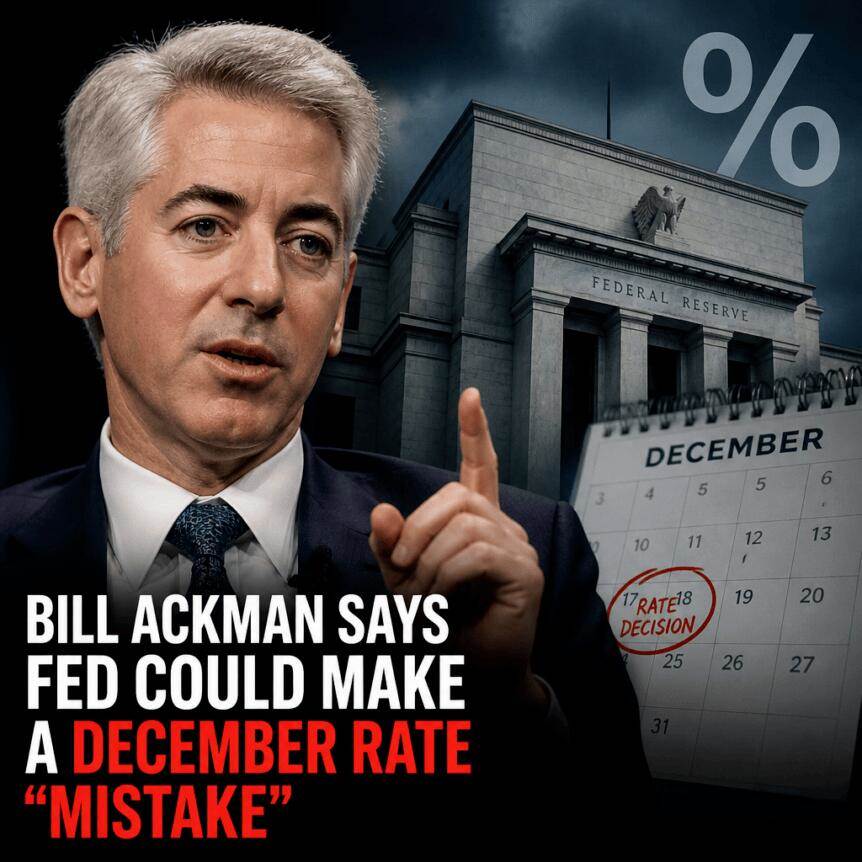
Bill Ackerman, managing director of the billionaire hedge fund, warns that if we continue to pursue the 2 per cent goal of inflation, we risk a recession.
On Sunday, Bill Ackman, the managing director of the billionaire hedge fund, published an article saying that if the Federal Reserve continued to raise interest rates in pursuit of the 2 per cent goal of inflation, the economy could be exposed to recession. He warned that the current financial situation was “a significant tightening.” His remarks coincided with the public disagreement within Federal Reserve officials about “the need for further rate hike” and “the time that policymakers can reasonably wait”.
Ackerman says that the global macro-level context, including increased military spending, tariff barriers, and large-scale investments in artificially intelligent infrastructure and energy, has made 3% a more realistic target for inclusion than 2%. A week ago, US Treasury Secretary Scott Bessent made a similar point, considering the Federal Reserve Eagle statements as one of the factors behind stock market sales last week.
Summary of core elements
- Early warning of recession risk:Ackerman warns that the continuation of the situation in order to force inflation to return to 2% could push the US economy, and even the global economy, to the brink of recession.
- Market sensitivity:The high level of attention to policy signals in financial markets was highlighted by the fact that the financier, Becent, linked the Eagle Reserve news to last week's market turmoil.
- Internal differences of opinionFederal Reserve officials are taking a different position. At least one of the dissenters in October argued that the financial conditions were still too liberal to bring the inflation back to 2 per cent.
- The next decision is expected to:The next interest rate solution is scheduled for 9 December. At the time of writing, CME FedWatch shows that the probability of 25 basis points is about 91.2 per cent.
Ackerman's Recession Warning is involved in the interest rate debate.
In a post published on platform X (formerly Twitter), Al-Akman argued that, given the dramatic changes in borrowing conditions, it might be counterproductive for Federal Reserve to continue its practice of rate hike. He noted that, until the rate of inflation returned to the level of the central bank’s first choice, policy austerity might have reached a level that undermined economic growth.
The alternative he proposed – proposed 3 per cent as a more feasible goal for inflation – is based on the current macro-environment and expenditure priorities. Al-Akman emphasizes that structural factors such as global military spending, tariff implications and large-scale construction associated with artificial intelligence infrastructure and energy supply, and investment drivers, make it more difficult to quickly reduce inflation to 2 per cent without causing unnecessary economic damage.
Ackerman's warning coincides with the CBS interview on Sunday with Finance Minister Scott Besent, who stated that some market participants believed that the state could commit “policy mistakes” if it was over-restricted. By implication, Besent suggests that the risk lies not only in whether inflation will decline, but also in whether monetary austerity will be too strong in relation to the economy's resilience.
Why is the market so sensitive?
Financial markets are not only responsive to anticipated policy developments, but are also highly sensitive to the tone of Federal Reserve communication. Bessent’s speech quotes the Eagles’ statement by Federal Reserve officials as a factor behind the stock market sales of last week, highlighting how the expected changes in interest rates can be quickly transmitted to risk assets.
This is particularly important for cryptocurrency investors and traders, because the encryption market is often seen as a high-Beta-value proxy indicator that reflects overall liquidity. When central bank policies are expected to change – especially with regard to the possibility of further rate hike – discount rates and risk preferences change rapidly, affecting all areas, from speculative positions to broader capital allocation.
Ackerman’s intervention directly challenged the idea that “policy makers can keep pressuring indigence without triggering recessionary risks.” Even if his argument does not change the official framework of Federal Reserve, it reinforces the debate that a “more aggressive path” can be costly.
What do the differences within Federal Reserve reveal?
The current interest rate discussion reflects a lack of consensus within Federal Reserve. Information indicates that in October, Federal Reserve maintained the benchmark interest rate between 3.75 and 4 per cent by 10 votes in favour and 2 against, and that both dissenters advocated a set of 25 basis points. One of the dissenters is Federal Reserve Governor Lisa Cook. In her speech on Friday, she noted that financial conditions remain too loose to bring the inflation rate back to 2 per cent. She estimates that the rate of inflation in October is 3.8 per cent, and warns that the delay may result in the central bank having to be even more substantial in the future.
Cook’s caution emphasizes that patience may no longer be viable in the current economic climate. In her view, if inflation is more sustainable than officials expect, the cost of delaying austerity will be higher in the future.
This tension – fearing over-restriction, on the one hand, and the perception that policies have not yet reached a sufficiently restrictive level – has created uncertainty about what constitutes “sufficient austerity.” For investors, this uncertainty is often as important as immediate policy decisions, because it shapes the entire course of the market’s anticipated Federal Reserve action.
Focus of attention by 9 December
According to CME FedWatch data, the probability of 25 basis points in Dec. is about 91.2%. The next Federal Reserve solution is scheduled for 9 December, which means that the market may be increasingly interested in forward guidance, interpretation of inflation data, and any further indication that officials view 2% as an immediate or long-term goal.
Given the contrary opinion of Federal Reserve officials – Cook advocated further austerity, and Al-Akman warned against the continuation of the rate hike – Readers should pay close attention to how Federal Reserve defines the remaining resistance: whether it tends to believe that financial conditions must be tightened further or to signal that, if interest rates are too long, concerns about the risks of recession are growing.
In the cryptocurrency context, changes in the probability distribution of rate hike rapidly affect market sentiment through expectations of relative attractiveness of liquidity and risk assets. Even without direct policy linkages, the mechanisms are the same: changes expected by central banks tend to lead to rapid revaluation of financial risks.
Prior to the next meeting of Federal Reserve, the key uncertainty lay not only in whether or not a rate hike was expected, but rather in how policymakers could justify the speed and magnitude of a rate hike – particularly in the light of competing views that financial conditions were already sufficiently tight to ease inflation, while another view was that financial conditions remained too loose to restore to 2 per cent.