
 Exchange Ranking
 Top Exchanges
 24h Volume Ranking
 Popularity Ranking
 Exchange BTC Balance
 Proof of Reserves
 Decentralized Exchanges
 Funding Rate
 Funding Heatmap
 Liquidation Data
 Max Pain
 Long/Short Ratio
 Whale L/S Ratio
 Binance/Okex/Huobi L/S
 Bitfinex Margin L/S
 ETF Tracker
 Solana ETF
 XRP ETF
 Hong Kong ETF
 Bitcoin Treasuries
 Crypto Reversal
 Ethereum Reserves
 HyperLiquid Wallet Analysis
 Hyperliquid Whale Watch
 Large Transactions
 On-chain Movement
 Bitcoin ROI
 Stablecoin Market Cap
 Options Analysis
 News
News Articles
 Economic Calendar
 Features
 Wallet
 Contract Calculator


 Security
 Collections
 Watchlist
 Following
StripChain: Blockchain infrastructure that simplifies cross-chain transactions
In recent years, although asset transfers between different networks in the blockchain ecosystem have become more convenient, users still have to deal with different wallets, bridging applications, and transaction confirmation processes. StripChain aims to reduce this complexity. As an infrastructure project, it is committed to making cross-chain transactions simpler and more user-friendly. The project aims to unify different blockchain networks under one system, with STRIP tokens serving as local assets that support the operation of the ecosystem. The token program plays an active role in multiple processes, from cross-chain transfers to security mechanisms.
What problem does StripChain aim to solve?
Today, when users want to transfer assets on the Ethereum network to Solana or other blockchains, they often need to use different wallets, connect to bridging applications, and pay various transaction fees. In addition, the use of encapsulated tokens and the liquidity structures on different networks also make the process more complex. StripChain aims to manage this process through a single interface. The platform strives to make cross-chain interactions as transparent as possible by managing the blockchain used by users in the background.
How does StripChain work?
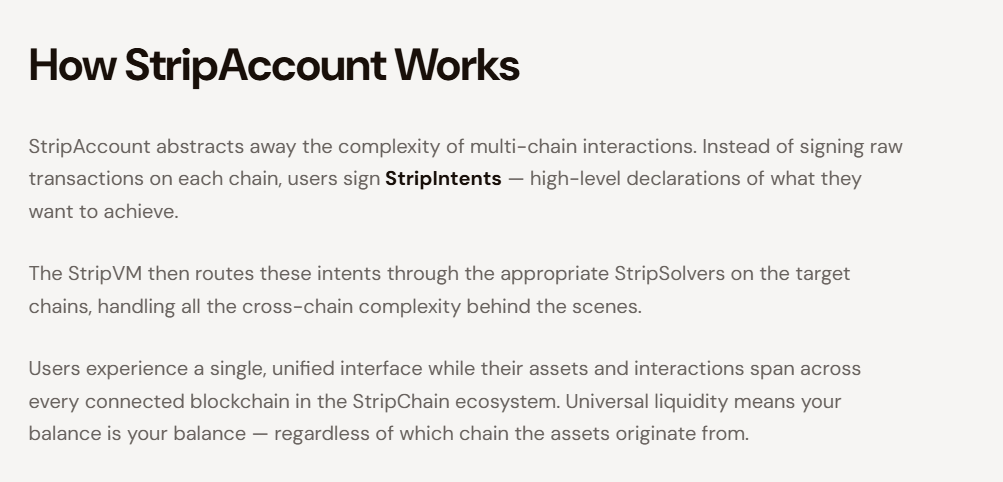
The core of StripChain is an execution infrastructure that connects different blockchain networks. The platform analyzes transactions from supporting networks, determines appropriate execution paths, and organizes transaction completion in the back office. In this structure, users do not need to confirm transactions individually on each blockchain, only need to specify the operation they want to perform at one time. The system then determines the appropriate network, liquidity sources and transaction routes to complete the process. Important components of this infrastructure include the StripVM execution layer, the StripAccount system that manages user transactions, and the StripSolver mechanism that serves as a network verifier.
Outstanding features of StripChain
The main outstanding features of this platform are as follows:
Access multiple blockchains through a single account
Cross-chain asset viewing and management
No need to process transaction details, a simpler user experience
Account system that supports Web2 login
Intent-oriented verification model to improve transaction security
How to simplify cross-chain asset transfers?
StripChain aims to integrate liquidity on different blockchains into a common framework. This allows users to transfer and redeem assets directly between supported networks without using different bridging applications. The platform also emphasizes using native assets as much as possible for transactions rather than using synthetic or encapsulated tokens. The transaction route is determined by the network verifier to select the optimal execution path.
What is the purpose of STRIP tokens?
STRIP is designed as a native token for the StripChain ecosystem. The token is not only used to pay transaction fees, but is also planned to be used for cybersecurity and ecosystem incentives. According to the white paper, the main uses of STRIP tokens include: paying network transaction fees, participating in pledge mechanisms, supporting the economic security of the network, and reflecting the value generated within the ecosystem into the token economy.
STRIP token economy
The total supply of StripChain is determined to be 300 million STRIP pieces. Among the token allocation, the maximum share is 30%, which is allocated to verifier rewards;22.59% is allocated to community sales;17.41% is allocated to teams and consultants; and the remaining portion is allocated to investors and ecosystem development work. The project also adopts a long-term attribution model. Community sales and existing investor shares are planned to be allocated without locks, while team and ecosystem funds are planned to be gradually released over a certain period of time.
Who supports StripChain?
StripChain announced a total of US$10 million in investment during the development process. Investors supporting the project include crypto investment companies such as Mechanism Capital, Hypersphere, Shima Capital, Zee Prime Capital, Ascensive Assets, Wave Capital, Impossible Finance, Comma3 Ventures and Cherry Street. In addition, industry celebrities such as Messari founder Ryan Selkis and The Crypto Dog are also listed as angel investors.

What is in the roadmap?
StripChain plans to gradually advance the development process. The goals of the first phase are to establish basic network infrastructure, develop StripVM execution layers, and build interoperability infrastructure that can run between different blockchains. In the subsequent phase, it is planned to promote the StripAccount system, expand cross-chain asset transfers, support new blockchain networks, and provide tools for developers. In the process, it also aims to make intent-based transaction models and unified liquidity infrastructure available in more applications. In the long run, StripChain's goals are to integrate more blockchains, expand the decentralized network of witnesses, improve governance mechanisms, and build a comprehensive cross-chain ecosystem so that different Web3 applications can run on the same infrastructure.
Outstanding Features of StripChain
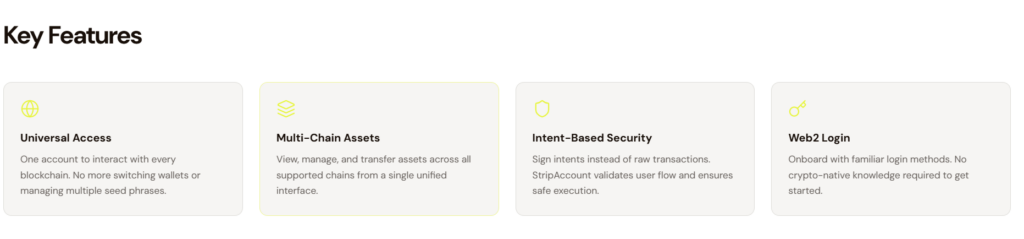
StripChain provides multiple functions designed to make cross-chain transactions more convenient. The main features highlighted by the platform are as follows:
Single account experience: Users can access the supported blockchain network through a single account, reducing the need to switch between different wallets.
Multi-chain asset management: Assets on different blockchains can be viewed, managed and transferred on a single interface.
Intent-oriented security model: Users define the actions they want to perform rather than technical transaction details, and the system performs necessary verifications in the background to ensure safe execution.
Web2-like login experience: The platform provides login methods similar to traditional Internet applications, making it easy for new Web3 users to get started.
Conclusion
StripChain is one of the infrastructure projects that aims to unify different blockchain networks into a single user experience. Its approach to simplifying cross-chain transactions, intent-based transaction model and unified liquidity structure are designed to provide a more practical experience for multiple network users. The long-term success of the project will depend on the actual implementation of its technology, the number of blockchains supported, and the ability of the developer ecosystem to expand. The expansion of the use scenarios of STRIP tokens within the ecosystem will also become one of the key topics for the future development of the project.
























