Exchange Ranking
 Top Exchanges
 24h Volume Ranking
 Popularity Ranking
 Exchange BTC Balance
 Proof of Reserves
 Decentralized Exchanges
 Funding Rate
 Funding Heatmap
 Liquidation Data
 Max Pain
 Long/Short Ratio
 Whale L/S Ratio
 Binance/Okex/Huobi L/S
 Bitfinex Margin L/S
 ETF Tracker
 Solana ETF
 XRP ETF
 Hong Kong ETF
 Bitcoin Treasuries
 Crypto Reversal
 Ethereum Reserves
 HyperLiquid Wallet Analysis
 Hyperliquid Whale Watch
 Large Transactions
 On-chain Movement
 Bitcoin ROI
 Stablecoin Market Cap
 Options Analysis
 News
 Articles
 Economic Calendar
 Features
 Wallet
 Contract Calculator


 Security
 Collections
 Watchlist
 Following
 BTC
New powers proposed to German Customs: seizure of assets of more than 100,000 Euros suspected of being sourced, cryptocurrency
The German Customs is about to acquire a new power to seize assets worth more than 100,000 euros, even if criminal proceedings have not been initiated, where there are reasonable grounds to doubt the legality of the origin of Bitcoin and other encrypted assets. This is the core of the Customs Fiscal Justice Act (Zollfinanzgerechtigkeitsgesetz), which was adopted by the German Bundestag on 12 November 2026.
For German investors, the practical proposal is very clear: before the Act is expected to enter into force on 1 January 2027, if you hold a larger silo, you should be able to prove the origin of your coins seamlessly. The Federal Senate still needs to approve the bill; its next plenary meeting is scheduled for 18 December.
In this context, cryptocurrency is not a marginal issue. In its statement on this decision, the Federal Government clearly states that customs should be able to monitor more closely the cross-border digital payment channels “and seize encrypted assets.” Thus, those who have sold, converted and stored Bitcoin on different platforms for many years now have ample reason to organize the purchase of receipts, exchange export records, and Wallet addresses.
Germany Customs Fiscal Justice Act: what was adopted by the Bundestag on 12 November
The bill's official name is lengthy: “The Act on Strengthening Customs Administration and Combating Financial Crime to achieve more Justice”, which is reproduced in the Bundestag's printed document 21/8282. During the discussion, it was usually referred to as the Customs Fiscal Justice Act. According to the Bundestag text file, the draft was adopted by the Federal Cabinet on 12 August 2026 and subsequently approved by the Bundestag on Thursday, 12 November, after an hour of debate.
The law is divided into two parts. The larger part concerns the organizational structure: the central customs authority will be restructured, the investigation and enforcement units will be merged, and the local customs offices will have a specialized unit to deal with complex cases of international money-laundering.
The second part is more important to the investors of cryptocurrency. It creates an administrative process for assets whose legitimacy is reasonably suspected. The government describes this tool in the English term “Suspicious Wealth Order”: an official order for suspicious wealth, rather than waiting for a definitive criminal act to take place. Minister of Finance Lars Klingbeil commented after the vote: “Thus, we send a clear signal to the criminals that we will intensify our fight!”
Asset investigation procedures: how the seizure without criminal proceedings works
The asset investigation procedure (Vermögensermittlungsverfahren) is at the heart of the new power. It is an administrative process in which customs determine the source of significant assets without first proving the existence of a specific criminal suspicion.
The process is expected to be phased in. First, customs temporarily seizes assets. According to the draft law of the professional law firm and the encrypted media, the period of initial seizure may be up to 30 days.
In this connection, the Bundestag Finance and Economics Commission has amended the draft Government: the original plan was to be decided by a single judge of the Finance Court and now by a panel of judges. Two other changes are of crucial importance to those affected: the parties' false statements can clearly give rise to reasonable doubt as to the source; and the seizure will remain in force if the administrative procedure is transformed into a criminal procedure.
Reasonable doubt from source: When customs intervenes
The decisive threshold in the law is “reasonable suspicion of lawful origin”. This is lower than “initial suspicion” under criminal law, but higher than mere speculation. Holding large amounts of space does not in itself make you the focus.
The Bundestag refers to the legislative note that “nearly every law-abiding citizen can explain where these assets originate or what kind of money is spent” in respect of significant assets.
This has practical consequences. Formally, you are not compelled to demand evidence, but the procedure will continue if you do not cooperate. If you remain silent or respond only partially, you will leave the assessment to customs and later financial courts. If you have a well-organized record, you can clear your doubts as soon as possible. Note that this does not constitute a legal recommendation: if an arrest occurs, the case should be referred to a lawyer specializing in tax or customs law.
Encrypted assets in law: Why explicitly mention Bitcoin
Encrypted assets are digital assets held and transferred on the blockchain: Bitcoin, utcoin, stablecoin, and any other token. For investigators, they have two characteristics that interest them: coins can move across borders within minutes, and not necessarily in banks that are obliged to provide information. This explains why the government specifically names encrypted assets in the new power.
Since 2024, the seriousness of the German authorities in dealing with the seizure of encrypted assets has become apparent. In that year, Saxony sold nearly 50,000 Bitcoin previously seized from the Movie2k operator of the film platform.
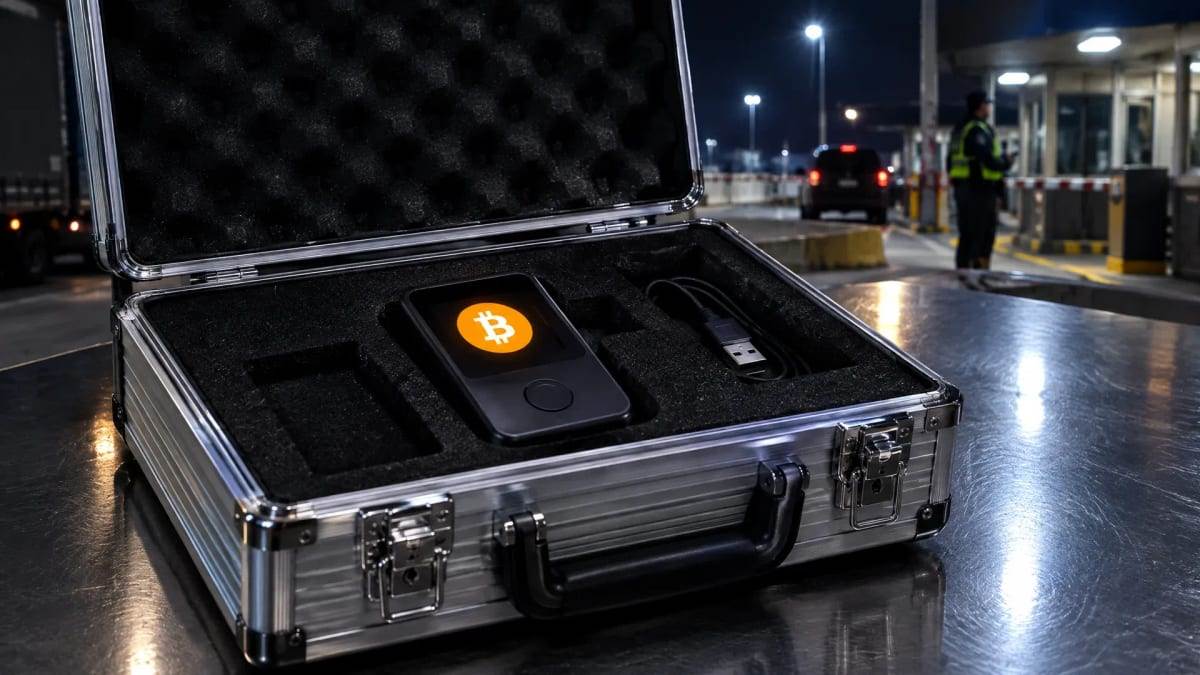
If it is an exchange account, it can contact the provider to freeze the hold. If the key is self-depositation, as you know it, it is technically difficult to do; then traditional means, such as seizing equipment, are used. Self-depositors, in particular, should distinguish between what is technical security and what is legally probative. A carefully chosen hardware walklet can prevent hacking, but it cannot replace evidence of the origin of coins.
€100,000 threshold: who might be affected and who wouldn't
The law addresses “significant assets.” According to legislation, these assets are usually valued at more than 100,000 euros. This figure is a guideline, not a fixed tax exemption. The calculation is based on the value at the time of the review, rather than on the original purchase price. For Bitcoin, the hold-up, which was purchased several thousand euros a year ago, is now easy to cross.
First, there are early buyers, who have huge revenues, long-time access and some records are stored in later closed platforms. The second is users who hold coins that come frommining, staking, airdrop, or private purchases, without traditional transaction confirmation. The third is anyone who buys or sells large assets in cash, for example, through ATMs or private transactions.
The legislative notes themselves emphasize this. Many investors’ concerns are more about “how” than “whether”: can I also present today the full chain of coins from the euro in a bank account to the Wallet?
Encrypted source of funds: Which records protect your assets
The source of the funds is a complete document of the money used to acquire the encrypted asset and the path to the current wallet. It is not just a document, but a chain. In practice, the following records form the chain:
- Bank statements:Shows the transfer to the exchange and the broker. They prove that the money purchased comes from your tax revenues or savings.
- Exchange export records:Many exchanges provide this export function in the account area.
- Wallet address and transaction ID:For every withdrawal to your own Wallet deal. Blockchain shows the path, but only you can prove that both ends belong to you.
- Mining, staking and lending statements:Examples include pool statements, an overview of incentives and a record of interest on the platform.
- Airdrop and the evidence of the gift:For example, the distribution of screenshots, gifts or recording of private purchases.
The biggest gap appears on a platform that no longer exists. If you buy a coin on an already closed or bankrupt exchange, you usually cannot access history records. Old e-mail confirmations, your own spreadsheets, and withdrawals of blockchain data can help solve this problem. Keep everything you can find while accounts and mailboxes remain.Encryption tax tool or portfolio trackerThe export records of multiple exchanges can be consolidated to produce the first overview that the authorities would like to see.
Source of funds for exchanges and banks: Customs is not the only one to ask.
According to the German Anti-Money Laundering Act, when the amount is high, the exchange and the bank must check the source of the funds. The platform will therefore demand evidence of deposits over a certain size, and anyone who fails to provide it risks being frozen.Exchange source of fundsIn the most extreme cases, banks even close their accounts;Discontinuation of accounts on suspicion of money-launderingThe article explains the consequences.
The new customs procedure begins at different starting points. Exchange checks are a matter of private law between you and the provider. Customs seizures are sovereign intervention with court proceedings. Both have the same things in common. Once you have prepared a document for the exchange, you are better prepared to respond to customs inquiries.
One advantage of regulation providers is often underestimated. Exchanges with EU-MiCA encryption licences must keep customer data and transactions for many years. This creates a second source of historical records that you can rely on.Regulation Encryption ExchangeThe comparison shows which platforms have such a mandate. Small or offshore undocumented providers lack such safety nets, and in the worst cases, the evidence disappears as the platform disappears.
Reverse the burden of proof or the duty to cooperate? The focus of criticism
After the vote, some encrypted media claimed that Germany now has a reversal of the burden of proof. This is inaccurate. The reversal of the burden of proof means that the parties must prove their lawful origin or lose their case automatically. On the contrary, the law provides for a procedure in which customs must give reasonable doubt and ultimately a court decision on confiscation.
It is reported that in the course of the legislative process, the Länder even proposed in their opinion a real reversal of the burden of proof for asset forfeiture. Although the Bundestag did not accept this, it accepted requests from other Federal Senates, for example to share information with state authorities.
According to the Bundestag, the Green Party complains that the expected additional income of €308 million is disproportionate to the estimated scale of money-laundering. According to the Left, this process tends to capture simple cases like cash couriers, rather than internationally embedded wealth.
18 December Federal Senate meeting: matters to be clarified before entry into force 2027
The next plenary session of the Senate is scheduled for Friday, 18 December 2026. It is not clear whether the Customs Fiscal Justice Act will be on the agenda. The draft agenda will be published on 1 December and the final version on 8 December.
This leaves three possible paths. If the Federal Senate approves it on December 18, the law could be applied as planned from the beginning of the year. If it is put on the agenda later, the start will be postponed accordingly. If the Senate convenes a mediation committee, the content may still change.
It is also not clear how customs will apply new powers in their daily operations. Administrative guidelines, case numbers, and the first financial court decisions will show where the limits of reasonable doubt are in practice. Until then, it is wise to guard against panic.
Encrypted source of funds: paper tracking records ready by December 18th
- Export history:Download the full trade history from every exchange and broker as a CSV file andEncryption Tax Tool. You'll see immediately what the purchase records are missing.
- Filling gaps:Save bank statements, e-mail confirmations and platform statements that are about to disappear.Encryption Exchange with RegulationThe latter will record your data according to MiCA.
- Records self-custody:Records the address of each banket's deposit and transaction ID. If you save a coin inHardware, store the record list separately from the device and the assistive word.
(As of 17 November 2026, this document does not constitute an investment proposal.