Exchange Ranking
 Top Exchanges
 24h Volume Ranking
 Popularity Ranking
 Exchange BTC Balance
 Proof of Reserves
 Decentralized Exchanges
 Funding Rate
 Funding Heatmap
 Liquidation Data
 Max Pain
 Long/Short Ratio
 Whale L/S Ratio
 Binance/Okex/Huobi L/S
 Bitfinex Margin L/S
 ETF Tracker
 Solana ETF
 XRP ETF
 Hong Kong ETF
 Bitcoin Treasuries
 Crypto Reversal
 Ethereum Reserves
 HyperLiquid Wallet Analysis
 Hyperliquid Whale Watch
 Large Transactions
 On-chain Movement
 Bitcoin ROI
 Stablecoin Market Cap
 Options Analysis
 News
 Articles
 Economic Calendar
 Features
 Wallet
 Contract Calculator


 Security
 Collections
 Watchlist
 Following
 BTC
 ETH
Key facts
Last week, the US Pot Bitcoin Exchange Trading Fund (ETF) showed some $1.79 billion in net buy-in, the largest single-week outflow since the week of June 26th. The iShares Bitcoin Trust (IBIT) in BlackRock fell, with $1.37 billion in outflows, bringing the Fund's continuity net outflow streak to four weeks.
Bitcoin reached a low point of two years on the weekend, approaching US$ 55,100, and then went back on Monday to about US$ 61,000.
The tide continues around, and the IBIT leads back to the wave.
According to SoSoValue, as of the week of November 20th, the US post Bitcoin ETF recorded approximately $1.79 billion in net redemption. This was the largest single-week outflow since June 26th, marking the fourth consecutive week of net redemption.
SoSoValue data show that the iShares Bitcoin Trust Fund (IBIT) in Beléd has been the main source of outflows of $1.37 billion. By Friday, Bitcoin ETF’s total asset size had fallen to $7.335 billion, compared to about $110 billion in mid-September.
This month to date, some $4.14 billion has left these funds, after the monthly run-off recorded in June. During the same period, the spot Ethereum (ETH) ETF also recorded $314 million in outflows, a negative growth for its eighth consecutive week.
Analyst ' s point of view: structural adjustment rather than short-term response
LVRG Research Chief Analyst Dan Khus stated that the current model was different from the early outflows, that he described the continuous outflows around the time as “structural” phenomena and linked them to continuing price pressures, large-scale liquidation and institutional shifts to capital preservation.
Rick Maeda, the head of Lavitas Markets, described the sale as mainly risk-reduction, pointing out that the flow occurred during the price decline, rather than after the increase. Maeda stated that cryptocurrency was at the end of the risk spectrum and was therefore the easiest asset class for the Fund to reduce.
Maeda also notes that quantum computing concerns and exchange-backs are additional counter-wind factors. Analysts link wider sales to the market’s expectation that Federal Reserve will be atrate hike again in December.
Jeff Mei, Chief Operator of BTSE, stated that the price index readings for personal consumption (PCE) published on Wednesday may indicate whether inflation is sustainable, thus prompting Federal Reserve to take a rate hike operation. Zeus Research analyst Dominick John stated that he expected an ETF outflow to increase further if it continued, and Bitcoin might perform better than Ethereum.
Bitcoin touched two years low.
Bitcoin's prices fell to a two-year low of nearly $55,100 over the weekend, reaching their weakest level since September 2024, then re-trading to about $61,000 on Monday. According to Maeda, the fall reduced the BTC from around $80,000 at the beginning of November to a low-end zone of $60,000.
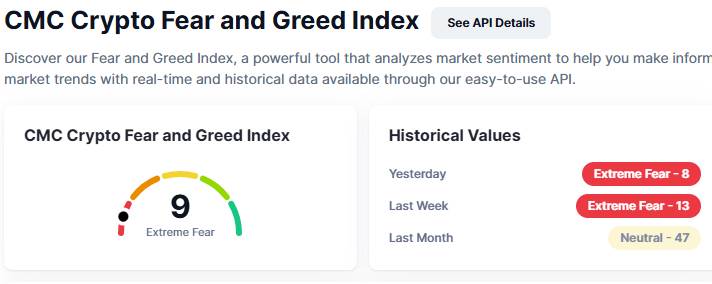
The fear of CoinMarketCap and the fear index (Fear and Greed Index), i.e. the investor mood indicator, read 9 at the time of writing, is in the “extreme fear” region.
Macro background: stock market turmoil triggered by AI Board
Last week, the NASDAQ composite index fell by about 10 per cent and the Standard 500 index fell by 8.6 per cent, owing in part to a dispute over the former Nvidia CEO Hoang In-hoon.