Exchange Ranking
 Top Exchanges
 24h Volume Ranking
 Popularity Ranking
 Exchange BTC Balance
 Proof of Reserves
 Decentralized Exchanges
 Funding Rate
 Funding Heatmap
 Liquidation Data
 Max Pain
 Long/Short Ratio
 Whale L/S Ratio
 Binance/Okex/Huobi L/S
 Bitfinex Margin L/S
 ETF Tracker
 Solana ETF
 XRP ETF
 Hong Kong ETF
 Bitcoin Treasuries
 Crypto Reversal
 Ethereum Reserves
 HyperLiquid Wallet Analysis
 Hyperliquid Whale Watch
 Large Transactions
 On-chain Movement
 Bitcoin ROI
 Stablecoin Market Cap
 Options Analysis
 News
 Articles
 Economic Calendar
 Features
 Wallet
 Contract Calculator


 Security
 Collections
 Watchlist
 Following
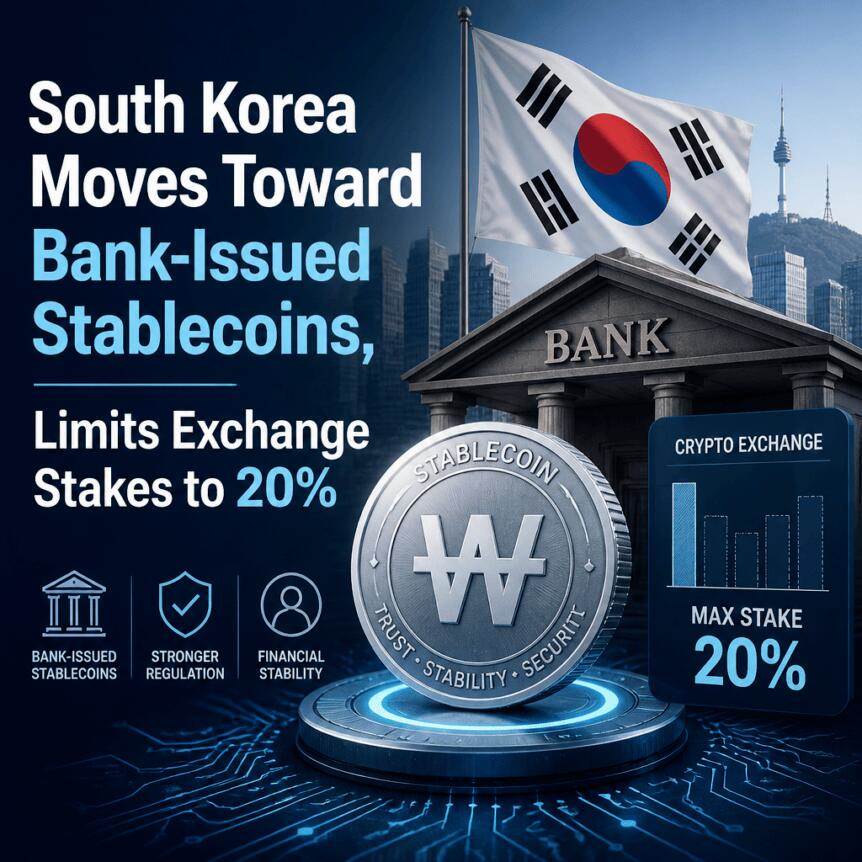
Korea proposes to regulate the issuance of the Korean Won stablecoin and limit the shareholding ratio on the exchange
The Korea Finance Commission (FSC) has issued a draft bill to establish a structured framework for the price-counting of the Korean Won and related cryptocurrency market activities. The proposal, which will be published on Tuesday, will initially limit the issuer’s eligibility for stalablecoin and set a ceiling on the influence of the main shareholders in the domestic cryptocurrency exchange.
According to the plan, issuers of stablecoin are required to obtain authorization from the Finance Committee and to meet minimum capital and reserve requirements; the exchange must hold the relevant licence and comply with operating and financial standards. In addition, the draft contains an initiative to try to overturn the domestic ban on the issuance of first coins (ICOs) imposed by Korea in 2017.
Core elements
- The draft requires that the issuer of the Korean Won stablecoin be authorized by the Finance Committee and hold at least 5 billion won of his own capital.
- The requirement for stablecoin reserves requires 100 per cent (or more) asset support for outstanding tokens and must be redeemed at face value without delay.
- Banks are required to collectively control more than half of the shares of the issuers of the stockcoin, but financial technology or technology companies can still be singled out as the largest shareholders.
- Cryptocurrency transactions require a trade, brokerage and trust licence, with a stockholding ceiling of 20 per cent (up to 34 per cent with the approval of the Finance Committee).
- The draft also seeks to lift the domestic ICO ban that has been in place in Korea since 2017.
Sportcoin issuance: bank-led, taking into account the participation of non-banking institutions
The draft of the Finance Committee focuses first on the issuance mechanism for the Korean Won's price calculation. According to the Financial Committee’s announcement, domestic issuers need to obtain the approval of the regulation agency and must have at least 5 billion won (approximately $3.7 million) of their own minimum capital.
The proposal also outlines a reserve and foreclosure mechanism to reduce the risk of decoupling. The issuer must hold a reserve covering at least 100 per cent of its outstanding currency and must redeem the stockcoin at face value without delay.
However, the Finance Committee has indicated that, while banks remain the majority of the group, financial technology or technology companies can still be the largest single shareholders. For investors and market participants, the practical effect is a hybrid model: governance and endorsement are anchored by banks, but the operational influence can extend to technology-driven enterprises.
The Financial Committee’s bulletin further shows that market opening is not entirely unlimited. On the contrary, the bill uses ownership thresholds to determine who can participate in the distribution level, which may shape the business model of competition in the Korean Won stablecoin field.
Exchange regulation and shareholder influence limits
In addition to issuing rules, the draft deals with domestic cryptocurrency exchanges. The Finance Committee points out that exchanges need to obtain trading, brokerage and hosting licences and meet specific capital and operational requirements.
More controversially, the bill introduces restrictions on the size of large shareholders. The proposal usually limits the shareholding share of the cryptocurrency exchange to 20 per cent, but the cap could be increased to 34 per cent if approved by the Finance Committee.
This idea seems to have met with resistance within the political circle. The draft’s restrictions on the ownership of the exchange have been opposed by legislators, highlighting the fact that the form of the final framework may be adjusted through parliamentary review and negotiation.
Regulation Reset: Beyond the 2017 ICO ban
In addition to stablecoin and exchange rules, the draft seeks to repeal the 2017 ban on domestic currency issuance for the first time. While the source does not provide further details on its implementation, the lifting of the ICO ban would represent a major shift in the way in which the country treats currency financing within its borders.
This change is significant because it may extend the legal path for token-related projects - although the framework of the Financial Committee's focus on stablecoin and exchanges suggests that regulation institutions aim to direct activities through licensing, disclosure and capital/reserve safeguards, rather than allowing participation to be determined solely by market forces.
Why is this plan so important at this time? The debate on who has the right to issue and the stalled progress
Korea’s efforts to promote clearer rules on stablecoin have faced internal tensions about governance. Sources point out that the bill was expected to be introduced in 2025, when President Lee promised to introduce the Korean Won in his campaign.
Sources report that central banks prefer bank control of issuers, while the Finance Committee prefers to allow non-banking companies to do the same. The draft reflects a compromise attempt: banks must be the majority owners, but non-banking financial technology or technology companies can be the largest single shareholders. This balance will determine which types of firms can be authorized and the pace of development of the Korean Won stockcoin market.
At the same time, a combination of exchange ownership caps and licensing requirements signals the broader intent of the Finance Committee: not only to regulation tokens, but also to regulation transactions and hosting infrastructure. If adopted, these provisions may affect how existing exchanges restructure their shareholder arrangements and how new entrants seek funding.
For those concerned with the risk of regulation, more importantly, the draft suggests that the Korean approach is still under negotiation and has not yet been finalized. Legislators have already opposed some of the elements of the plan, and the issuer and exchange ownership framework may be one of the most likely areas to change before it is finally adopted.
Follow-up focus
Until the draft formally enters the advisory and legislative review phase, there remains uncertainty about key details – particularly the degree of strict enforcement of the ownership threshold and the manner in which the restrictions on exchange governance are adjusted. For market participants, the most practical next step is to monitor how the Financial Committee is responding to political rebounds, and whether the final rules will retain the bank-led distribution model of the draft, while tightening or relaxing the control requirements of the exchange.