
 Exchange Ranking
 Top Exchanges
 24h Volume Ranking
 Popularity Ranking
 Exchange BTC Balance
 Proof of Reserves
 Decentralized Exchanges
 Funding Rate
 Funding Heatmap
 Liquidation Data
 Max Pain
 Long/Short Ratio
 Whale L/S Ratio
 Binance/Okex/Huobi L/S
 Bitfinex Margin L/S
 ETF Tracker
 Solana ETF
 XRP ETF
 Hong Kong ETF
 Bitcoin Treasuries
 Crypto Reversal
 Ethereum Reserves
 HyperLiquid Wallet Analysis
 Hyperliquid Whale Watch
 Large Transactions
 On-chain Movement
 Bitcoin ROI
 Stablecoin Market Cap
 Options Analysis
 News
News Articles
 Economic Calendar
 Features
 Wallet
 Contract Calculator


 Security
 Collections
 Watchlist
 Following
Integration of cryptocurrency with GameFi and iGaming ecosystems
In recent years, cryptocurrency and gaming (GameFi) and iGaming ecosystems have developed rapidly, but many platforms limit user rewards to short-term activities or points systems. Mint (MNTD) aims to integrate this experience into an ecosystem and is developed as an ancillary token. The platform aims to establish a long-term structure to support rewards received by game players through pledges, loyalty programs and community benefits.
MNTD is developed based on the Base network and is positioned as a native token in the MINT ecosystem. The token is intended to be used to enhance players 'status on the platform, obtain additional rewards, pledge and participate in community programs. In addition, daily gaming activities, recommendation systems and season-based reward plans are also important parts of the ecosystem.
What problem does Mint aim to solve?
The Mint team believes that in existing games and iGaming platforms, user loyalty programs are mostly carried out independently of each other, and the points earned cannot be transferred outside the platform. At the same time, many reward systems are based only on short-term activities, while mechanisms for rewarding users for long-term contributions within the platform are very limited.
The MINT ecosystem aims to integrate different activities such as games, pledges, daily tasks, and recommendation systems under the same reward model. The purpose is to allow users 'activities on the platform to be evaluated around the single token economy and gain more advantages over time.
How does the MINT platform work?
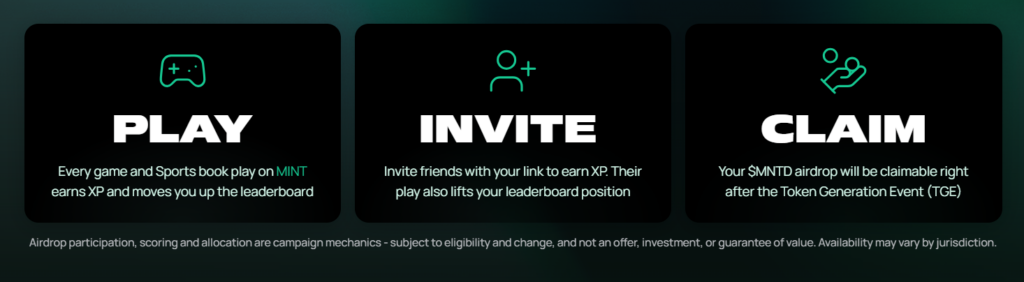
MINT is built on a reward model where users can gain experience points by playing games and connect these interactions with the MNTD ecosystem. The experience points players gain by completing games, daily tasks and other activities on the platform not only determine a user's ranking on the leaderboard during the season, but are also seen as a key criterion for allocating MNTD airdrops after planned token generation events.
In addition, users can also gain extra experience points by inviting friends. Users who join the platform through the recommendation system will also contribute points to the inviter for their game activities. As a result, users can make progress in the reward system by playing games or contributing to community development.
 What is the use of $MNTD tokens?
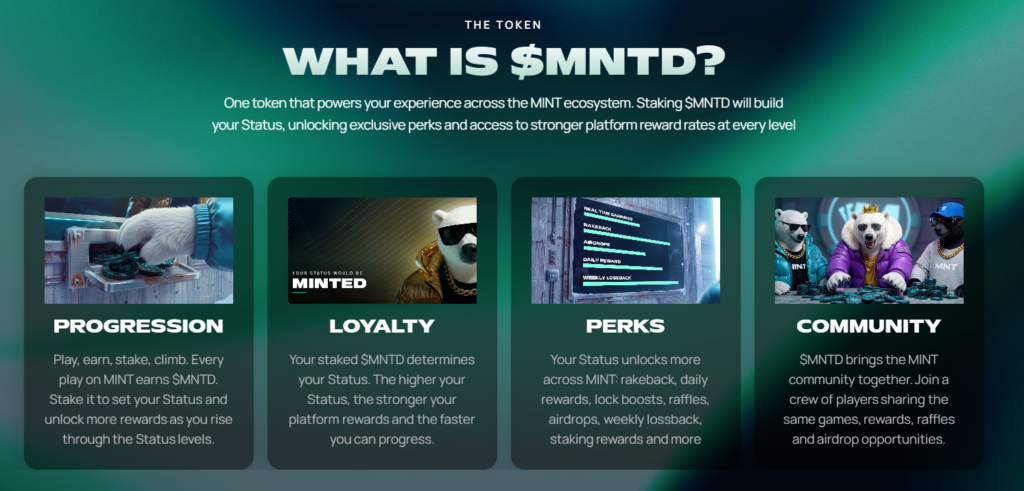
MNTD was developed as a native utility token for the MINT ecosystem. The reward system, user identities and various benefits within the platform all revolve around this token. In order to allow users to more effectively utilize the rewards earned through playing games and gain more privileges in the ecosystem, MNTD has been planned for multiple uses.
The uses of this token include pledges, intra-platform rewards, increased daily reward rates, refunds and loss refund benefits, sweepstakes, airdrop plans and community activities. In addition, users who reach a specific identity level will be able to enjoy higher platform benefits.
 How does the pledge system work?
In the MINT ecosystem, pledges are not only designed as a mechanism to generate passive income, but also the infrastructure that determines a user's level of identity on the platform.
Users can enhance their "identity" level by pledging the MNTD tokens they hold. As their identity level improves, users will be able to receive higher daily rewards, a stronger return rate, weekly loss return benefits, airdrop opportunities, and various platform privileges. The platform has seven different identity levels starting from NOOB to APE, WOLF, BILL, SHADOW, ALPHA and MINTED.
In addition, users can choose to lock tokens for a specific time to earn an additional reward multiplier. However, this locking system is optional, and the platform also plans to support non-locking pledge options.
How is token allocation planned?
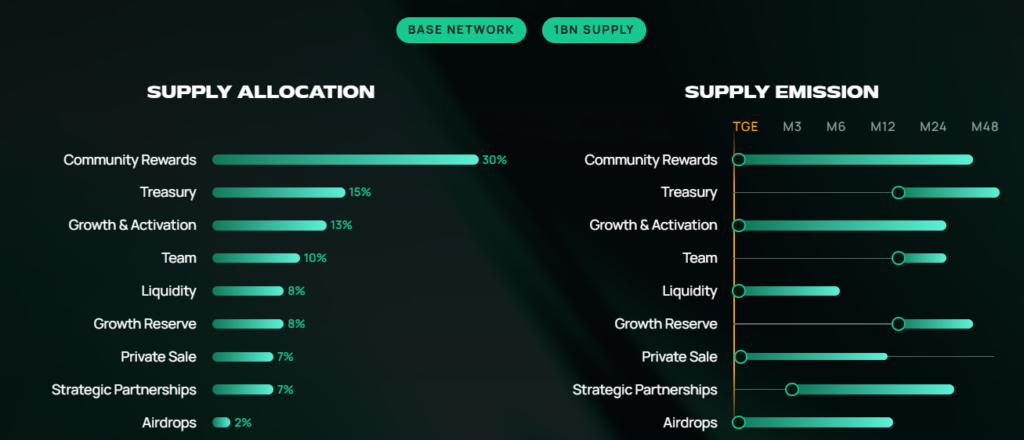
The total supply of MNTD is determined to be 1 billion tokens. In token allocation, 30% of the largest share is allocated to community rewards. The purpose is to reward players and users in the long term for contributing to the development of the ecosystem.
Under the allocation plan, 15% of supply will be allocated to the treasury, 13% for growth and user acquisition, 10% for team share, 8% for liquidity, 8% for growth reserves, 7% for private equity sales, 7% for strategic partnerships, and 2% for airdrop plans. Most tokens will enter circulation according to a specific unlocking schedule.
At the same time, the platform adopts a fixed supply model and aims to reduce the supply in circulation over time through a buy-back and destruction mechanism that uses ecosystem revenue.
 How do XP and airdrop systems work?
The experience value system is at the core of user interaction in the MINT ecosystem. Users who play games on the platform earn experience points through each activity, while users who invite friends can also earn additional points through the referral program. These points are key criteria for determining the ranking of the first season rankings.
The platform adopts a "play-invite-collect" mode. Users first accumulate experience points by playing games, then increase points through the invitation system, and after the token generation event, if they meet the requirements, they can apply for an MNTD airdrop. The platform said the allocation of airdrops will be based on the user's performance during the season.
In addition, the platform also has a daily check-in system. Users can win MNTD rewards by checking in through the app every day. Under the current event, the daily check-in reward is displayed as 10 MNTD, but the reward amount may gradually decrease over time based on the event stage. Specific details of how these rewards will be distributed after the token generation event are planned to be announced later.
What is on the roadmap?
MINT plans its development process into three main phases.
The goals for the first phase are: token generation events, centralized and decentralized exchange listings, first-season airdrop distribution, activation of seven different user identity levels, open pledge systems, and integration of platform rewards with MNTD.
The second phase of the plan includes: Season 2 airdrops, new exchange listings, trading competitions, migration of identity systems to the chain, and creation of the MINT Pass market. At the same time, it is also planned to develop a dynamic NFT-like MINT Pass structure.
Long-term plans include: third season airdrops, offline activities for advanced users, 3D avatar integration, in-game application scenarios, and new activities with partners.
Overall Conclusion
MINT was developed as a GameFi ecosystem designed to combine gaming experiences with a blockchain-based reward economy on the same platform. Through an experience system, pledge model, daily rewards and a community-centered token economy, it aims to extend user interaction into the long term.
The repurchase and destruction mechanisms, identity systems, season-based airdrops, and expanded MNTD token usage scenarios in the platform roadmap are all designed to provide more functional support to the ecosystem over time. As the development process progresses, how these plans are implemented and accepted by users will become key factors in determining the future of the project.
























