Exchange Ranking
 Top Exchanges
 24h Volume Ranking
 Popularity Ranking
 Exchange BTC Balance
 Proof of Reserves
 Decentralized Exchanges
 Funding Rate
 Funding Heatmap
 Liquidation Data
 Max Pain
 Long/Short Ratio
 Whale L/S Ratio
 Binance/Okex/Huobi L/S
 Bitfinex Margin L/S
 ETF Tracker
 Solana ETF
 XRP ETF
 Hong Kong ETF
 Bitcoin Treasuries
 Crypto Reversal
 Ethereum Reserves
 HyperLiquid Wallet Analysis
 Hyperliquid Whale Watch
 Large Transactions
 On-chain Movement
 Bitcoin ROI
 Stablecoin Market Cap
 Options Analysis
 News
 Articles
 Economic Calendar
 Features
 Wallet
 Contract Calculator


 Security
 Collections
 Watchlist
 Following
 BTC
 ETH
 SOL
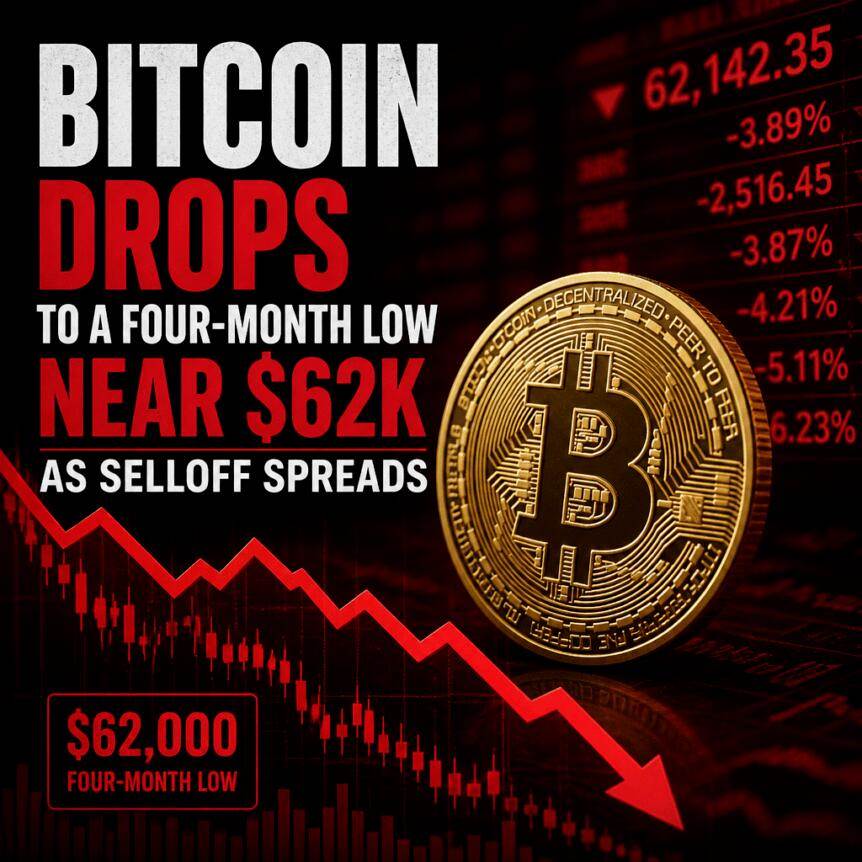
Bitcoin, down to four months low, nearly $62,000.
On Sunday, as the wider cryptocurrency market continued to sell, Bitcoin fell to a low point of nearly $62,000 for four months, driving down prices of several large coins. Although Bitcoin then recovered part of the fall and re-entered the $65,000 mark, the overall loss this week remained heavy.
According to CoinGecko, Bitcoin touches a low 24-hour point of $62,080.91 on Sundays, which is the weakest level since July. In spite of the rebound, the BTC has fallen by almost 15% over the past seven days.
Key points
- Bitcoin touched US$62,080.91 on Sunday, the lowest point since July, and then partially rebounded to over US$65,000.
- CoinGecko showed a general weakness of the main currencies, with ETH falling by 19.5 per cent and SOL falling by 20.7 per cent in the past week.
- According to CoinGecko, the total encryption market fell by about 4 per cent in 24 hours, to $2.26 trillion.
- Market sentiment has worsened: according to Alternative.me data, “encrypted fear and greed index” dropped from 13 on Saturdays and 20 on Fridays to 10 on Sundays (in the “extreme fear” zone).
- Financial flows to the United States of America's spot Bitcoin ETF have exacerbated market pressures, with a reported $2.35 billion net outflow for two weeks in a row.
Bitcoin, four months low, not very strong.
The fall of Bitcoin to the $62,000 area marks a new downside in the market, which CoinGecko points to as the BTC’s most vulnerable since July. The subsequent rebound suggests that the seller may have suspended its actions at lower prices, but the overall trend is still downward, given the depth of the decline this week.
For traders and fund managers, the key lesson is that the current recovery has not yet translated into a level that can stabilize market sentiment. As of the time of reporting, the BTC has fallen by almost 15% this week, and the decline on Sunday seems to have reinforced risk avoidance rather than reversed this trend.
Atcoin joins the downfall, both mobility and emotional weakness.
Sunday risk avoidance spread to other major networks. CoinGecko data show that ETH dropped by 19.5 per cent and SOL by 20.7 per cent this week, indicating that sales are widespread and not confined to single assets or narratives.
At the market level, CoinGecko reports that the total encrypted market fell by about 4 per cent in 24 hours, to $2.26 trillion. When such a general decline is accompanied by weak emotional indicators, it usually points to a tightening of liquidity – even for projects with a strong base, it is difficult to escape when capital exits at-risk assets.
Fear indicators are getting further into "extreme fear"
Emotional indicators have also worsened. Alternative.me’s “encrypted fear and greed index” dropped to 10 on Sundays, down from 13 on Saturdays and 20 on Fridays, and remains in “extreme fear” zones.
This is important because emotional indicators often reflect the degree of radicality that investors are willing to buy at a low level. When the index remains at a very low level for a long time, it may indicate that currency waiters are still waiting for clearer confirmation signals – whether from price stability, improved ETF flows, or changes in macro and liquidity conditions.
This decline was preceded by market pressures, including reports of a downfall of $70,000 on Friday, when the market had shown a weakening of investor sentiment and concerns about institutional capital outflows and tight liquidity.
Not Bitcoin ETF Emission Increased Pressure
An important part of the background of the bear market is the flow of funds to the United States of America's spot Bitcoin ETF. These funds reportedly recorded $2.35 billion net outflow for two weeks, which has been under constant pressure.
It was reported that, as of 13 November, ETF net outflowed $1.07 billion, compared to $1.28 billion in the previous week. In the same narrative, the outflow of iShares Bitcoin Trust Fund under BlackRock was extended to 11 trading days last Friday.
In practice, a continuous net outflow may weaken the instant buy-in at the most common BTC institutional access point. While ETF flows are not an isolated price-fixing factor, a sustained withdrawal pattern makes it more difficult for markets to absorb the pressure – especially at a time when the overall mood has deteriorated.
Follow-up focus
At a time when the BTC is at a low point in months and is in “extreme fear,” the next signs that investors may be concerned are whether ETF outflows continue or begin to stabilize, and whether the market can hold the rebound area back on Sunday. If the vulnerability increases again, the $62,000 area could be the focus of further downsliding; if the position is maintained, it could be the starting point for a more durable consolidation.