Exchange Ranking
 Top Exchanges
 24h Volume Ranking
 Popularity Ranking
 Exchange BTC Balance
 Proof of Reserves
 Decentralized Exchanges
 Funding Rate
 Funding Heatmap
 Liquidation Data
 Max Pain
 Long/Short Ratio
 Whale L/S Ratio
 Binance/Okex/Huobi L/S
 Bitfinex Margin L/S
 ETF Tracker
 Solana ETF
 XRP ETF
 Hong Kong ETF
 Bitcoin Treasuries
 Crypto Reversal
 Ethereum Reserves
 HyperLiquid Wallet Analysis
 Hyperliquid Whale Watch
 Large Transactions
 On-chain Movement
 Bitcoin ROI
 Stablecoin Market Cap
 Options Analysis
 News
 Articles
 Economic Calendar
 Features
 Wallet
 Contract Calculator


 Security
 Collections
 Watchlist
 Following
 BTC
Artificial intelligence alerts: the debt crisis could affect the encryption market
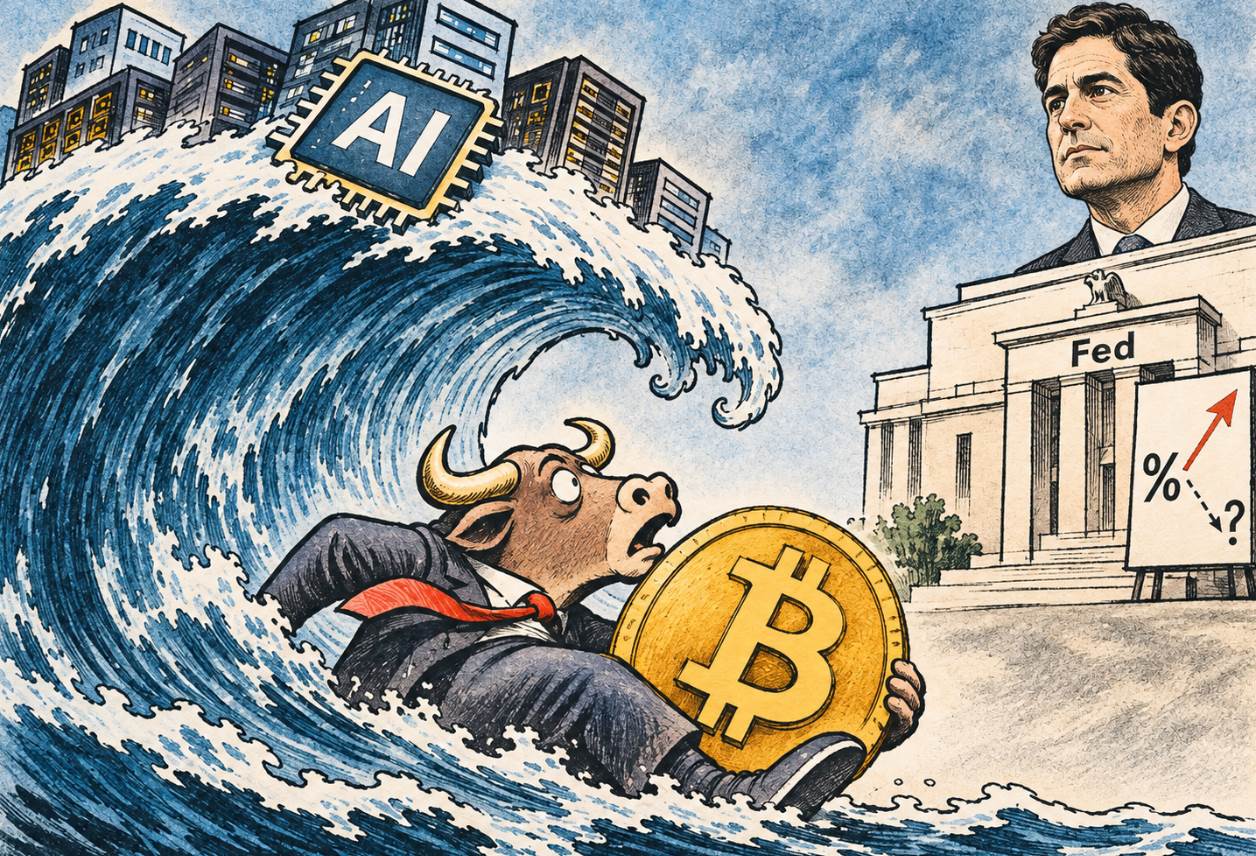
The AIS industry is flashing a warning light. The problem is not the technology itself, but the huge amount of money invested around the expectation that "AI will change the world." Enterprises buy expensive semi-conductors and build data centres by borrowing, but the time and the return on these investments are still uncertain.
Capital flows and asset linkages
Although AI and Bitcoin are different markets, there is a common denominator: when they are well-funded and investors are optimistic about the future, they tend to grow simultaneously. Large-scale capital flows into AI enterprises, while the cryptocurrency market attracts funds that expect higher prices. In periods of excess liquidity, potential problems are often hidden; once the funds are tightened, the situation reverses.
If the profits of AI fail to meet expectations, the consequences will be severe. Investors may avoid additional investment, and banks and financial institutions may reduce the size of their loans. Those that rely on borrowing expansion may be forced to sell their assets or reduce the size of their investments.
Risk of vulnerability in Bitcoin
Bitcoin has a very high liquidity as a 24-hour, uninterruptible asset. When investors need cash, they often sell it first, which is easy to realize. If the force of leverage investment is folded at this time, the price decline will be more intense.
The double-edged sword effect of interest rate policy
There is, of course, another possibility. Prices tend to stabilize as the investment boom in AI recedes, and if the US Federal Reserve (Fed) lowers interest rates, the cryptocurrency market may be open to opportunity.
However, not all rate cut are good. Proactive rate cut in a stable economic environment is quite different from the one that was forced into emergency rate cut as a result of the financial crisis. The former is a good market, while the latter may be a sign of serious economic problems.
Historical revelation and investment warning
Ultimately, the key is not whether the AI bubble has broken down, but whether debt can be resolved in an orderly manner, or whether it can become a systemic crisis as a result of a centralized divestment of financial institutions and investors. Investors need to focus not only on British share prices or Bitcoin prices, but also on macro signals such as the increased difficulty of corporate finance and the contraction of financial institutions’ credit.
The Internet did not disappear in 2000, but rather created a new generation of leading firms. The same is true of the AI area: while technology continues to improve, enterprises that cannot afford to pay their debts will end up out.
It is often not the bubble itself that destroys the market, but the moment when the capital that supports the bubble is out of hand. Trusting in the future of AI does not mean that all AI firms’ stocks will rise; believing that the future of Bitcoin will not mean that investment can be added blindly.
When the AI bubble breaks, it is not simply a fall in prices that Cryptocurrency investors should fear, but rather a chain reaction of financial institutions shrunk their loans and investors sold their assets to get cash. By then, even Bitcoin could collapse.