Exchange Ranking
 Top Exchanges
 24h Volume Ranking
 Popularity Ranking
 Exchange BTC Balance
 Proof of Reserves
 Decentralized Exchanges
 Funding Rate
 Funding Heatmap
 Liquidation Data
 Max Pain
 Long/Short Ratio
 Whale L/S Ratio
 Binance/Okex/Huobi L/S
 Bitfinex Margin L/S
 ETF Tracker
 Solana ETF
 XRP ETF
 Hong Kong ETF
 Bitcoin Treasuries
 Crypto Reversal
 Ethereum Reserves
 HyperLiquid Wallet Analysis
 Hyperliquid Whale Watch
 Large Transactions
 On-chain Movement
 Bitcoin ROI
 Stablecoin Market Cap
 Options Analysis
 News
 Articles
 Economic Calendar
 Features
 Wallet
 Contract Calculator


 Security
 Collections
 Watchlist
 Following
 BTC
 ETH
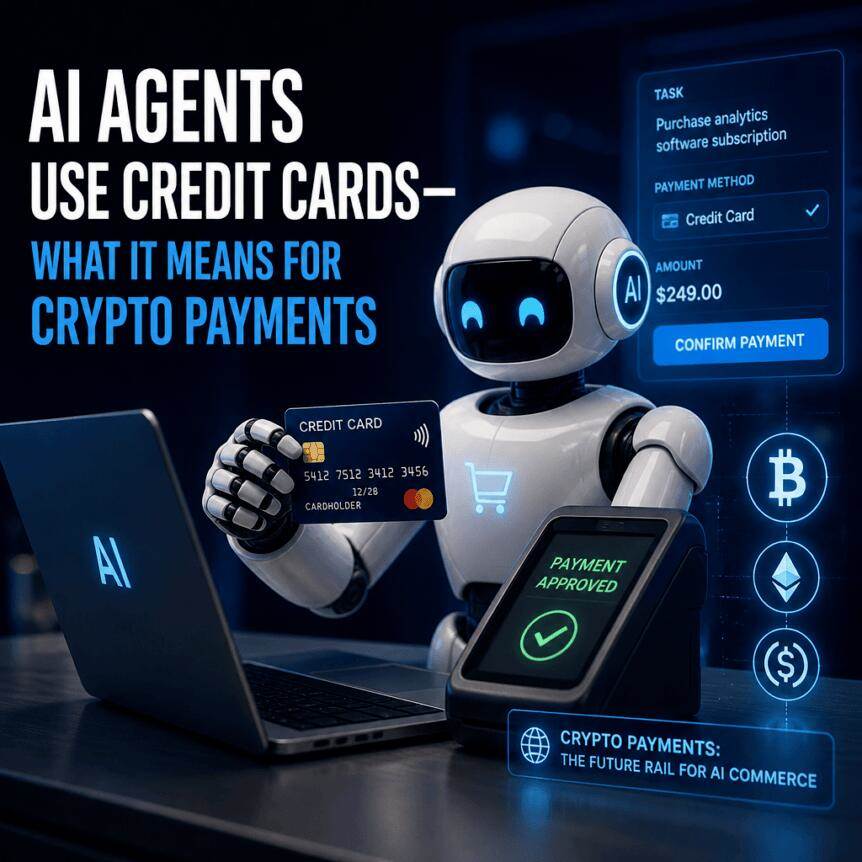
AI agent is moving from demonstration to daily business: credit card and stablecoin game
The AIS Agent is moving from a conceptual demonstration to a daily commercial application – they can not only book travel, reorder household goods, or even pay for data or calculate service costs on behalf of the user. A central question is, what payment route will drive this “agent economy”? Although many people in the cryptocurrency circle believe that payment is the inevitable way forward, recent reports and expert comments suggest that the answer is even more complex: credit cards still dominate in human-like transactions; and stablecoin may be better suited to high-frequency, low-value machine-to-machine activities.
Earlier this month, the Wall Street Journal reported that the AI robots had begun to use credit cards to buy on behalf of consumers, and that banks and pay providers were busy adapting to the shift. The story echoed a broader industry debate – whether the chain infrastructure of the encryption industry could be a default method for agency payments, or whether traditional providers would adjust and continue to control customer relationships.
Key points
- Credit cards are still the default selection:Credit cards may retain their default status when the surrogate purchaser has received goods or services through the card network, especially in cases involving non-payment and consumer protection.
- Areas of strength for stablecoin:The experts believe that stablecoin is more appropriate for the typical machine to make micropayments and high-frequency transactions in machine requests, such as obtaining data or computing resources.
- The accountability and dispute framework is a key point of difference:In addition to technology, the “responsibility and dispute” framework for dealing with agency errors appears to be a major competitive advantage for traditional finance.
- Synchronising "%s"The role of encryption may shift to the bottom-up facility - i.e., a chain settlement behind the scene, rather than a front-end market for agency payments.
- The future limits of full encryption:Even using stablecoin, the costs and frictions surrounding mobility, conversion and hosting may limit the simplicity of a fully encrypted future.
Why do credit cards still fit a lot of agency buys?
Card payments are the default for most network commerce, so it is not surprising that proxy workflows tend to take advantage of payment channels already supported by the business. A proxy booking of flights or reservation of hotel rooms is essentially a human-like transaction – usually in a business that has already received a credit card and has provided a familiar dispute solution mechanism.
Lewis Nurcombe, Chief Collector of WalletConnect, stressed the importance of this: consumer protection measures such as non-payment may remain in place when agents interact “in their personal capacity” with the business dealing with card payments.
Visa’s study on proxy commerce also points to the method of extending the payment provider’s ecosystem system without exposing the details of the payments made by the bottom cardholders. In principle, monetization and expenditure control allow agents to trade within the established boundaries.
In other words, for many mainstream examples, the path of least resistance is not a completely new payment layer, but a gradual adaptation in the existing card network and business processes.
stablecoin for micropayments: when the card economy fails
Many experts pointed out that once agents start paying for other machines, economic models change dramatically. In machine-to-machine scenarios, the amount of each transaction may be very small – for example, the cost of API calls, data queries, or single units of calculation is only a few cents. These transactions can be so frequent that fixed processing and transaction costs on traditional card channels are disproportionately expensive.
David Krause, Professor of Finance Studies, University of Marquette, described the problem as a mismatch between the design of a card channel and the payment of a particle size by the agent. He pointed out that the card system was designed for humans to choose to pay large sums of money that would absorb fixed costs.
Krause states that in this case, stablecoin may be more reasonable, because they are consistent with the micropayment model. Nurcombe similarly suggests that stablecoin is best suited to a scenario where “the amount of the transaction is too small, too high or too wide so that the card payment is no longer reasonable”.
A technical example discussed in the report is x402, described as an open, neutral Internet-based payment standard that allows services to request payments during an interactive process. This approach focuses on paying for access to specific resources rather than following the traditional process of closing accounts.
The Chief Executive Officer of Nevermined, Aitoor Argomaniz, provided a comparative statement: it was reported that the company had set the price of 100 API calls at 10 cents per trip, and noted that, owing to network restrictions, the traditional card infrastructure (through Stripe) could not handle fees below $0.50. The total cost of the 100 payments was estimated by Nevermined at approximately 10 cents by using Coinbase on the Base network.
However, the article also emphasizes that there is no friction. Even if the chain settlement reduces part of the cost, the stockcoin transaction may still involve infrastructure and operating costs, as well as costs associated with conversion, hosting and liquidity. The International Liquidation Bank (BIS) study also found that a stockcoin transfer could lead to transaction, conversion and cash withdrawal costs, and that limited mobility between the stockcoin and local currencies could add further obstacles.
Disputes, identification and who should be held responsible for agency errors
While the choice of payment routes is important, the more fundamental challenge for proxy finance may be accountability. Who is responsible if AI agents are wrong about goods, send payments to the wrong destination, or are manipulated to carry out unauthorized transactions?
Krause emphasizes that the decisive question is not just “encrypted or card” but how society will deal with proxy identity and attribution. He believes that the encryption industry has not yet fully built up the capacity for agent error dispute solution, and points out that when the agent successfully completed an erroneous purchase for the first time, responsibility for the outcome of the dispute must be borne.
One partial mitigation measure is to limit access by granting the agent an independent walklet funded by controlled funds. It is reported that WalletConnect is developing a method of allowing the proxy to operate the walklet, while retaining control over the rest of the funds.
But the limitation of the spending cap is also clear – they can reduce losses, but they cannot automatically resolve the question of who is responsible for unauthorized acts, wrong purchases, or losses resulting from exploitation. Krause points out that traditional payment systems have established mature relationships between customers, businesses, and regulation institutions, and have mature dispute solution processes.
From this perspective, the competitive advantage of traditional finance lies not only in the breadth of the business, but also in the transformation of payments into a legal and operational mechanism of trust.
Pipeline and Market Ownership: Encryption may be settled backstage
Encryption advocates who advocate the use of the chain still find resonance in at least one case: even if the card continues to be a user-oriented standard, payment networks can integrate stablecoin settlements in the back. The report suggests a possible result, namely, that the blockchain technology improves payment efficiency without forcing consumers to hold it directly or interact with cryptocurrence.
This vision recreates the problem of the capture of encryption values.
The article refers to the acquisition of BVNK, an infrastructure provider for steablecoin, which was completed by Mastercard in August. The deal can amount to up to $1.8 billion, giving the infrastructure to connect the card to the French currency and the chain. It does not mean that the cards will disappear, but that traditional channels may acquire the capacity to use the blockchain technology route and to settle transactions, which is particularly applicable when there is a profit — and may include examples of agency-to-agents-to-agents-to-services use.
If this path accelerates, agents can trade through a familiar interface, while the network is more flexible behind the scenes to process settlements.
For readers interested in subsequent developments, the key uncertainty is whether the proxy payment system will adopt a single channel in all transactions or will be divided by example – i.e., cards will be used for compatible commercial transactions, stationcoin will be used for machine-driven micropayments. In either case, the timetable adopted may be equally affected by the liability framework and the level of preparedness for disputes, not just technical capacity.