
 Exchange Ranking
 Top Exchanges
 24h Volume Ranking
 Popularity Ranking
 Exchange BTC Balance
 Proof of Reserves
 Decentralized Exchanges
 Funding Rate
 Funding Heatmap
 Liquidation Data
 Max Pain
 Long/Short Ratio
 Whale L/S Ratio
 Binance/Okex/Huobi L/S
 Bitfinex Margin L/S
 ETF Tracker
 Solana ETF
 XRP ETF
 Hong Kong ETF
 Bitcoin Treasuries
 Crypto Reversal
 Ethereum Reserves
 HyperLiquid Wallet Analysis
 Hyperliquid Whale Watch
 Large Transactions
 On-chain Movement
 Bitcoin ROI
 Stablecoin Market Cap
 Options Analysis
 News
News Articles
 Economic Calendar
 Features
 Wallet
 Contract Calculator


 Security
 Collections
 Watchlist
 Following
 ADA
ADA The Cardano hard fork has entered a critical chapter in the history of blockchain. The network successfully activated the Van Rossem upgrade through the first fully decentralized on-chain governance process. This milestone is more than just a routine software update. It demonstrates that the Cardano blockchain can evolve through community-approved decisions rather than relying on centralized development authority.
As the latest Cardano news continues to attract attention from the digital asset market, this upgrade also establishes a framework for future protocol improvements, while strengthening the network's long-term commitment to decentralized governance. 
Cardano hard fork introduces protocol version 11 through historic governance
Cardano hard fork officially activates protocol version 11 after being approved through its decentralized governance framework. Unlike previous network upgrades, this proposal was approved entirely through on-chain voting under Voltaire's governance model. This achievement makes Cardano one of the first mainstream blockchain ecosystems to be able to implement protocol changes without relying on centralized decision-making.
The latest version 11 of the Cardano protocol also confirms the increasingly mature governance of the Cardano chain, providing token holders with the role of directly shaping the future of blockchain technology, and at the same time setting a new benchmark for decentralized blockchain governance.
Van Rossem upgrade compared to earlier Cardano network upgrades
Early Cardano upgrades relied heavily on Input Output Global to coordinate network improvements before community adoption. The latest Cardano hard fork follows a different path, allowing governance representatives and stakeholders to directly approve proposals through decentralized voting. For anyone who asks "What is a Cardano Van Rossem hard fork", the answer goes beyond the technical improvement itself.
It represents a structural shift to community-led development, making the 2026 Cardano blockchain upgrade significantly different from previous milestones such as Alonzo, Vasil and Chang, as governance now plays an active role in the evolution of the protocol.
Cardano hard fork lays the foundation for Dijkstra era
In addition to protocol version 11, Cardano hard fork also lays the technical foundation for the upcoming Dijkstra era. The next stage of development is expected to introduce Ouroboros Leios, a throughput expansion architecture designed to increase transaction capacity without sacrificing decentralization, before the end of 2026. This roadmap puts scalability at the heart of the network's future strategy.
The latest July 2026 Cardano governance update also suggests that future protocol enhancements may continue to occur through decentralized voting, thereby enhancing confidence in Cardano's long-term innovation cycle and sustainable blockchain development. 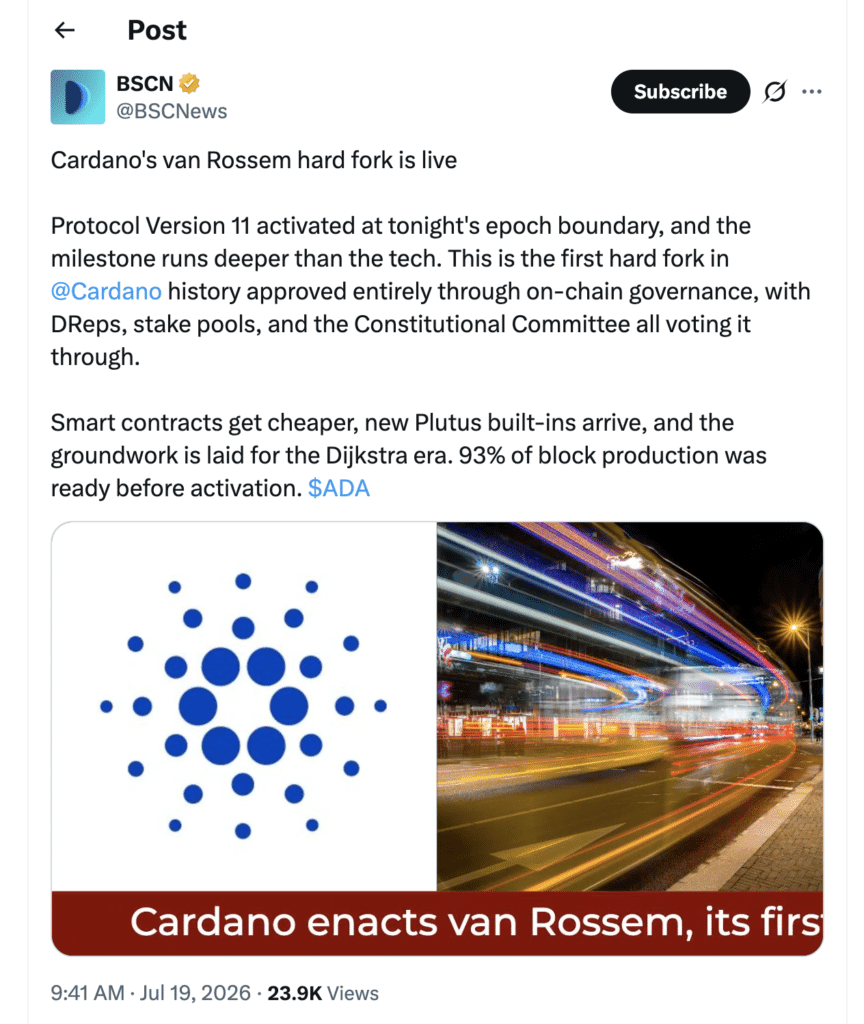 #
#
Community governance becomes new standard developed by Cardano
One of the most important results of the Cardano hard fork is the shift to community-led governance. Input Output Global is gradually withdrawing from node development responsibilities, while independent engineering teams take on a greater role in the ecosystem. This shift supports Cardano Voltaire's broader goal of governance, which is that decentralized contributors guide technological progress rather than a single organization.
The successful activation also highlights how Cardano activated the Van Rossem hard fork through collaborative governance rather than centralized execution, setting a governance precedent that may be closely watched by many blockchain projects. 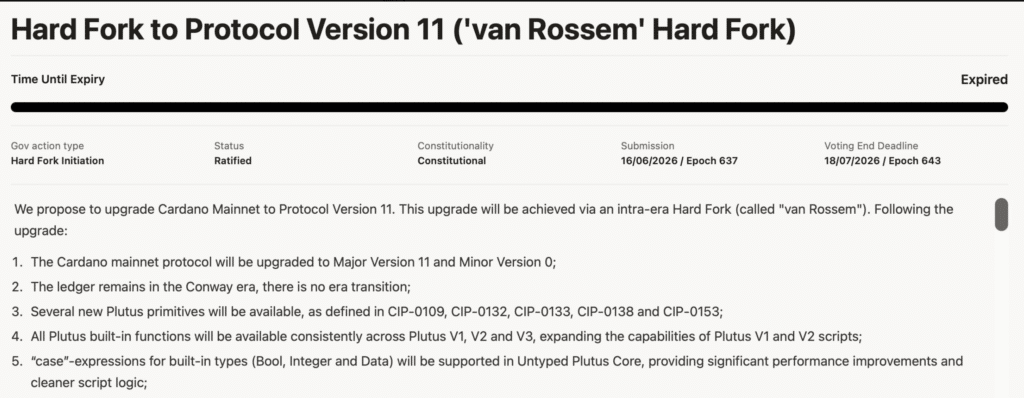 #
#
ADA price performance after Cardano's hard fork
Despite the amount of attention that governance progress has attracted, market participants continue to monitor ADA prices. Cardano is currently trading at around $0.161385, down 2.83% in the past 24 hours. Daily trading volume is close to US$204.77 million, and the network market value is approximately US$5.89 billion.
The circulation supply is 36.49 billion ADAs, with the maximum supply of 45 billion units. Although the immediate market response remains cautious, many analysts believe that ADA prices after Cardano's hard fork may depend on future adoption of scalability improvements and continued expansion of the ecosystem rather than short-term speculation.
Cardano (ADA) Price Overview
Current Price: $0.161385
24-hour Up and Down: -2.83%
24-hour Trading Volume: $204,769,413
Market Value: $5,888,373,029
Circulation Supply: 36,486,449,262 ADA
Maximum Supply: 45,000,000,000 ADA
Although the latest ADA price movements reflect recent market caution, a successful Cardano hard fork may improve investor sentiment over time as the network moves towards scalability upgrades in the Dijkstra era and into the future. Market participants may continue to focus on governance adoption, developer activity and ecosystem growth to assess Cardano's long-term trajectory. 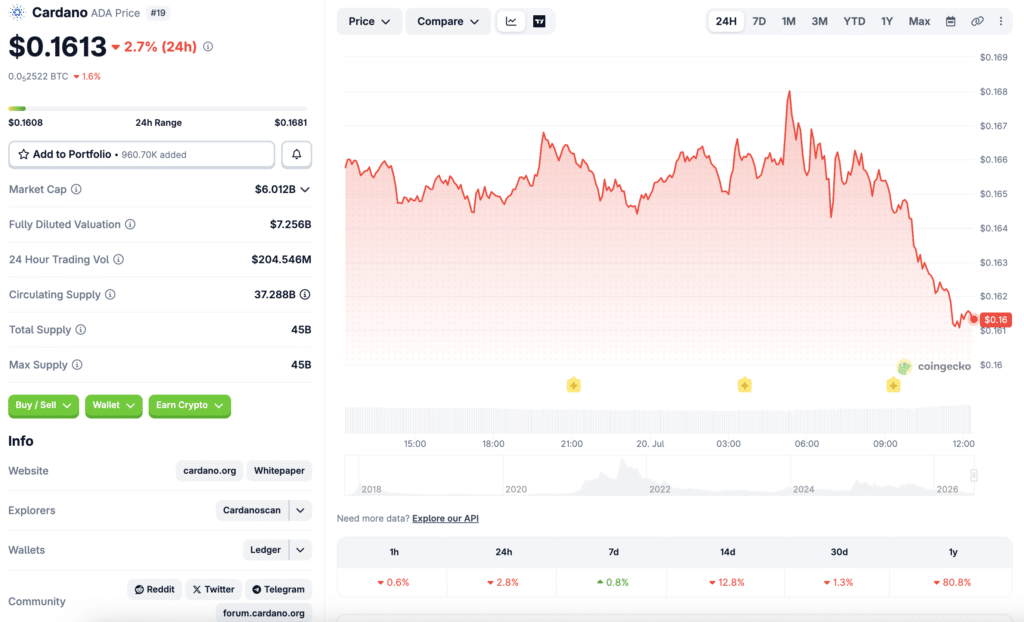 #
#
What this upgrade means for Cardano smart contracts and the broader ecosystem
The Cardano hard fork also enhances the technical capabilities that the network provides to developers building decentralized applications. The updated infrastructure under version 11 of the protocol supports future enhancements to Cardano smart contracts, governance tools and ecosystem scalability. The latest Cardano upgrade news indicates that the network is steadily moving from protocol maturity to wider adoption. [TAG
As developers prepare for the Dijkstra era and Ouroboros Leios, successful governance processes demonstrate that Cardano's long-term strategy combines technological innovation with decentralized engagement, an increasingly valuable combination in today's competitive blockchain industry.
Conclusion
Cardano hard fork represents one of the most significant blockchain milestones of 2026. Version 11 of the protocol not only introduces another software update, it validates Cardano's decentralized governance vision through the first full on-chain approval process. Combined with the transition to community-led development and preparation for the Dijkstra era, the network is well positioned for the next phase of development.
Investors, developers and blockchain observers should continue to focus on future governance proposals, ecosystem adoption and scalability initiatives as Cardano moves towards a more decentralized and technologically resilient future.
Appendix: Key Glossary
Cardano Hard Fork: A major network upgrade that introduces protocol level changes while maintaining blockchain continuity.
Van Rossem upgrade: The July 2026 Cardano network upgrade activates protocol version 11 through full on-chain governance.
Protocol version 11: The latest Cardano software protocol, introducing governance and infrastructure improvements.
Cardano On-Chain Governance: A decentralized governance system that allows stakeholders to approve protocol upgrades directly on the blockchain.
Voltaire Governance: Cardano's governance framework enables communities to make decentralized decision-making.
Ouroboros Leios: Cardano's planned throughput expansion protocol is designed to improve network performance.
Dijkstra Era: Van Rossem's next stage of development after the upgrade is expected to bring scalability improvements.
ADA: Cardano's native cryptocurrency, used for transactions, pledges and governance participation.
FAQs about Cardano hard forks
What is a Cardano hard fork?
The Cardano hard fork is a major protocol upgrade that introduces new blockchain capabilities while maintaining network compatibility.
Why is the Van Rossem upgrade important?
It is the first Cardano protocol upgrade approved entirely through decentralized on-chain governance.
What is protocol version 11?
Version 11 of the protocol is the latest version of Cardano software that enhances the governance infrastructure and prepares the network for future scalability upgrades.
Will a Cardano hard fork affect ADA holders?
Existing ADA holders do not need to redeem their tokens. The upgrade occurs at the protocol level and will not change the cryptocurrency itself.
What is Van Rossem after the upgrade?
The next major milestone is the Dijkstra era, which is expected to introduce Ouroboros Leios and significantly increase network throughput.
























