
 Exchange Ranking
 Top Exchanges
 24h Volume Ranking
 Popularity Ranking
 Exchange BTC Balance
 Proof of Reserves
 Decentralized Exchanges
 Funding Rate
 Funding Heatmap
 Liquidation Data
 Max Pain
 Long/Short Ratio
 Whale L/S Ratio
 Binance/Okex/Huobi L/S
 Bitfinex Margin L/S
 ETF Tracker
 Solana ETF
 XRP ETF
 Hong Kong ETF
 Bitcoin Treasuries
 Crypto Reversal
 Ethereum Reserves
 HyperLiquid Wallet Analysis
 Hyperliquid Whale Watch
 Large Transactions
 On-chain Movement
 Bitcoin ROI
 Stablecoin Market Cap
 Options Analysis
 News
News Articles
 Economic Calendar
 Features
 Wallet
 Contract Calculator


 Security
 Collections
 Watchlist
 Following
TLDR:
Contents
TLDR:
Ethics controversy tests bipartisan Senate support
Trump's cryptocurrency business exacerbates regulatory differences
The Clarity Act faces delays in passage in the Senate due to Democratic demands for stricter moral limits on the president's cryptocurrency profits and enforcement actions.
Republicans need the support of at least seven Democratic lawmakers, so bipartisan support is crucial before the digital assets bill is submitted to the president for signature.
Critics point out that the draft could allow Trump to retain indirect cryptocurrency interests while his children can continue to run independent digital asset businesses.
Factors such as stablecoin reward rules, bank deposit risks, use of campaign funds, and predicted market odds declines have combined to intensify this ethical controversy.
The Clarity Act faces new obstacles in the Senate, as the Donald Trump family's cryptocurrency interests fuel an ethics controversy. According to Bloomberg, Democrats hope to impose stricter restrictions on the digital assets bill before supporting it. They believe the current proposal could allow Trump and his relatives to continue to profit from the Memin and World Liberty Financial projects.
Republicans need the votes of at least seven Democratic lawmakers to pass the bill in the Senate. Negotiators now believe that in addition to consumer protection measures and illegal financial regulation, ethical rules are the core issue. The controversy lowered expectations that the bill would pass before the August recess and eroded market confidence that a deal would be reached this year.
Ethics controversy tests bipartisan Senate support
After months of delay, Senate Republicans this week released revised language for the bill in a bid to restart negotiations. Democrats and regulators rejected the proposal, saying its moral protection clause contained loopholes. Their concerns center on whether the Clarity Act can restrict the president from profiting from the regulated crypto market. 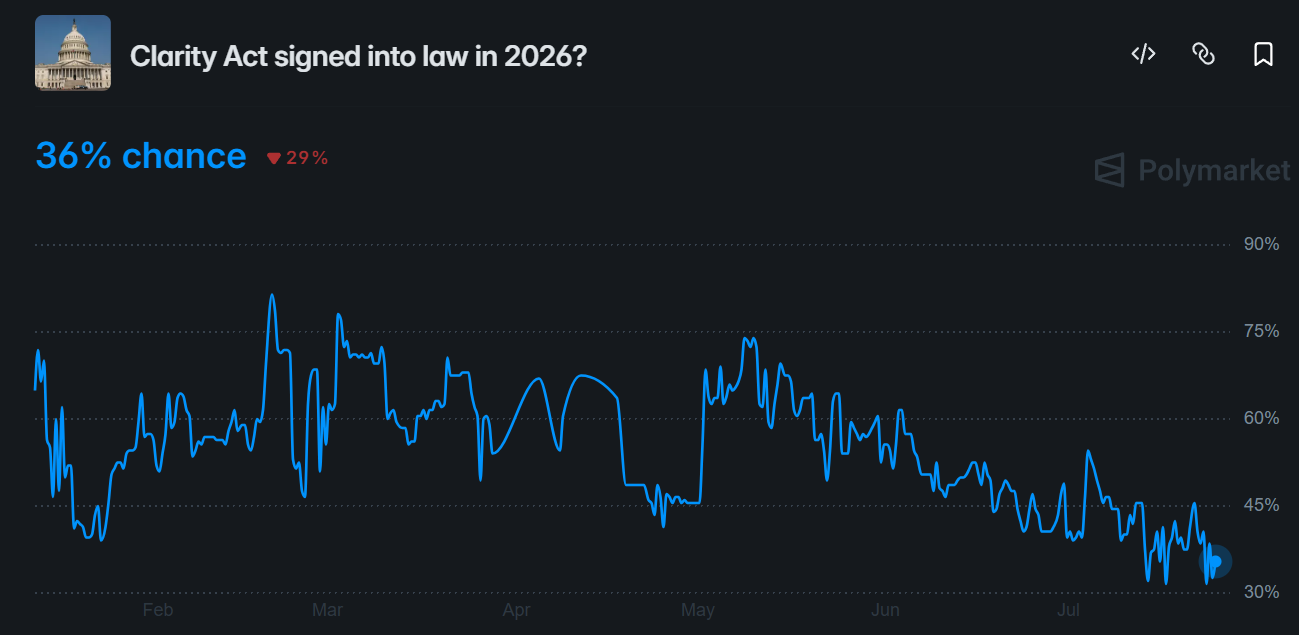
Probability of passage of the Clarity Act: Polymarket
The proposal allows Trump to divest his shares or place his assets in a confidential trust, but does not require a full sale. Critics have questioned the bill's language involving officials with direct interests in digital assets.
Trump holds exposure to World Liberty Financial through DT Marks DEFI LLC, which owns approximately 38% of the joint venture. Such a structure could complicate enforcement under the proposed standards.
The draft excludes children of government officials. As a result, Donald Trump Jr. and Eric Trump can continue their cryptocurrency business activities. The measure will also not recover revenue already generated through token and memin projects. Regulators believe the restrictions undermine the bill's ability to resolve existing conflicts of interest.
Democrats oppose giving primary enforcement power of new ethics rules to the Justice Department. The framework would prevent state attorneys general from serving as independent channels for law enforcement. Senator Angela Alsbrooks described ethics issues as the decisive issue in the negotiations. Senators Ruben Gallego and Tom Tillis are working on a possible compromise for the White House.
Time pressure is now a new factor. Senate Majority Leader John Thun expects the Clarity Act to fail before the August recess. Negotiators still need to agree on consumer protection and illegal financial measures. Without changes, Democrats could refuse to provide the key votes Republicans need to prevent the bill from passing quickly.
Trump's cryptocurrency business intensifies regulatory differences
Ethics issues are not the only obstacle facing the Clarification Act. Banks want stricter limits on stablecoin rewards, fearing that deposits could flow into profitable crypto accounts. Such a shift could weaken banks 'ability to lend and put pressure on banking profits. Tillis has discussed that if deposits fall significantly, the Federal Deposit Insurance Corporation or other regulatory agency should have circuit breaker powers.
Senator Cynthia Loomis opposed to this approach. She is one of the strongest Republican supporters of the digital assets bill. The disagreement shows how Trump's cryptocurrency business controversy is intertwined with debates over market structure and competition issues in the banking industry.
Critics have questioned a regulation that would end ethics rules on January 20, 2029. This date coincides with the inauguration day of Trump's successor. Opponents say the sunset clause could limit accountability after his term. Republicans believe the proposal sets stricter limits than previous presidents have accepted.
Political pressure may affect the negotiation process. Fairshake and its two affiliated super political action committees have raised $164 million for the midterm elections. Federal documents show they have spent $66.6 million. If negotiations fail, pro-cryptocurrency Democrats could face industry opposition, while progressives could attack any compromise.
Senator Chris Murphy urged Democrats to make cryptocurrency corruption a campaign issue. Other Democrats worry that rejecting the Clarification Act could prompt industry funding to turn against Senate candidates.
Forecast markets reflect this uncertainty. Traders at Polymarket put the probability of passage of the Clarification Act at about one-in-three. That level is about half the probability recorded on May 14 when the Senate committee supported an earlier version. Trump's cryptocurrency business controversy is currently the core factor leading to the decline in market expectations.
























