
 Exchange Ranking
 Top Exchanges
 24h Volume Ranking
 Popularity Ranking
 Exchange BTC Balance
 Proof of Reserves
 Decentralized Exchanges
 Funding Rate
 Funding Heatmap
 Liquidation Data
 Max Pain
 Long/Short Ratio
 Whale L/S Ratio
 Binance/Okex/Huobi L/S
 Bitfinex Margin L/S
 ETF Tracker
 Solana ETF
 XRP ETF
 Hong Kong ETF
 Bitcoin Treasuries
 Crypto Reversal
 Ethereum Reserves
 HyperLiquid Wallet Analysis
 Hyperliquid Whale Watch
 Large Transactions
 On-chain Movement
 Bitcoin ROI
 Stablecoin Market Cap
 Options Analysis
 News
News Articles
 Economic Calendar
 Features
 Wallet
 Contract Calculator


 Security
 Collections
 Watchlist
 Following
Key Insights
Pi Network completed the SLICE token distribution after 242,000 users invested 15.92 million Test-Pi.
PI prices remain near the support level of US$0.080 - 0.082, while resistance levels around US$0.095 limit the rebound.
Despite the new Launchpad feature, planned token unlocking still keeps supply pressure high.
As of the time of publication, Pi Network rose 1.5% to US$0.083 after the second beta network token release. For SLICE, Pioneer users will be able to view allocation records, token pricing, liquidity tools, and new tracking charts.
At the same time, CoinMarketCap data shows that Picoin prices are trading near the US$0.080 to US$0.082 support level, and planned token unlocks may increase supply. Therefore, the latest Picoin news presents a polarized situation. Ecosystem testing is still underway, but the market still needs stronger demand before it rebounds into a broader recovery.
However, the price targets and levels mentioned in this article are based on technical analysis and do not guarantee future performance. Investors should conduct their own due diligence or seek professional financial advice before making investment decisions because cryptocurrencies are highly volatile.
Pi Network completes SLICE distribution to pioneer users
Pi Launchpad distributed 10 million SLICE test tokens during the participation period that lasted from June 11 to June 28. More than 242,000 pioneer users invested 15.92 million Test-Pi in this process. The project used these results to test a simpler allocation system.
Users can now view personal assignments in the Pi browser. The interface also displays the issue price, effective price, liquidity pool access, and SLICE's performance relative to Test-Pi. These new features allow participants to track post-release activity within the Launchpad app.
SLICE tokens are associated with the third-party game "Slice of Pi". This connection allows Pi Network to study participation rewards through a practical application. The team stated that SLICE will always remain on the test network and will never be transferred to the main network.
This test follows the first Launchpad experiment, which attracted more than 478,000 participants. Feedback leads to a clearer commitment process and automated fair access holdings.
How does SLICE liquidity pool cultivate testnet marketing skills?
The SLICE token pool contains SLICE and Test-Pi. It uses automated market makers to adjust prices based on how users complete exchanges. Buying SLICE increases Test-Pi and decreases SLICE, while selling creates the opposite balance.
A constant product formula manages these reserve changes. The model keeps the product of the two reserves stable before deducting expenses. When one reserve falls, another must rise. This will cause the SLICE price displayed after each transaction to change.
Pi Network uses the system as a learning tool for decentralized finance. Pioneer users can see the impact of liquidity, demand and reserve balances on prices. The new chart makes these changes easier to track during testnet activity.
This update also provides usage data before any main-network token is released. However, SLICE tokens will not reduce the supply of Pi coins, nor will they create direct purchase demand for native assets. This limits its direct role as a price catalyst.
Pi network prices maintain support amid rising supply pressures
Pi coin prices briefly traded around US$0.083 after the announcement, but the four-hour structure remained bearish. Prices remain below the falling 200-cycle moving average near $0.159. Lower lows and lower highs define the medium-term trend.
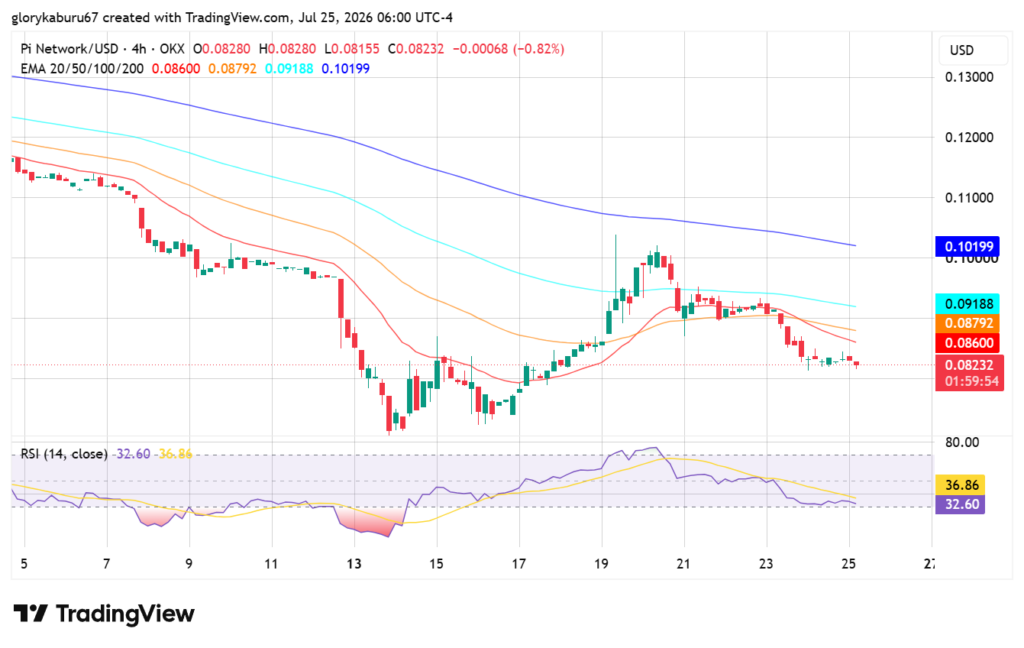
The first support range is between US$0.080 and US$0.082. A break below this zone could expose $0.070 to $0.073. TradingView data showed direct resistance around $0.090 to $0.095, followed by $0.100 to $0.105.
According to TradingView data, the four-hour RSI is about 32, which is below the neutral level of 50. A rebound above 45 could signal improving demand, while a drop below 30 could signal another round of selling before buyers return.
In current Pi-coin news, supply remains the main risk. PiScan data shows that approximately 127 million PI tokens are scheduled to be unlocked within 30 days. Broader estimates predict that more than 1.2 billion PIs will be released in 2026.
These tokens need to be absorbed in markets with low transaction volume. Reducing selling may help protect support. Before short-term structural improvement, stronger demand is needed and exceeds $0.095.
























