
 Exchange Ranking
 Top Exchanges
 24h Volume Ranking
 Popularity Ranking
 Exchange BTC Balance
 Proof of Reserves
 Decentralized Exchanges
 Funding Rate
 Funding Heatmap
 Liquidation Data
 Max Pain
 Long/Short Ratio
 Whale L/S Ratio
 Binance/Okex/Huobi L/S
 Bitfinex Margin L/S
 ETF Tracker
 Solana ETF
 XRP ETF
 Hong Kong ETF
 Bitcoin Treasuries
 Crypto Reversal
 Ethereum Reserves
 HyperLiquid Wallet Analysis
 Hyperliquid Whale Watch
 Large Transactions
 On-chain Movement
 Bitcoin ROI
 Stablecoin Market Cap
 Options Analysis
 News
News Articles
 Economic Calendar
 Features
 Wallet
 Contract Calculator


 Security
 Collections
 Watchlist
 Following
 AAVE
AAVE  ADA
ADA  AVAX
AVAX  BNB
BNB  BTC
BTC  CRV
CRV  ENA
ENA  ETH
ETH  FIL
FIL  HBAR
HBAR  LDO
LDO  NEAR
NEAR  ONDO
ONDO  SOL
SOL  SUI
SUI  TAO
TAO  UNI
UNI Key Insights
After Gray assigned BNB a leading fund weight of 30.6%, the BNB price remained at around US$592.
Ethereum and Solana followed closely, accounting for 29.47% and 29.15% respectively, while smaller positions fell significantly.
Gray reduces exposure to UNI and NEAR, although both still retain the largest fund weights.
After its second-quarter review, Gray listed BNB as the largest position in its smart contract funds, with the asset receiving a portfolio weight of 30.6%. Since then, BNB prices have approached $592 in Thursday trading. Ethereum followed closely with 29.47%, while Solana accounted for 29.15%. The adjustment gave BNB a narrow lead over these two competing assets.
However, the market reaction remained restrained. BNB fell during the trading session and remained below the $606 resistance level. This development enhanced BNB's institutional image, but did not immediately trigger a price breakthrough. Gray scale indicates that the announced distribution reflects the closing price as of August 3.
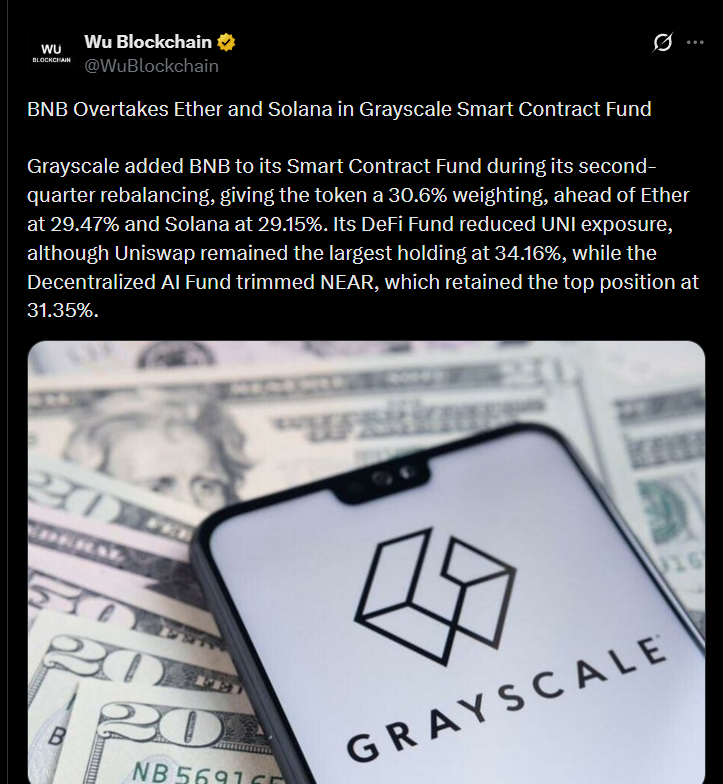 BNB tops the list among grayscale funds
BNB prices gain institutional attention after fund adjustments
Gray increased BNB's position by selling existing smart contract fund components at previous weights, and then used the proceeds to purchase new assets. The process follows the methodology of CoinDesk's smart contract platform for selecting cap indices.
BNB entered with a weight of 30.6%, immediately becoming the largest component of the fund. The weights of Ethereum and Solana are basically the same as the previous allocation. However, after joining BNB, the decline in smaller positions was more significant.
Cardano's weight dropped to 4.88% from 17.96% at the time of the first quarter review. Hedera dropped to 2.08%, and Avalanche dropped to 1.92%. Sui accounted for 1.9% of the updated portfolio.
This change reflects exponential rules rather than gray's direct predictions of the market. Component weights may change daily with token prices, and the official basket is also subject to quarterly review.
Smart contract funds and Gray's proposed spot BNB exchange-traded products remain independent of each other. For BNB prices, this inclusion has increased its visibility among investors tracking diversified crypto products.
BNB prices are steady near support, with sellers defending $606
BNB prices are trading around $592 after failing to break the 100-day simple moving average (approximately $606). Despite the gray scale announcement, the rejection of this resistance level brought new selling pressure. Trading activity was not enough to form a strong trend above resistance.
The token remains trading above the important moving average for a short time frame, which helps support recovering price movements. However, a lack of breakthrough momentum around $606 may keep BNB within a limited range. Buyers need to achieve a solid close above that level to improve momentum.
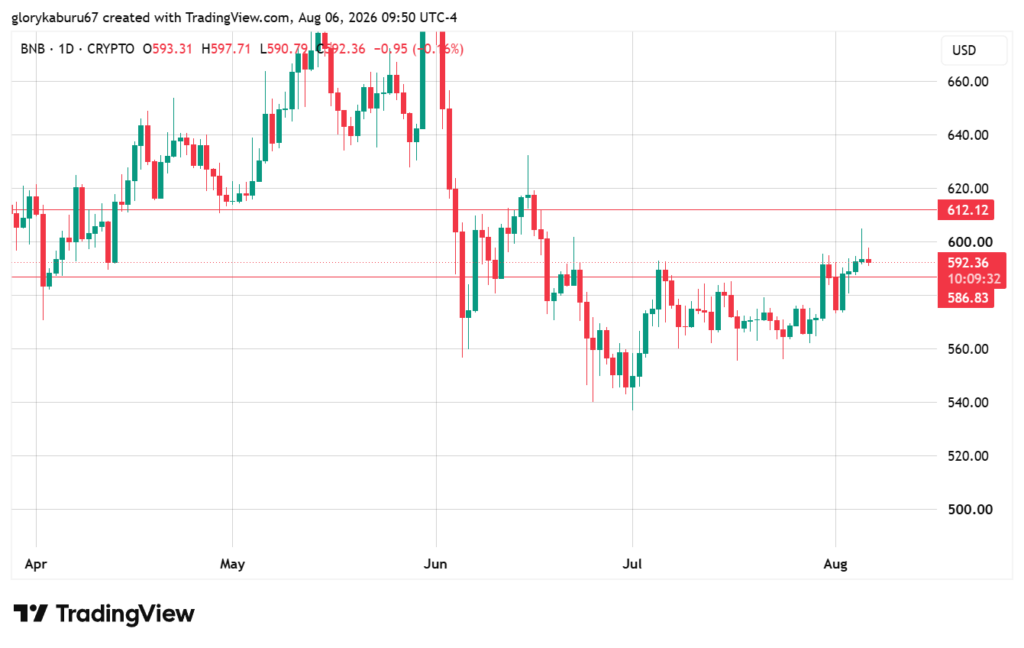 BNB Price Chart
Once a breakthrough is confirmed, it may expose the US$610 to US$612 region. On the other hand, losing $592 would weaken the recent breakthrough structure. According to technical indicators from TradingView data, the next support area is between $581 and $582.
During the same period, Bitcoin and BNB rose slightly and fell slightly respectively. This divergence is a positive signal for specific profit-taking of tokens rather than a sign of a decline in the overall market. BNB also recorded weekly gains before the pullback.
Therefore, BNB's price response reflects more chart resistance than negative fund signals. However, the trading levels and forecasts outlined in this article are analytical rather than guaranteed results. Investing in cryptocurrencies involves significant risks and may lead to financial losses.
Therefore, investors must conduct their own research or consult licensed experts before making digital asset investment decisions.
Gray adjusted DeFi and AI fund allocations in the second quarter
Gray also reduced its Uniswap exposure in DeFi funds. After adjustment, UNI still leads the basket with a weight of 34.16%. Ondo rose to 25.44%, up from 19.83% at the time of the previous quarter's review.
Aave holds 19.97%, Ethena holds 12.19%. Curve and Lido DAO completed their portfolios at 4.42% and 3.82% respectively.
Similar changes have occurred in decentralized AI funds. Gray sold some of its NEAR positions and reallocated the proceeds to existing components. NEAR still ranks first with 31.35% configuration.
Bittensor followed closely with 29.15%, and Render held 21.59%. Filecoin accounted for the remaining 17.91%. These four assets now constitute a complete AI fund basket.
Gray scale indicates that DeFi and smart contract funds do not generate income. Both funds pay for ongoing operating expenses by allocating ingredients. As a result, the amount of cryptocurrency represented per share will gradually decrease over time.
























