Exchange Ranking
 Top Exchanges
 24h Volume Ranking
 Popularity Ranking
 Exchange BTC Balance
 Proof of Reserves
 Decentralized Exchanges
 Funding Rate
 Funding Heatmap
 Liquidation Data
 Max Pain
 Long/Short Ratio
 Whale L/S Ratio
 Binance/Okex/Huobi L/S
 Bitfinex Margin L/S
 ETF Tracker
 Solana ETF
 XRP ETF
 Hong Kong ETF
 Bitcoin Treasuries
 Crypto Reversal
 Ethereum Reserves
 HyperLiquid Wallet Analysis
 Hyperliquid Whale Watch
 Large Transactions
 On-chain Movement
 Bitcoin ROI
 Stablecoin Market Cap
 Options Analysis
 News
 Articles
 Economic Calendar
 Features
 Wallet
 Contract Calculator


 Security
 Collections
 Watchlist
 Following
 BTC
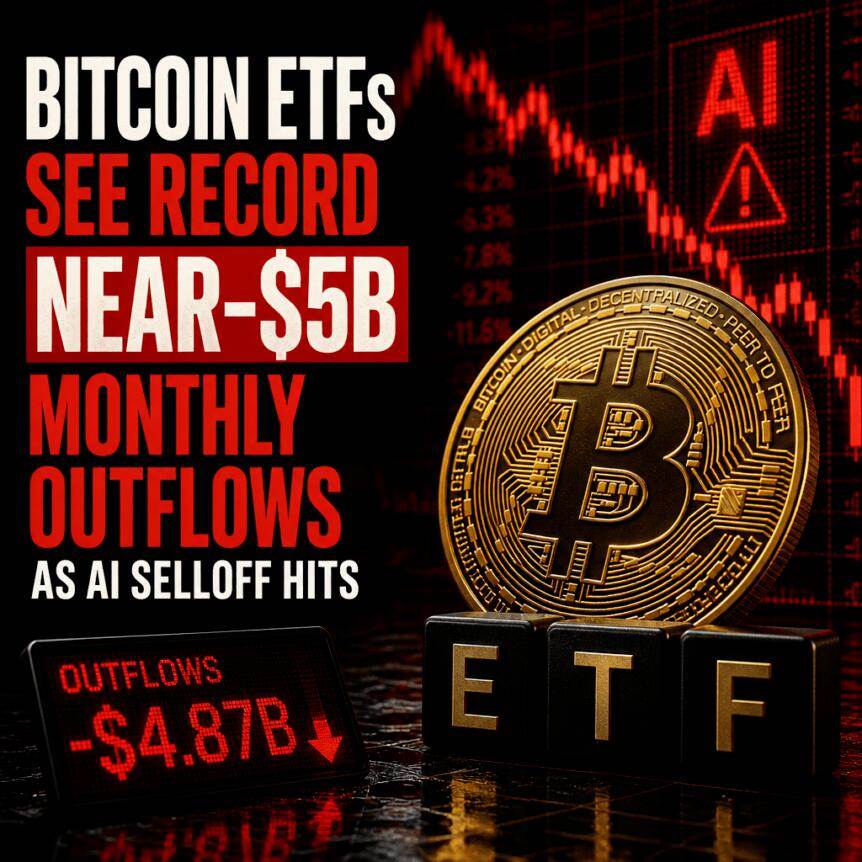
America's spot Bitcoin ETF is under pressure to renew: November is a record month for net outflow, and AI plate fluctuations and interest rates are expected to be key variables
With monthly foreclosures climbing to nearly $5 billion for the first time since January 2024, when a product started trading, the US-listed Pot Bitcoin Exchange Trading Fund (ETF) is showing pressure to renew. The latest daily data show a pattern of capital outflows, rather than a one-off decline.
According to SoSoValue, these funds recorded $231.6 million on Tuesdays, continuing the trend of outflows over six consecutive trading days. The total amount of the net amount in November was $4.94 billion, exceeding the $4.51 billion recorded in June.
Core elements
- SoSoValue data show that the US spot Bitcoin ETF recorded $231.6 million on Tuesday in net redemption, which allowed the outflow to continue on six trading days.
- The net ransom in November amounted to $4.94 billion, exceeding the monthly high of $4.51 billion created before June.
- The cumulative net outflow in 2026 was approximately $4.57 billion, eliminating part of the recovery achieved by the Fund in attracting $6.34 billion in funds in the third quarter.
- Troxx attributed the weak demand to higher interest rate expectations and the market vulnerability associated with the AI stock before December ' s Federal Reserve decision.
In November, we broke the flow record, and the redemptions got stronger.
The most immediate indicator is the scale and continuity of outflows. SoSoValue reports that the $231.6 million net outflow on Tuesday followed a series of ongoing foreclosures, which kept the net flow of multiple trading days negative. This phenomenon is significant, because the ETF outflows tend to presage the cautious attitude of investors that, when investors redeem their shares, even the broader cryptocurency mood remains intact, and the potential demand for spot Bitcoin exposures may diminish.
So SoSoValue reported a net redeeming of $4.94 billion in November, setting a new threshold for the category. This figure breaks previous monthly records – that is, the $4.51 billion outflows in June – and highlights the speed with which the mood around the market for these regulation products deteriorated earlier in 2026.
Change after three quarters of recovery
At the beginning of 2026, the spot Bitcoin ETF had successfully achieved a significant rebound in demand. The Fund reportedly attracted $6.34 billion in funding during the quarter.
In practice, this shift highlights the asymmetries that are common in ETF-driven markets: when risk preferences return, inflows can re-establish exposures; but when macro-conditions deteriorate or investors reduce the share of a single high-Beta asset class in the portfolio, outflows may quickly erase the progress that has been made before.
Terox points to interest rates and stock market pressure as being related to the AI plate.
In a November study, the digital asset investment company Teroxx attributed the fall in demand to rising interest rates and weak shares associated with artificial intelligence (AI). The company also noted that market participants were increasingly preparing for December ' s Federal Reserve might be another rate hike, a context that could have a negative impact on growth-sensitive stock baskets and speculative or long-term assets – and traditional investors usually classified Bitcoin as the latter.
Teroxx’s point of view (shared by comments to Cointelegraph) views ETF flows as a response to broader risk positioning, not just as a basic face of cryptocurrency. If investors are moving away from assets that are considered sensitive to higher discount rates, there may be continuous buy-backs even without a direct change in web usage or headline news from regrowing.
Rates of return and institutional readiness are key to the next step
As long as the artificial intelligence stock remains “searching the bottom” and December's decision-making nears nearer, Tyrox’s researcher Leonardo Larieira states that Bitcoin’s inflow may continue to be under pressure in the short term. His argument links ETF demand to two dynamic factors: the psychological orientation of the stock market and interest rates.
Larieira adds that a long-term recovery in Bitcoin ETF inflows requires stability in the rate of return on US Treasury debt. In his framework, once the return of institutional capital to high – or at least no longer destabilizing – yields ceases, there will be a more mature market environment than in August.
For investors and traders, the practical revelation is that the ETF flow path in the short term may depend more on whether macro-risk premiums cool, rather than on encrypted catalysts. The focus is on the direction of the national debt return rate, the expectations of the December meeting of Federal Reserve, and the stability of the weakness of the shares associated with AI — Larieira believes that these signals can directly influence allocation decisions.
It is uncertain whether the current round-up is a short pause or a long-term foreclosure period. Given that November has surpassed previous highs of outflows, and that the cumulative amount in 2026 effectively offsets the three-quarter rebound, market participants may focus on the next data release for ETF issuers, as well as on any expected change in interest rates that could change the flow narrative.