
 Exchange Ranking
 Top Exchanges
 24h Volume Ranking
 Popularity Ranking
 Exchange BTC Balance
 Proof of Reserves
 Decentralized Exchanges
 Funding Rate
 Funding Heatmap
 Liquidation Data
 Max Pain
 Long/Short Ratio
 Whale L/S Ratio
 Binance/Okex/Huobi L/S
 Bitfinex Margin L/S
 ETF Tracker
 Solana ETF
 XRP ETF
 Hong Kong ETF
 Bitcoin Treasuries
 Crypto Reversal
 Ethereum Reserves
 HyperLiquid Wallet Analysis
 Hyperliquid Whale Watch
 Large Transactions
 On-chain Movement
 Bitcoin ROI
 Stablecoin Market Cap
 Options Analysis
 News
News Articles
 Economic Calendar
 Features
 Wallet
 Contract Calculator


 Security
 Collections
 Watchlist
 Following
With the development of the blockchain ecosystem, the amount of data generated is also growing rapidly. However, how to store this data in a reliable, verifiable and long-term accessible way is becoming an increasingly important issue. In particular, artificial intelligence applications have begun to generate greater demand for on-chain data, making data infrastructure one of the most critical components of the Web3 ecosystem. Covalent (CXT) plays a role at this juncture, aiming to build a decentralized data infrastructure that standardizes, authenticates and makes multi-chain blockchain data available to developers through a single API. Covalent Network is not only a platform that collects data from different blockchains, but also focuses on providing Long-Term Data Availability, Data Verificability, and the reliable data infrastructure needed for artificial intelligence applications. As the native token of the ecosystem, CXT is at the heart of cybersecurity, pledges, governance and economic incentives.
What is the purpose of Covalent (CXT)?
Covalent is a decentralized data infrastructure that integrates data from different blockchains under unified standards, allowing developers to easily access this data. The platform indexes detailed data on multiple blockchains and makes it accessible through a single API. In this way, developers, companies and researchers can obtain comprehensive blockchain data through a single system without having to build separate data infrastructures for different networks. Covalent Network also operates as a decentralized protocol managed by the community. The core goal of the network is to ensure that blockchain data is accessed in a reliable, verifiable and sustainable manner over many years.
 How does Covalent work?
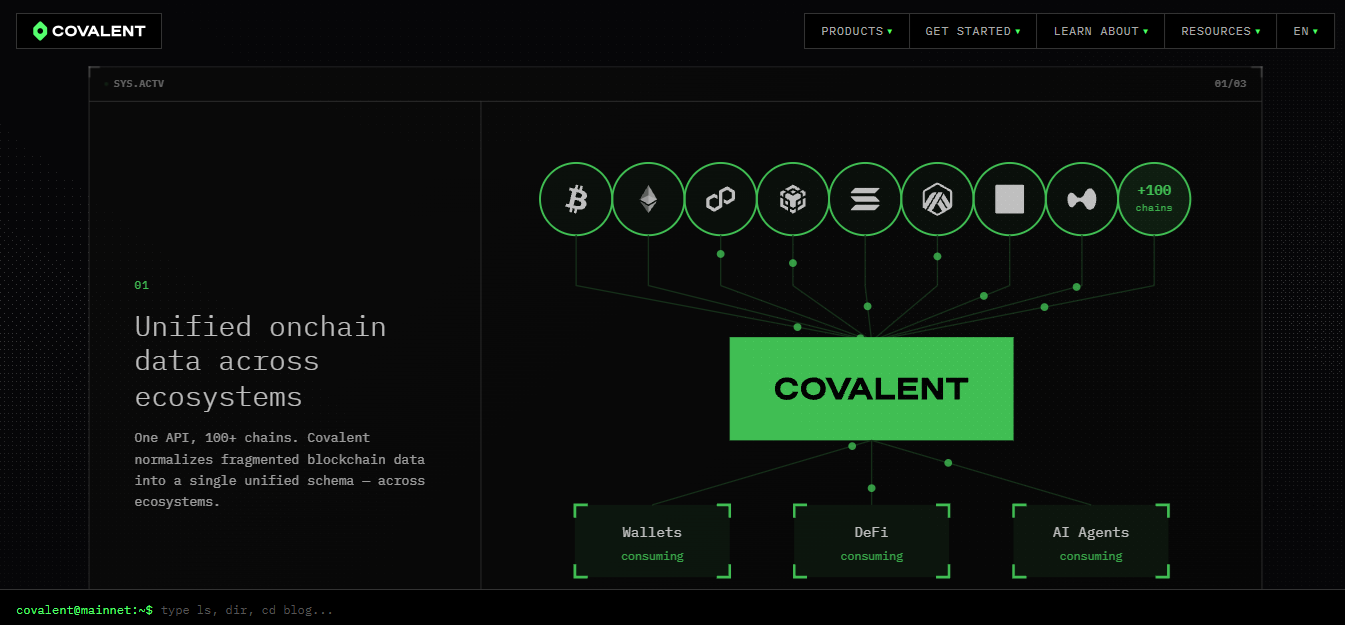
Covalent Network continues to collect data from the blockchain, index it, and store it at multiple nodes on the network. The collected data is then made available to developers through the GoldRush API (formerly the Unified API). Through this architecture, users can: access historical blockchain data, real-time network data, transaction records, smart contract information, and other detailed data on the chain-all through a single API. The goal of the platform is to standardize data access as much as possible, thereby simplifying interactions between different blockchains.
Long-Term Data Availability
One of Covalent's most important concerns is long-term data availability. The project defines long-term data availability as: historical data on the blockchain is still accessible many years later. With the popularity of the Rollup architecture in the Ethereum ecosystem and changes to protocols such as Danksharding and EIP-4444, the storage of historical data is gradually being moved out of the core protocol. Covalent Network takes on this responsibility and aims to give developers access not only to current data, but also to reliable access to historical blockchain records. To this end, the network is committed to building long-term data storage infrastructure for Ethereum, other Layer-1 networks, and different blockchain ecosystems.
 Data Verificability
One of the core features of the Covalent Network is data verifiability. Every data processing process performed on the platform is supported by cryptographic certification. Therefore, the correct operation of the network operator, the non-tampering of the data, and the reliability of processing information can be verified through cryptographic methods. This architecture is particularly important for artificial intelligence applications, because AI systems require verifiable data sources to produce reliable results.
Data Infrastructure for Artificial Intelligence
Covalent positions itself as a data infrastructure for artificial intelligence. As autonomous AI agents increasingly demand blockchain data, the project aims to support AI applications by providing structured data, verifiable data, real-time data, and multi-chain data access. The platform covers more than 230 blockchain data infrastructures and aims to provide sub-second latency data services for AI systems.
Modular Data Infrastructure
Covalent Network is built on a modular architecture. Through this architecture, the data layer and storage processes of the blockchain are separated. The Block Specens data format developed by the platform allows blockchain state to be stored in a standard form. In this way, operations such as processing data, reanalyzing data on the chain, and creating standard data patterns can be done in a more efficient manner without running network nodes.
 Multi-chain support
Covalent does not just serve a single blockchain. The platform provides a multi-chain data infrastructure through an architecture that supports multiple blockchains, standard data models, compatibility with commercial data tools, low hardware requirements, and an efficient storage system. This allows developers to manage the data collection process between different networks through a single system.
What is the GoldRush API?
The GoldRush API is the main API service on the Covalent Network for accessing indexed data. Formerly known as the Unified API, the system allows developers to quickly and standardize query blockchain data. Most data requests on the platform are completed through the GoldRush API.
What is the purpose of Covalent (CXT) tokens?
CXT is a native utility token for Covalent Network. The token is used in the three core areas that make up the network economy.
Network Governance
CXT holders can participate in the future decision-making process of the network. Within the scope of governance, proposals including new data sources, integrating new blockchains, pledge parameters, data modeling standards, and network updates will be voted on. The governance process is first discussed in a community forum, followed by voting without Gas fees through Snapshot, and the final result is reached. Voting rights are proportional to the number of CXTs held.
 Pledge and Cybersecurity
CXT is also the foundation of Cybersecurity. Network operators must pledge a certain amount of CXT to generate and verify data. If malicious or wrongful behavior is discovered, the pledged tokens may be partially reduced (Slashing). Users who are unwilling to run infrastructure can delegate CXT tokens to operators and receive pledge rewards.
The economic value generated by Internet use of
The GoldRush API and other Covalent data products revolves around CXT. A portion of the revenue generated by developers, companies and artificial intelligence applications that use the platform will be used to purchase CXT from the open market. The purchased tokens are then used to support the Strategic Reserve. This structure provides an economic model designed to drive growth in CXT demand as network usage increases.
Covalent (CXT) and the artificial intelligence economy
Covalent positions CXT as a core payment tool in the verifiable data economy. Every API query, data request initiated by AI agents, and new blockchain integrations contribute to the network economy. According to this idea, the goal is to form an economic cycle of "more use → more income → higher CXT demand".
 Covalent (CXT) Supply Structure
The total supply of CXT is 1 billion units. All tokens are created at network startup. The token economy is designed to not generate inflation. Although the Mint feature is included in smart contracts, it is disabled by default and can only be activated after a formal decision is made by community governance.
Covalent (CXT) Token Economics
CXT tokens are allocated as follows:
Private Equity (Private Sale): 20.4%
Ecosystem: 20%
Reserves: 18.9%
Team: 14.4%
Seed: 10%
Pledge: 8%
Open sales: 3.4%
Private Sale 2: 2.9%
Consultants: 2%
Total supply is limited to 1,000,000,000 CXT.
Covalent (CXT) Investors
Covalent has raised approximately US$10.69 million to date. Well-known funds and investment companies that have invested in this project include:
Tier 1: Coinbase Ventures, YZi Labs (formerly Binance Labs)
Tier 2: Hashed, 1kx, Mechanism Capital, Delphi Ventures, Hypersphere Ventures, Double Peak
Tier 3: Woodstock Fund, AU21 Capital, Moonrock Capital, TRGC, CoinGecko Ventures
Tier 4: RockTree Capital, CMCC Global, Avalanche VC, Brilliance Ventures
Tier 5: Morningstar Ventures
























