
 Exchange Ranking
 Top Exchanges
 24h Volume Ranking
 Popularity Ranking
 Exchange BTC Balance
 Proof of Reserves
 Decentralized Exchanges
 Funding Rate
 Funding Heatmap
 Liquidation Data
 Max Pain
 Long/Short Ratio
 Whale L/S Ratio
 Binance/Okex/Huobi L/S
 Bitfinex Margin L/S
 ETF Tracker
 Solana ETF
 XRP ETF
 Hong Kong ETF
 Bitcoin Treasuries
 Crypto Reversal
 Ethereum Reserves
 HyperLiquid Wallet Analysis
 Hyperliquid Whale Watch
 Large Transactions
 On-chain Movement
 Bitcoin ROI
 Stablecoin Market Cap
 Options Analysis
 News
News Articles
 Economic Calendar
 Features
 Wallet
 Contract Calculator


 Security
 Collections
 Watchlist
 Following
 APT
APT  BTC
BTC  ETH
ETH  SOL
SOL  SUI
SUI  TON
TON  TRX
TRX A Look at the Chains Leading 7-Day Activity
Blockchain activity has never really slowed down, but occasionally, snapshots of transaction data reveal the truth more clearly than usual.
In the past seven days, Solana has processed approximately 21.9 million transactions, putting it well ahead of all other networks on the list. Aptos and TRON are close behind, while Ethereum and Bitcoin, despite their size and long history, lag behind.
Here are the top chains ranked by transaction volume and what these numbers might tell us.
Solana leads the 7-day trading volume ranking
Solana leads the 7-day ranking with 21.9 million transactions, more than double the second-place Aptos (8.6 million transactions).
Solana is a first-level blockchain built for high throughput and low costs. It uses a mechanism called proof of history, combined with proof of stake, allowing it to process transactions faster than most competing networks. This design choice is a big reason why activities tend to be concentrated on Solana during peak periods of on-chain usage (whether trading, casting or application-based trading).
High transaction volume does not automatically mean that more real users or more economic value is flowing through the network. Activity may come from robots, automated transactions, or applications that generate large amounts of small transactions. Despite this, such a huge gap between first and second places cannot be ignored.
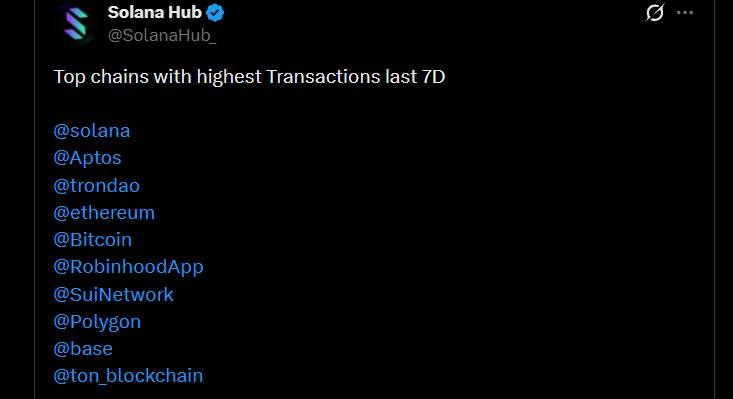
Top chains in the 7-day ranking
The following is a brief introduction of each chain in the ranking based on the same 7-day snapshot.
Solana -21.9 million transactions
Solana topped the list with 21.9 million transactions in 7 days. The network is known for its sub-second block times and fees that are usually less than 1 cent. Its ecosystem covers a large number of DeFi, NFT and Memecoin trading activities, which often drives its trading volume to levels well beyond many other chains.
Aptos -8.6 million transactions
Aptos ranked second with 8.6 million transactions. This is a first-level chain built by former Meta employees and uses the Move programming language. Aptos regularly sees extremely high daily trading volume peaks associated with specific app launches, so weekly totals change rapidly based on activity on the network.
TRON -7.5 million transactions
TRON ranks third with 7.5 million transactions. The network is known for being the backbone of large USDT transfers around the world, especially in markets where cheap, fast stablecoin transactions are crucial. This stablecoin flow is the main driver of TRON trading volume.
Ethereum-2.7 million transactions
Ethereum recorded 2.7 million transactions during the same time period. As the largest smart contract platform by total lock-in value, the Ethereum main network has lower transaction volume than some newer chains, in part because higher fees shift daily activities to second-tier networks such as Base and Arbitrum.
Bitcoin-2.6 million transactions
Bitcoin followed closely, with 2.6 million transactions. As the original blockchain, Bitcoin was designed to prioritize security and settlement rather than high throughput. Its transaction volume is naturally lower than those built for speed and capacity.
Robinhood -2.2 million transactions
Robinhood's network recorded 2.2 million transactions. Its inclusion alongside the mature first tier chain reflects the platform's move towards on-chain infrastructure, which is linked to its broader push for tokenized assets and cryptocurrency exchange products.
Sui -2.1 million transactions
Sui had 2.1 million transactions in 7 days. Sui is another first-level chain based on the Move language, designed around parallel transaction processing. Its trading volume tends to fluctuate with gaming and DeFi app activity on the web.
Polygon -1.4 million transactions
Polygon recorded 1.4 million transactions. Originally built as an Ethereum scale-up solution, the chain has now expanded to its own payment and business-related application ecosystem, which has shaped its transaction model.
Base -1.2 million transactions
Base recorded 1.2 million transactions. Built by Coinbase as the second-layer network of Ethereum, Base has grown rapidly since its launch, driven mainly by consumer applications, social tokens and trading activities.
TON -715,000 transactions
TON finished the list with 715,000 transactions. The network is closely connected to Telegram's user base, and its transaction activity often reflects the use of Telegram's integrated mini apps and wallets.
Solana's comparison with other top chains
Solana's 21.9 million transactions is more than 2.5 times that of Aptos (8.6 million transactions) and almost three times that of TRON (7.5 million transactions). Compared with Ethereum and Bitcoin, the gap is even wider-Solana handled approximately eight times the transaction volume of the two networks during this time period.
That being said, comparing Solana with Ethereum or Bitcoin based solely on transaction volume may be misleading. Ethereum's activity is spread across dozens of second-layer networks, so its mainnetwork data underestimates the total usage of the ecosystem. At the same time, Bitcoin was not designed to compete on transaction volume-its value proposition is based on security and scarcity, not throughput.
The comparison with Aptos and TRON is more straightforward because the competition among the three in terms of speed and low-cost transactions is clearer. Here, Solana's lead looks more meaningful.
Comparison of top chains by transaction volume in the past 7 days
Ranking| chain| Trading Volume (7 days)
1| Solana |21.9 million
2| Aptos |8.6 million
3| TRON |7.5 million
4| Ethereum| 2.7 million
5| Bitcoin| 2.6 million
6| Robinhood |2.2 million
7| Sui |2.1 million
8| Polygon |1.4 million
9| Base |1.2 million
10| TON |715,000
transaction volume reveals what information is about network activity
High transaction volume usually means that the network is experiencing a lot of on-chain activity, whether it comes from transactions, application use, or money transfers. This is a signal of block space needs.
But transaction volume alone is not a measure of network health. A chain can generate huge numbers due to a popular app, robot-driven trading strategy, or low-value junk transactions, and this does not reflect wider adoption. It also does not state the value of dollars flowing through the network, a very different indicator from raw transaction volume.
Therefore, it is best to view this ranking as a snapshot of activity rather than a final conclusion as to which blockchain wins.
What could change the trading volume rankings?
These rankings change frequently, sometimes even within days. The release of a new app, a hit game or a surge in stablecoin transfers can all lift a certain chain up several places.
For example, Aptos has previously experienced peaks in daily trading volume related to specific app launches, briefly allowing it to overtake Solana. TRON's data changes with stablecoin demand, which may fluctuate due to regional payment trends. Even for a small chain like TON, if a popular mini app becomes popular on Telegram, it may experience a sudden jump.
Because of this, a single seven-day window is only a starting point for comparison, rather than a fixed picture of each network's condition.
Final summary
Solana became the clear leader in this seven-day ranking with 21.9 million transactions, while Aptos and TRON were far behind. The trading volume of Ethereum and Bitcoin here is significantly lower, and the reason is related to their design rather than a decline in correlation.
Think of this ranking as a snapshot of network activity during a given week, rather than a judgment of which blockchain is superior or will perform better in the future.
























