Exchange Ranking
 Top Exchanges
 24h Volume Ranking
 Popularity Ranking
 Exchange BTC Balance
 Proof of Reserves
 Decentralized Exchanges
 Funding Rate
 Funding Heatmap
 Liquidation Data
 Max Pain
 Long/Short Ratio
 Whale L/S Ratio
 Binance/Okex/Huobi L/S
 Bitfinex Margin L/S
 ETF Tracker
 Solana ETF
 XRP ETF
 Hong Kong ETF
 Bitcoin Treasuries
 Crypto Reversal
 Ethereum Reserves
 HyperLiquid Wallet Analysis
 Hyperliquid Whale Watch
 Large Transactions
 On-chain Movement
 Bitcoin ROI
 Stablecoin Market Cap
 Options Analysis
 News
News Articles
 Economic Calendar
 Features
 Wallet
 Contract Calculator


 Security
 Collections
 Watchlist
 Following
 ETH
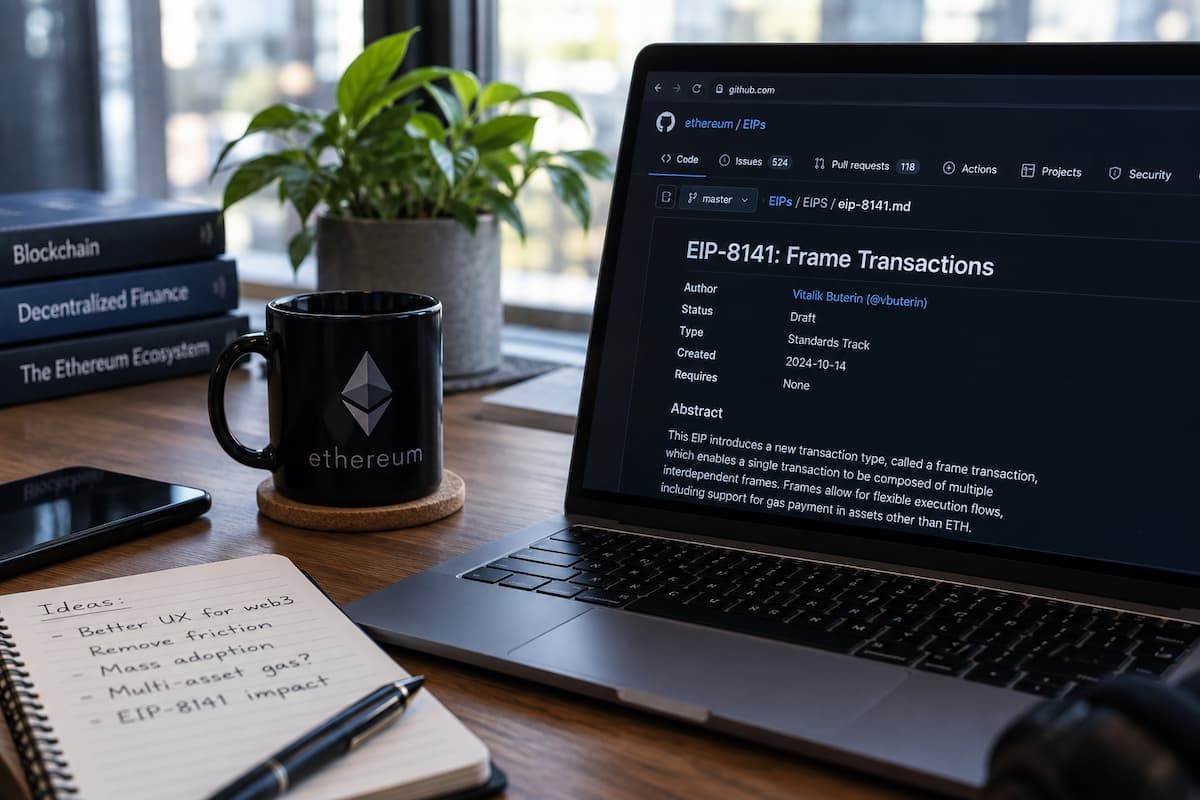
ETH EIP-8141: A new "frame transaction" proposal has been added to the Ethereum roadmap
EIP-8141, also known as the "Frame Transaction" proposal, has been officially included in Ethereum's future upgrade roadmap. The proposal allows a transaction to be split into multiple interconnected "frames", where a single frame can use non-ETH assets to pay Gas fees.
This change aims to address a specific pain point faced by new users: when conducting transactions denominated in other assets, users are forced to hold ETH to pay fees.
Technology core: Atomic multi-frame operation
Ethereum core developers have pushed EIP-8141 to the specification track, making it part of future network upgrades. The proposal solves a long-standing friction point: on the current Ethereum network, ETH is required to pay Gas fees for every transaction, even if the sole purpose of the transaction is to transfer stablecoins that have nothing to do with ETH. For example, users who only hold USDC cannot send the token directly unless they first obtain a small amount of ETH from elsewhere.
According to technical documentation maintained in Ethereum's official EIP repository, the core of the proposal introduces a new transaction type that is capable of packaging multiple associated operations (called "frames") into one atomic operation. In practice, one frame can process payments for stablecoins or other tokens, while another associated frame is responsible for covering Gas costs. Gas fees can be paid by third parties such as apps or sponsors or can be automatically converted from tokens held by users.
The entire transaction will only take effect if all frames in the transaction have been successfully executed. This mechanism ensures security and avoids risk scenarios where "payment succeeds but Gas coverage fails" or vice versa.
The difference between protocol level fixes and account abstraction
This is not the first attempt to solve the same problem. A number of account abstraction proposals proposed in recent years, including EIP-7702, have gradually weakened the requirement that "each wallet must only be able to pay for Gas with ETH, like a purely externally owned account (EOA)." However, the unique contribution of EIP-8141 is that it turns Gas sponsorship and multi-asset payments into native parts of transaction construction, rather than an additional workspace built through the smart contract wallet layer. This is the key difference between protocol-level repairs and temporary solutions.
The importance of the timeline goes beyond the code itself
Ethereum's most influential upgrades often take years, from proposal to mainnetwork activation, requiring multiple stages such as test network and client implementation. The lockdown of EIP-8141 in the specifications for future upgrades is an important milestone, meaning that the idea has passed a core board review that failed the vast majority of proposals. But this does not mean that the feature is about to go online.
The gap between "regulated" and "deployed" is where such proposals have historically been prone to stagnation or redesign. Therefore, the current objective assessment is that the direction has been set, but the friction it targets has not yet been truly eliminated.