Exchange Ranking
 Top Exchanges
 24h Volume Ranking
 Popularity Ranking
 Exchange BTC Balance
 Proof of Reserves
 Decentralized Exchanges
 Funding Rate
 Funding Heatmap
 Liquidation Data
 Max Pain
 Long/Short Ratio
 Whale L/S Ratio
 Binance/Okex/Huobi L/S
 Bitfinex Margin L/S
 ETF Tracker
 Solana ETF
 XRP ETF
 Hong Kong ETF
 Bitcoin Treasuries
 Crypto Reversal
 Ethereum Reserves
 HyperLiquid Wallet Analysis
 Hyperliquid Whale Watch
 Large Transactions
 On-chain Movement
 Bitcoin ROI
 Stablecoin Market Cap
 Options Analysis
 News
 Articles
 Economic Calendar
 Features
 Wallet
 Contract Calculator


 Security
 Collections
 Watchlist
 Following
What can developers build on Wire Network?
Imagine that one application charges a separate network fee every time it is used. On the conventional Internet, it sounds ridiculous; but in the blockchain field, it was considered normal. Wire Network was created to change the situation.
The Guide explores applications that are driven by Wire Network design, covering games, finance, and software that can perform operations on behalf of users. The following Wire Network uses examples from official documents and public project statements to demonstrate the possibility of their design being allowed, rather than a list of currently on-line applications.
Core elements
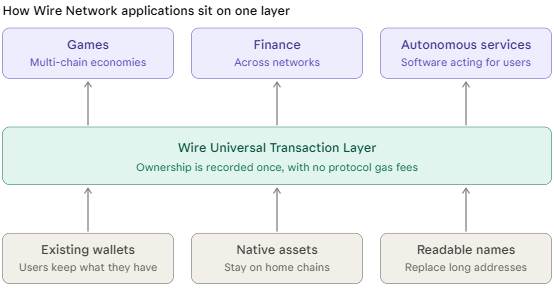
- Wire keeps the asset in place and only exchanges ownership, so an application can serve users on multiple chains.
- Play, finance and self-service are the three main areas highlighted by the team.
- Developers plan their own costs and applications can cover some of the users.
What's Wire Network?
WireNetwork runs its own Layer-1 blockchain. Above it is the General Trading Layer (Universal Transport Layer, UTL). The official document states that it allows all encrypted assets and Wallet to use smart regulation on a single blockchain. The transactions in UTL do not generate protocol-level Gas fees, so the user operates in a non-Gas-free environment. The external address format can be deciphered to readable names.
Why is the cross-chain application currently in a difficult situation?
Each chain has its own wallet, rules, and application. If a team wishes a user to cover three chains, it often needs to be developed three times.
One-time build, touch the chain.
Wire is designed to provide a single building space and a single settlement layer for the team to complete the transaction. Users enter with the existing Wallet and Wire addresses are derived from it. For teams that want to build on Wire Network, the focus is on a single level, not on multiple levels.
Apply process behind operation
The steps are very brief when the user is operating in the application. The asset has never moved and only the record of ownership has changed.
The drums provide support for ERC-20, ERC-721 and ERC-1155. This covers currency, collections and game props.
A game with a multi-chain economy
Imagine a game where the object is on one chain, the currency is on the other, and the player comes from the third. This is difficult to achieve today. Each side needs its own tools and a walklet. On UTL, the ownership of these assets can be traced in one place, while the asset itself remains intact. Players use their already-existing walklet to join, and the cross-chain game does not have to choose a “winner” between chains.
Cross-network finance
Financial applications face the same fragmentation. Borrowing or trading applications usually choose a chain, and their liquidity is limited to it. Users on other chains are excluded or pushed to the bridge, protocol. Wire design points to another path: cross-network activities are coordinated in one place, and ownership swaps replace packaging coins. Cross-chain financial applications can reach more users without requiring them to move assets first.
Autonomous services and AI agents
The third area is the software that provides human services. For example, billing, price monitoring, or automated services for the transfer of funds when conditions are met. Autonomous services require stable costs, clear identification and a single clearing house. Wire’s CEO describes UTL as the financial track of the AI proxy economy. He compared it to the AI global passport and common currency. AI proxy is an early idea of the network. The team does not claim that there is a finished product, but fixed rules and predictable costs are very suitable for self-functioning software.
Three short stories.
Here is a schematic of the design, not the real product.
Player:A game player opens a new title with her already existing Wallet. Her objects are in one chain, and the currency of the game is in another. The game reads ownership information from Wire, so she does not need to move any assets.
Dealer:A financial application shows users options from multiple networks. He exchanges ownership of assets and keeps them on the main chain. There are no steps to bridge, and there are no copies of them.
Services:A small program pays a monthly bill when it meets a specific rule. The application behind it bears the costs, so the user does not need to see any costs.
Developer freedom: control of costs
The team indicated that they wanted to give developers more control over the allocation of computing resources and the operation to pay for support. This included allowing applications to bear certain costs for users. This was a practical expression of the developers’ freedom.
These resources are allocated through the Resources Owners' Association.
The rules that shape every application
The document lists the development principles that apply to network applications.
These rules set the boundaries before the first line of code is prepared.
Wire Network ecology system: Where to start
The Wire Network eccentric system is open-sourced and documents point to ready-made tools.
Attention
The Wire Network applications described here show the possibility of their design being allowed. They are not today's applications. The team says they don't try to predict each application, but they want to give developers the freedom to create them.
You must confirm the details of the plan, the details of the tokens and the state of the network before the action is taken.
Concluding remarks
WireNetwork is betting on a clear idea that, if the asset remains in place and ownership changes, the application will no longer need to select a particular chain. This concept may be important in the three areas of play, finance, and self-service. For anyone who explores Wire Network applications, the best first step is to look at official documents.