Exchange Ranking
 Top Exchanges
 24h Volume Ranking
 Popularity Ranking
 Exchange BTC Balance
 Proof of Reserves
 Decentralized Exchanges
 Funding Rate
 Funding Heatmap
 Liquidation Data
 Max Pain
 Long/Short Ratio
 Whale L/S Ratio
 Binance/Okex/Huobi L/S
 Bitfinex Margin L/S
 ETF Tracker
 Solana ETF
 XRP ETF
 Hong Kong ETF
 Bitcoin Treasuries
 Crypto Reversal
 Ethereum Reserves
 HyperLiquid Wallet Analysis
 Hyperliquid Whale Watch
 Large Transactions
 On-chain Movement
 Bitcoin ROI
 Stablecoin Market Cap
 Options Analysis
 News
 Articles
 Economic Calendar
 Features
 Wallet
 Contract Calculator


 Security
 Collections
 Watchlist
 Following
 BTC
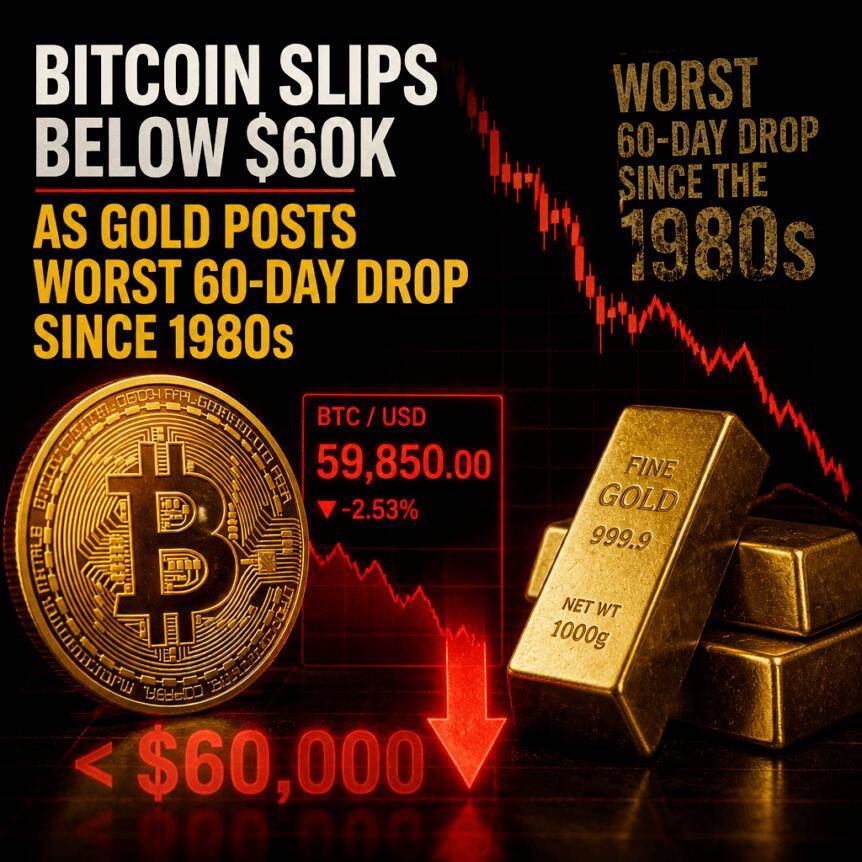
Bitcoin Falls $60,000: The rebounding effect of Inverda recedes, and the market liquidity narrative triggers a chain reaction
On Tuesday, Bitcoin’s prices fell below $60,000. On Monday, there was a wave of rebound, driven mainly by the broader risk sentiment triggered by Nvidia’s decision to reappoint CEO Wong.
TradingView data show that the BTC/USD transaction price on Bitstamp platform reached a minimum of $59,380 and fell by about 8 per cent from a high point of about $64,505 per week. CoinGlass reported that the total value of the cryptocurnce in the last 24 hours was $827 million, highlighting the rapid reversal of market sentiment as stock market activity subsided.
Key points
- Prices fell sharply:Bitcoin fell by nearly 8 per cent from a high of $64,505 on a single plate on a Monday, slipped to about $59,380 on Bitstamp, falling back under the $60,000 psychological threshold.
- Large-scale liquidation:The CoinGlass data show that the total value of encrypted assets within 24 hours is $827 million, of which long holdings total $348 million, short holdings total $478 million.
- Drivers of rebound:Monday's rebound was linked to the reinstatement of the CEO of Weidar, which boosted the technology unit and contributed to a 6.5 per cent increase in the NASDAQ index.
- Link analysis alert:Long-held Bitcoin holders are being sold at a loss, and this pattern may contain the subsequent increase in the rebound.
- Gold falls and liquidity accounts:The sharp decline in gold over the past two months has contributed to a broader “liquidity” narrative, placing pressure on multiple asset classes.
The Young Weidar-driven rebuff failed to maintain its height.
As previously reported, Huang’s reinstatement triggered not only a rebound in the encryption market, but also a rise in traditional markets when Wall Street opened. In the process, the price of the British stock was reported to have increased by up to 35%, while the NASDAQ aggregate price rose by 6.5%, reporting 24,089 points.
This rising risk bias continues to take place in Asian markets, and the optimism of artificial intelligence trading has contributed to the general rise. Korea’s KOSPI index rebounded by 6.3% after reaching its lowest closing price in 11 months.
Kobeissi Letter's analytical commentary warns that the wider AI is likely to face more volatile market conditions. The account post on platform X states that the “political headlines” related to the so-called “key CEO dispute” are cause for concern, while pointing out that broader AIS transactions are “healthy technical fixes.” The same post suggests that the latest trend seems more like the beginning of a revision rather than a long-term bear mark.
For traders, the key revelation is that Bitcoin’s rebound appears to have occurred in tandem with external catalysts (stocks and artificial intelligence sentiment), rather than driven by pure encryption-specific fundamental improvements. Once this linkage breaks, Bitcoin will be hard to sustain the increase.
Data on bilateral competition for $64,500
Prices are weakening rapidly. Citing TradingView, Tuesday BTC/USD prices were below $60,000, following Monday's surge that had stopped at about $64,505. The CorinGlass data on liquidation show the level of pressure on leverage positions during the inverted period: within 24 hours before 8 a.m. at UTC, $348 million long positions and $478 million short positions were lost.
The importance of these data is that they reflect not only the direction, but also the widespread use of leverage on both fronts, which leads to rapid deleverage. In practice, large-scale totals of liquidation usually coincide with the “repricing” phase, i.e., the removal of pre-cargo purchase orders and the active repositioning of traders.
While the Monday rebound pushed up prices, the Tuesday mixed inventory data suggest that the market creates uncertainty as to whether or not the higher prices will be stable and fast.
"Down with the domino effect."
The stock market-driven narrative also overlaps with the sharp swings in gold. Gold is reported to have risen by 1.6 per cent on Monday, after its daily collection prices reached their lowest level since September 2025.
According to the same background information, gold remains well below its early peak, about 35 per cent below its historic peak of $5,602 per ounce in January. According to one analyst, Lukas Kuemmerle, the liquidity events that started with the AI stock are “sipping out of every market” and leading to a decline in commodities, regardless of their basic aspect, as described in his article on Monday in Substack.
Although gold is not a direct rival of Bitcoin, the common denominator is capital rotation: when liquidity tightens or emotional changes, there may be a correlation sale between traditionally different assets. Investors interested in cross-asset signals usually observe whether Bitcoin behaves as an independent value-storage tool or continues to trade as a high-bita-value risk asset.
Long-term holders' losses may have suppressed subsequent increases
In addition to short-term transactions, the chain analysis points to a potential resistance to Bitcoin's rebound. A contributing analyst from CryptoQuant warned that long-term Bitcoin holders selling in a loss-loss situation may limit Bitcoin's response in a subsequent rebound attempt.
The data description indicates that when the BTC climbed to about US$ 64,500, the long-term holder (defined in the analysis as an entity holding the BTC for at least 155 days) lost an average of 33 per cent. The group ' s ratio of profit on the output of expenditure (SOPR) fell to 0.67, which had previously fallen to 0.64 on Friday, when CryptoQant analysed 0.64 as the second lowest reading in 2026.
The analysts also stressed that surrender is often a process, not a single data point. Such a framework is important for the interpretation of the next trend: even if the sales pressure reaches its peak, it may not immediately reverse a steady build-up phase.
In early November, Cointelegraph reported that new investors in Bitcoin accounted for most of the losses realized. This means that different groups of investors are under pressure at different times – and any recovery may therefore require improving the overall situation of both “new” and “long” groups, not just one.
As Bitcoin returns to critical levels, investors should observe whether the volume of liquidation cools, and whether the long-term holder SOPRs are stable or up – signals that the sale cycle is losing strength. Equally important is whether stock market volatility associated with artificial intelligence headlines continues to spill over to the encrypted market, or whether Bitcoin can be decoupled when traders re-evaluate risks.