Exchange Ranking
 Top Exchanges
 24h Volume Ranking
 Popularity Ranking
 Exchange BTC Balance
 Proof of Reserves
 Decentralized Exchanges
 Funding Rate
 Funding Heatmap
 Liquidation Data
 Max Pain
 Long/Short Ratio
 Whale L/S Ratio
 Binance/Okex/Huobi L/S
 Bitfinex Margin L/S
 ETF Tracker
 Solana ETF
 XRP ETF
 Hong Kong ETF
 Bitcoin Treasuries
 Crypto Reversal
 Ethereum Reserves
 HyperLiquid Wallet Analysis
 Hyperliquid Whale Watch
 Large Transactions
 On-chain Movement
 Bitcoin ROI
 Stablecoin Market Cap
 Options Analysis
 News
News Articles
 Economic Calendar
 Features
 Wallet
 Contract Calculator


 Security
 Collections
 Watchlist
 Following
 BTC
BTC Bitcoin News
BIP-110 has been in the form of a proposal for months. On August 9, it evolved into a chain fork.
Nodes running BIP-110 software began rejecting standard Bitcoin (BTC) blocks at a block height of 961,632 after miners Roughnecks, who used the Ocean mining pool, produced a replacement block. The main network continues to be built based on blocks dug out by AntPool, which do not carry BIP-110 signals. Today, there are two competing versions of Bitcoin at the height of this block. They share the same parent block, but contain different transactions.
Chain with minimal computing power
The problem faced by BIP-110 is simple: almost no one supports mining. In the two weeks before the fork, only 51 of the 2016 blocks carried the required version bit 4 signal, accounting for only 2.53%. The proposal originally set 55%(or 1109 blocks per cycle) as the activation threshold for non-mandatory forking. However, a small number of chains still enter the mandatory signal window without authorization, but lack the computing power needed to advance quickly.
As of 18:00 UTC on August 9, the main chain has reached a block height of 961,640. The BIP-110 chain only produced two blocks, remaining at 961,633. The gap between seven blocks in just a few hours is enough to show that there is almost no computing power behind the fork. Among the first nine new blocks in the main chain after the fork, none carries the BIP-110 signal.
For the BIP-110 rule to take effect, its chain must reach a block height of 963,648 to lock and 965,664 to activate. These restrictions will last for about a year and cover 52,416 blocks. With less than 3% of miners supporting it, the prospects for this path are slim. On August 1, developer Chris Guida wrote code based on a more radical alternative-proof-of-work changes originally drafted by Bitcoin Knots maintainer Luke Dashjr. Guida calls it an emergency option and does not set an activation date.
Technical controversy driving the proposal
BIP-110 was written by anonymous developer Dathon Ohm and targeted non-financial data stored on the blockchain. It will limit most new output scripts to 34 bytes, OP_RETURN output to 83 bytes, and limit certain data push and witness elements to 256 bytes. Several Taproot features will face temporary restrictions. The output of unspent transactions created before activation is not affected.
The controversy behind the proposal can be traced to Bitcoin Core's October 2025 version 30 update, which removed the software's default OP_RETURN output limit of 83 bytes. Proponents believe miners have included larger OP_RETURN transactions due to fees; critics say the move will attract spam and open the door to storing illegal content on the chain. In response, BIP-444 proposed in October 2025 to try to solve the problem through consensus mechanism rules rather than optional relay settings. BIP-110 is its successor.
Ocean CTO Luke Dashjr, who has been one of the most vocal supporters of BIP-110, believes that data storage places a burden on node operators and competes with the use of currency in block space. Strategy Executive Chairman Michael Saylor published a 110-point article in July 2026 arguing that consensus rules should address security threats rather than trying to define what transactions are effective.
Blockstream CEO Adam Back said the proposal risks dividing the network, and the issues it addresses do not require consensus-level fixes. In early 2026, a developer demonstrated this through practical cases: he embedded images into the blockchain without using OP_RETURN, Taproot, or OP_IF, directly challenging the core assumptions of BIP-110.
BIP-110 did not create new tradable assets. The future of a few chains depends on whether more miners start sending signals of support, and whether exchanges and wallets choose to recognize it.
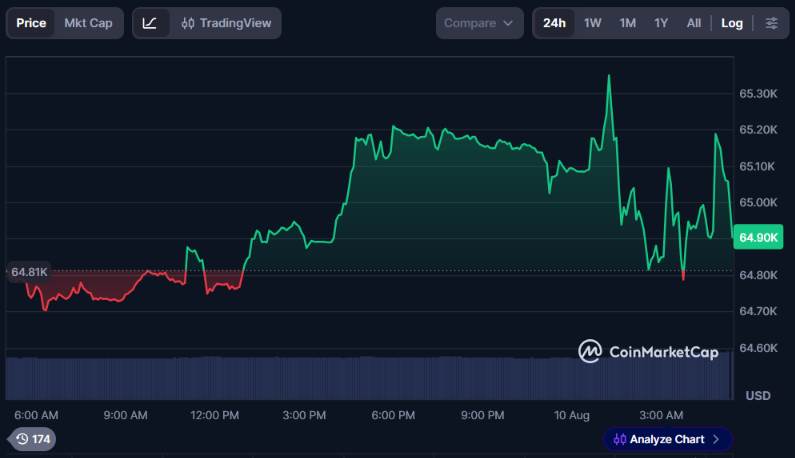
When the fork occurred, the trading price of BTC was close to US$65,000, and there was no clear price response.