Exchange Ranking
 Top Exchanges
 24h Volume Ranking
 Popularity Ranking
 Exchange BTC Balance
 Proof of Reserves
 Decentralized Exchanges
 Funding Rate
 Funding Heatmap
 Liquidation Data
 Max Pain
 Long/Short Ratio
 Whale L/S Ratio
 Binance/Okex/Huobi L/S
 Bitfinex Margin L/S
 ETF Tracker
 Solana ETF
 XRP ETF
 Hong Kong ETF
 Bitcoin Treasuries
 Crypto Reversal
 Ethereum Reserves
 HyperLiquid Wallet Analysis
 Hyperliquid Whale Watch
 Large Transactions
 On-chain Movement
 Bitcoin ROI
 Stablecoin Market Cap
 Options Analysis
 News
News Articles
 Economic Calendar
 Features
 Wallet
 Contract Calculator


 Security
 Collections
 Watchlist
 Following
Thailand's Securities and Exchange Commission proposes new rules for stablecoin transfers: Ban transfers to other people's wallets
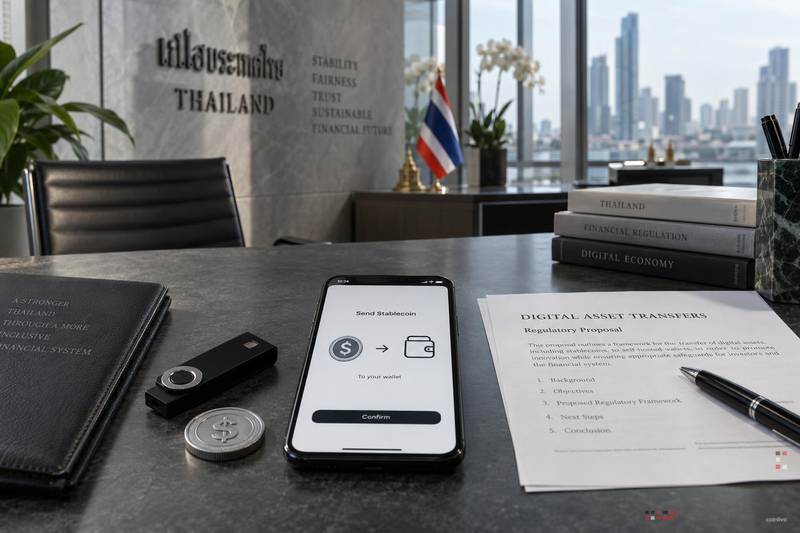
Thailand's Securities and Exchange Commission (SEC) is proposing a new rule that would prohibit licensed cryptocurrency companies from making stablecoin transfers to wallet addresses other than customers. At present, the proposal has not yet taken effect and is still in the stage of public solicitation. The final regulations may still change before they are officially promulgated.
Core Points
- Thailand's Securities and Exchange Commission has only proposed restrictions and has not yet implemented enforcement.
- This regulation mainly covers transfers of stablecoins to other people's wallet addresses.
- Regulated objects are licensed cryptocurrency companies supervised by regulatory agencies.
Thailand's Securities and Exchange Commission's Specific Proposal for stablecoin transfers
The regulatory body promoting this initiative is the Thailand's Securities and Exchange Commission, which oversees the country's licensed digital asset business. Regulators have approved the principles of the plan on September 3, 2026, and have since been open to public comment. A stablecoin is a cryptocurrency designed to maintain value stability and is usually pegged to currencies such as the U.S. dollar. According to the proposal, deposit sending wallets and withdrawal receiving wallets must belong to the same customer, and transfers to or from other people's wallets are clearly prohibited.
It needs to be emphasized that this is a proposal, not a rule that has already entered into force. The Securities and Exchange Commission opened public consultation on September 11, 2026 and accepted opinions as of September 25, 2026. The proposal is similar in spirit to the previous Thailand crypto "Travel Rule", but is a separate measure.
The Securities and Exchange Commission also proposed setting a cap on the daily transfer amount of stablecoins. The daily limit for deposit transfers per person at each licensed operator is 5 million baht, and a separate daily cap of 5 million baht applies to withdrawal transfers.
Proposed daily caps for stablecoin transfers:
·Deposit/withdrawal caps: 5 million baht each
·Daily limits are calculated separately per person and per licensed digital asset operator.
·Maximum value of specific transfer exemptions; these exemptions do not exempt individual customer ownership requirements.
·Proposal only; no effective date has been determined.
Source: Thailand Securities and Exchange Commission, September 3, 2026
The transfer value must also match the source of income and financial status declared by the customer. The Securities and Exchange Commission said the move was based on observations of strong growth in stablecoin activity, particularly the TEDA USDT, and trading patterns related to money laundering and cybercrime risks.
Transfer types and company scope involved in the proposal
The rule targets licensed cryptocurrency companies known as "digital asset business operators" and not all cryptocurrency users in Thailand . This is not a nationwide ban on holding or using stablecoins.
Wallet ownership is at the heart of the plan. The idea is simple: Money moved through regulated companies should start with the wallet you own and end with the wallet you own, not someone else's. This directly restricts the sending of stablecoins to others through these companies.
The information provided does not fully detail how transfers to customers 'own external wallets will be handled in all cases. It stated that ownership check requirements must be met, but did not elaborate on the specific verification steps the company would use.
Some transfers are exempt from the value limit. According to the Securities and Exchange Commission, these exemptions include transfers of certain carrier transactions, operators authorized by the Central Bank of Thailand , and transfers of qualified stablecoins against Thai baht market makers. Importantly, these exemptions only involve value ceilings and do not explicitly exempt individual ownership requirements.
The scope of this consultation goes beyond the wallet itself. The proposal also sets a minimum over-the-counter trading value of 3 million baht for brokers and dealers, requires the publication of trading prices, and prohibits over-the-counter trading between clients arranged by brokers. In addition, brokers will be prevented from using liquidity providers to trade stablecoins against Thai baht. This is in line with broader tightening measures and echoes previous actions by Thailand against high-value USDT transactions.
Outstanding matters regarding the proposed restrictions
Several key details have not yet been determined. The information provided does not indicate the effective date of the stablecoin restrictions, so the timing of any launch is unclear. Another established "travel rule" will take effect on February 27, 2027, but this is the date of the "travel rule" and not these proposed stablecoin restrictions, and the two should not be confused.
How the company conducts wallet ownership checks and exactly what needs to be verified remain open issues rather than announced measures. The final scope and any other exceptions may change during the comment call period.
The impact of sending stablecoins to others through a licensed company depends on whether the rule is adopted and its final terms. There is currently no content confirming penalties, circumvention methods or opinions on the next steps after closing. This is also different from Thailand 's parallel rule work on retail Bitcoin and Ethereum ETF, which targets different parts of the market.
For ordinary crypto holders, the practical lesson is straightforward: if the rules are adopted, sending stablecoins to friends or third-party wallets through the Thailand licensed exchange will be restricted, and large daily transfers will face caps. However, until the Securities and Exchange Commission finalizes the rules, these are only proposals under review, not requirements that must be complied with today.
Disclaimer : This article is for reference only and does not constitute financial or investment advice. There are significant risks in the cryptocurrency and digital asset markets. Be sure to conduct independent research before making a decision.