Exchange Ranking
 Top Exchanges
 24h Volume Ranking
 Popularity Ranking
 Exchange BTC Balance
 Proof of Reserves
 Decentralized Exchanges
 Funding Rate
 Funding Heatmap
 Liquidation Data
 Max Pain
 Long/Short Ratio
 Whale L/S Ratio
 Binance/Okex/Huobi L/S
 Bitfinex Margin L/S
 ETF Tracker
 Solana ETF
 XRP ETF
 Hong Kong ETF
 Bitcoin Treasuries
 Crypto Reversal
 Ethereum Reserves
 HyperLiquid Wallet Analysis
 Hyperliquid Whale Watch
 Large Transactions
 On-chain Movement
 Bitcoin ROI
 Stablecoin Market Cap
 Options Analysis
 News
 Articles
 Economic Calendar
 Features
 Wallet
 Contract Calculator


 Security
 Collections
 Watchlist
 Following
 LINK
Dinlink and Swiss Bank move $2 trillion into the market
Chainlink works with the Swiss Bank (UBS) to build a blockchain solution, which aims to move structural instruments to blockchain. Chainlink describes the project as a major production milestone in the monetized capital market.
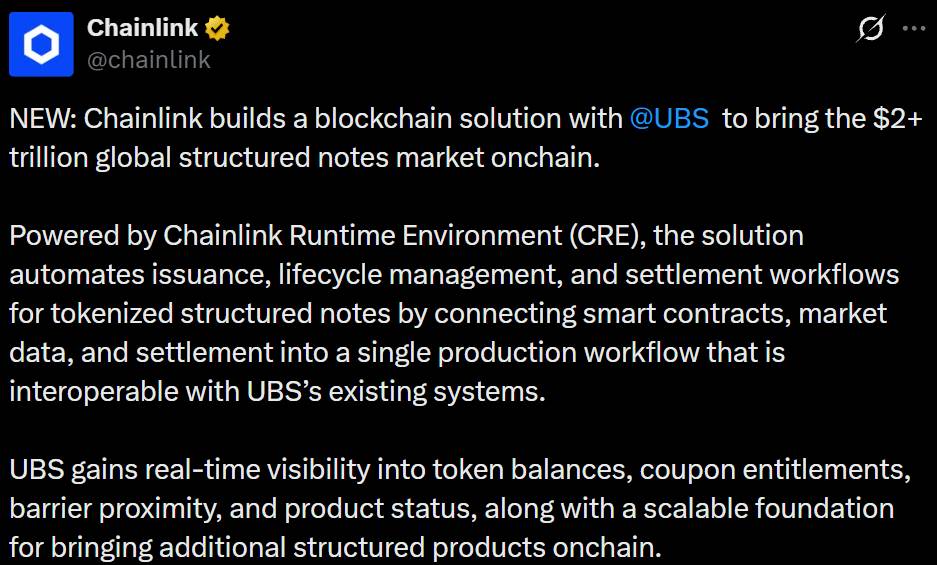
Source: Chainlink post.
This paper analyzes the structural instruments of monetization at the basic level.
What did Chainlink and Swissan announce?
According to Chainlink’s official post, the solution aims to bring the global market for structural instruments worth more than $2 trillion into the chain. The programme is supported by the CRE (Caiinlink Runtime Environment, a chain-based environment).
- Release:Create Paper
- Lifecycle management:Dealing with events during the active period of the instrument
- Settlement:Final steps to complete the transaction
The program integrates the smart contract, market data and settlements into a single production stream. In addition, the work stream is compatible with the existing system of the Bank, so that the bank does not need to be rebuilt from scratch.
Common explanation of structural instruments
Structural instruments are a financial derivative whose return depends on the performance of other assets (e.g., shares or indices). Such instruments usually contain established rules on the level of payments and prices, and therefore need to be carefully tracked.
The post highlights four aspects that are now visible in real time:
The above is a general interpretation of these terms. The post itself lists these four elements, but does not elaborate on their definition.
How Chainlink ' s Time Environment (CRE) is integrated
In the SmartCon 2025 review, the CRE is described as an integrated layer of finance on the chain.
In the new solution, the CRE serves as a bridge between the three usually separated components:
- smart condition:Run and follow established rules on the blockchain
- Market data:Provides information on price dynamics to futures
- Settlement:Completed transactions
Chainlink states that these components are now operating as a single workstream. This is essential because structural instruments are highly dependent on price data.
The advantage of the Swiss Sing in this solution
The advantages mentioned in the post for readers who are interested in a structured instrument for tokenization include:
- Real time visibility:Real-time view of balances, coupons, barrier proximity and product status
- Reduction of interference:The workflow interoperates with the systems that are already in use by Swiss SB
- Growth space:According to the post, the Swiss Bank has acquired a scalable infrastructure to move more structural products into the chain.
The third point is very important. The post describes it as a cornerstone in support of a variety of products, rather than a one-off test.
The post does not provide any details. It does not indicate how many bills were issued, how large or what their value was. Nor does it provide a timetable for new products.
The early collaboration between Swiss and Chainlink.
Is this the first time that the parties have cooperated? That is not the case.
In the 2025 review, it was mentioned that the Bank had completed the world’s first production-to-end FCFA work flow based on the Chainlink digital proxy technical standard. The same review noted that Chainlink had also used Swift messaging and CRE and the Bank to advance the monetization.
Overall, this suggests that the focus of business is shifting from the fund to a monetized structural instrument, a different type of product. Structural instruments require continuous tracking of coupons and price levels, making them more complex than simple ownership records. That is why Chainlink calls them production milestones.
Conclusions
Chainlink and the Bank have built a solution to automate the distribution, management and settlement of structural instruments along the chain. The official post emphasizes real-time visibility, connectivity to the current system of the Bank, and basic support for more products.
Readers should focus on the official channel of Chainlink to get updates.