
 Exchange Ranking
 Top Exchanges
 24h Volume Ranking
 Popularity Ranking
 Exchange BTC Balance
 Proof of Reserves
 Decentralized Exchanges
 Funding Rate
 Funding Heatmap
 Liquidation Data
 Max Pain
 Long/Short Ratio
 Whale L/S Ratio
 Binance/Okex/Huobi L/S
 Bitfinex Margin L/S
 ETF Tracker
 Solana ETF
 XRP ETF
 Hong Kong ETF
 Bitcoin Treasuries
 Crypto Reversal
 Ethereum Reserves
 HyperLiquid Wallet Analysis
 Hyperliquid Whale Watch
 Large Transactions
 On-chain Movement
 Bitcoin ROI
 Stablecoin Market Cap
 Options Analysis
 News
News Articles
 Economic Calendar
 Features
 Wallet
 Contract Calculator


 Security
 Collections
 Watchlist
 Following
 RUNE
RUNE Key insights:
THORChain stated that hundreds of validators may still conceal centralized control.
Two-thirds of THORChain nodes must approve most governance and code changes.
More validators can decentralize control, but they will also split protocol revenue between nodes.
THORChain co-founder
Chad Barraford believes that blockchain can have hundreds of validators, but it is still possible to remain centralized if operators and infrastructure are shared.
The network believes that unless these participants operate independently and can join without a license, the number of validators in itself does not explain. Its stance focuses on who controls validators, governance, infrastructure, data access, contracts and protocol changes.
The network also points out that hidden control may exist within systems that ostensibly use decentralized blockchain infrastructure.
THORChain questions the number of verifiers as a measure of decentralization
The network uses verifier independence as an example of how centralization can be hidden within a protocol. It said when the same entity operates hundreds of verifiers from the same data center, these verifiers provide limited protection.
A closed verifier selection process may also centralize control even if the network reports a large number of verifiers. Therefore, it emphasizes operator independence and open participation rather than just focusing on the number of validators.
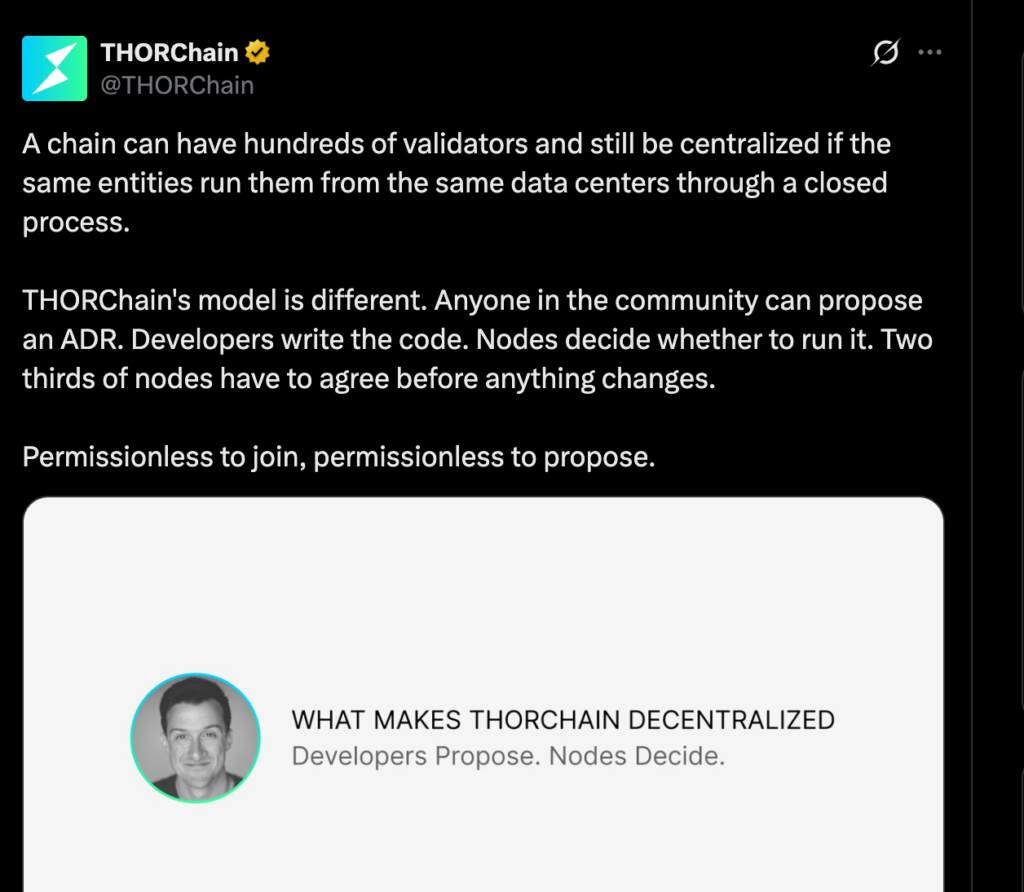
THORChain stated that the number of validators cannot justify decentralization| Source: X
The same argument also extends to infrastructure and data access under the framework described by the network. A social platform may store information on the chain while relying on APIs controlled by the original developer.
These developers can still filter information, restrict access, or shut down major access points completely. In this example, decentralized storage does not eliminate the control of the centralized API layer.
Governance may become another focus point when proposal approval relies solely on participant votes. Low participation can give a small number of token holders a huge influence on the final outcome.
The source example describes a founder holding a large token position and influencing the proposal through that position. According to THORChain, decentralization should be evaluated on a system-wide basis rather than just individual visible components.
Nodes have ultimate authority over protocol upgrades
The protocol separates software development from final protocol approval through a node adoption-centered process. Anyone in the community can raise an ADR (Architectural Decision Record) and the developer writes the relevant code.
The node then decides whether to run the proposed software and accept the network changes. Most code updates and governance proposals require support from two-thirds of nodes to be adopted.
Under this arrangement, developers cannot force nodes to install patches or accept updates. When technical issues require network-wide decision-making and coordinating software adoption, this process can slow down response times.
However, this delay reflects the requirement for independent nodes to review and accept changes before implementation. The network compared the process to systems that can resume operations more quickly by a smaller group.
Verifier growth brings economic and coordination trade-offs: THORChain
THORChain also describes verifier extension as an economic and technical trade-off rather than an automatic upgrade. A larger set of validators could further decentralize control, but would also divide agreement revenue among more operators.
More participants have also increased the unity needed to reach network-wide consensus. The system may fund more validators through inflation, but this will erode the value of current RUNE holders.
Conversely, node activity responds to revenue generated by the protocol, as stated in the source text.
























