
 Exchange Ranking
 Top Exchanges
 24h Volume Ranking
 Popularity Ranking
 Exchange BTC Balance
 Proof of Reserves
 Decentralized Exchanges
 Funding Rate
 Funding Heatmap
 Liquidation Data
 Max Pain
 Long/Short Ratio
 Whale L/S Ratio
 Binance/Okex/Huobi L/S
 Bitfinex Margin L/S
 ETF Tracker
 Solana ETF
 XRP ETF
 Hong Kong ETF
 Bitcoin Treasuries
 Crypto Reversal
 Ethereum Reserves
 HyperLiquid Wallet Analysis
 Hyperliquid Whale Watch
 Large Transactions
 On-chain Movement
 Bitcoin ROI
 Stablecoin Market Cap
 Options Analysis
 News
News Articles
 Economic Calendar
 Features
 Wallet
 Contract Calculator


 Security
 Collections
 Watchlist
 Following
 SOL
SOL Solana is preparing to adjust its charging model for network computing resources.
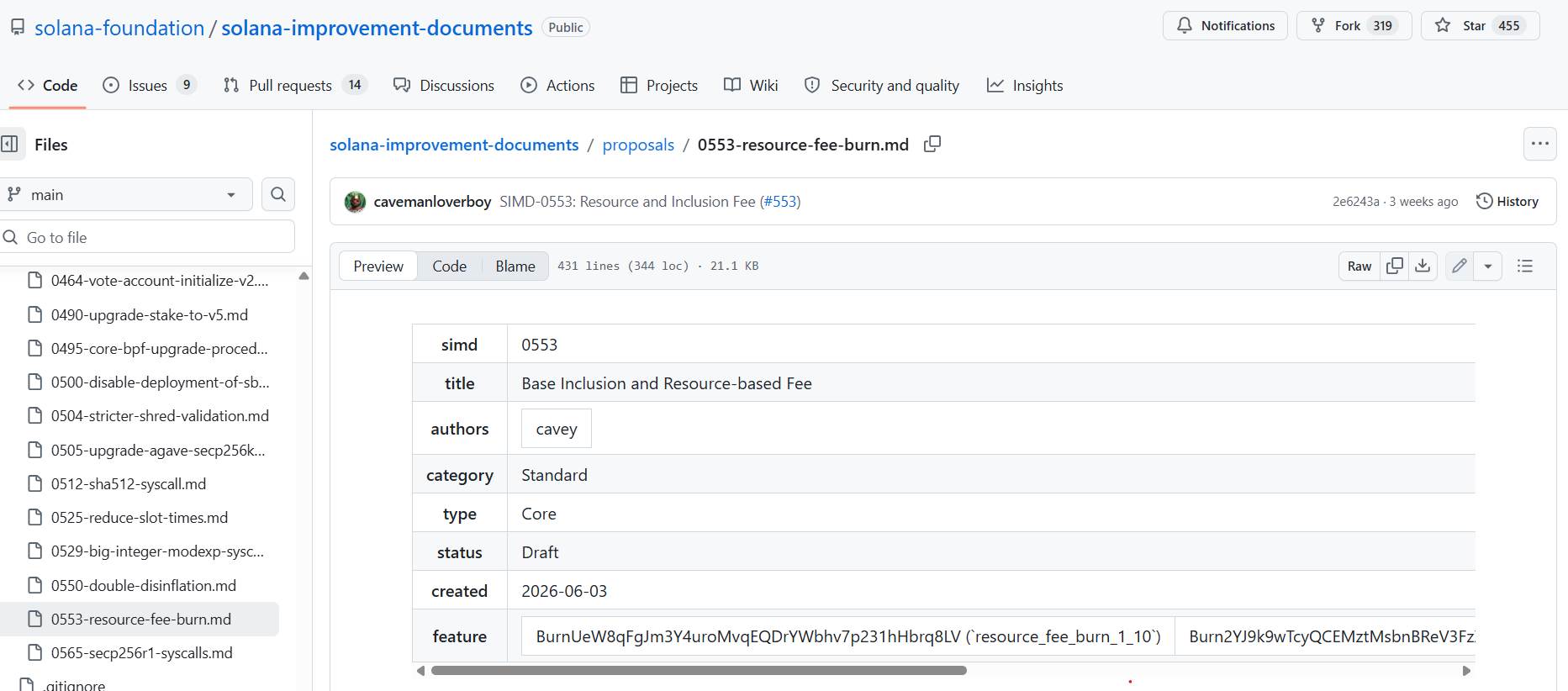
The Solana Improvement Document (SIMD-0553) plans to make users who consume the most resources pay more while reducing the cost of simple transactions. As an additional benefit, the plan will also increase SOL's destruction rate in stages and may even help it achieve deflation in the future.
Cavey, a researcher at Solana infrastructure company Temporal and author of the proposal, said the current fee does not reflect the true cost: "If I submit a transaction that does not perform any operation, I will charge the same fee as a transaction that consumes 200 million CPU cycles." The proposal would change the status quo by linking fees more closely based on the resources actually requested for each transaction. Resource fees will no longer belong to the validator, but will be destroyed, taking SOL out of circulation.
Of course, reducing verifier revenue has not been welcomed by everyone. Contributor bji pointed out on GitHub: "I like the part of the proposal that gives trade submitters additional incentive to accurately set the upper limit of calculation units. I am neutral or negative in other aspects." 'More destruction' should not be a goal, and validators 'income should not be cut arbitrarily."
SIMD-0553 entered Solana's new on-chain governance process in early August and passed the initial support phase on August 4. It is currently in the support and discussion phase, which usually lasts for seven eras (about two weeks). If approved, it will change the incentive mechanism for Solana's cheap block space.
So, what is the cost?
Waste of resources will become expensive
Cavey said Solana's current fee structure creates problems for developers. Core developers have been working on increasing network speeds for years, but apps have little economic incentive to stop wasting resources-inefficient transactions cost the same as efficient transactions.
"By implementing this resource pricing immediately, application developers will be forced to optimize," Cavey said. If the proposal is passed, developers who reduce resource consumption can reduce end-user costs and make applications more attractive, while developers who consume more Solana computing power will have to pay corresponding fees.
Cavey pointed out that the proposal specifically targets the arbitrage behavior of computational waste-searchers can submit a large number of transactions and pay a small fee even though most fail. In the past 30 days, the five traders with the highest failure rates submitted 11.5 million transactions, consumed 929 million units of account, and made a profit of only $16,091 on 2477 transactions, but paid only 78 SOL fees. Resource fees will encourage arbitrage searchers to adopt smarter and more flexible response strategies.
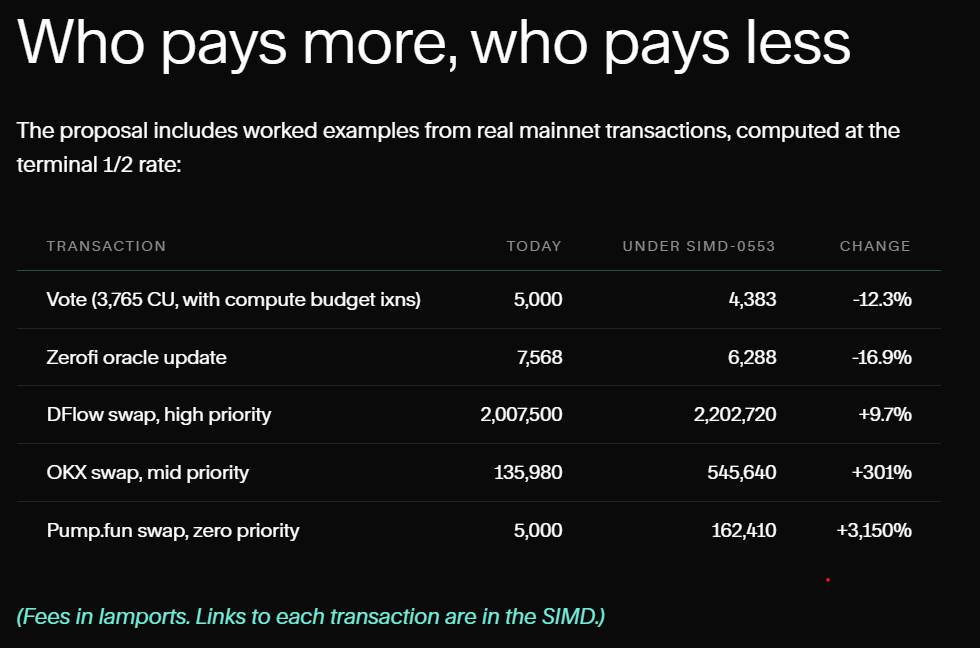
Cavey stated that stablecoin and token transfer fees could be reduced by approximately 20%. Temporal's simulations also found that under the new model, voting transaction fees would be reduced by approximately 12.3%, and oracle update fees would be reduced by 16.9%.
What is the trade-off?
Some trading activities will become much more expensive. Temporal estimates that under the proposed terminal rates, the cost of high-priority swaps through DFLow will increase by 9.72%, while the cost of medium-priority OKX swaps will increase by 301%, and the cost of zero-priority pump.fun swaps will increase by 3150%. This means that transaction costs for the network's most heavy-duty users-especially those who use robots to submit large quantities of transactions-could skyrocket.
Don't worry though, expense growth is based on a low base. Cavey believes that even the most computing-intensive transactions will cost only about $0.05 under the new model, compared with $2 to $5 that users may pay to exchange $100 on a centralized exchange.
The current proposal denies a unified increase in Solana's existing 5000 Ramport fees, arguing that it would disproportionately harm high-volume senders such as market makers, while still failing to reasonably price resource use.
Other Costs to Consider
"There are a few people who have raised concerns about the parameters, but overall, everyone is very supportive," Cavey said, citing core issues such as validator revenue, increased costs for high-frequency users and increased complexity. Contributor mschneider questioned why fees should be based on the resource requested by the transaction rather than the actual usage: "It seems more natural to use units." Cavey explained that charging resources based on requests allows users to understand costs in advance and allows verifiers to confirm their ability to pay before processing transactions. But this means that users may pay for unused resources, incentivizing developers to accurately estimate needs.
Verifiers may initially face a small reduction in basic fee revenue of approximately 4%. Cavey said parameters can be adjusted if necessary to offset the impact, but contributors such as bji remain skeptical and believe that verifier income should take precedence over additional destruction.
Theproposal also raised concerns about complexity, with some contributors questioning whether the new fee model would make Solana more difficult to use. Cavey refuted that view, saying that most users do not have to calculate fees themselves because apps and exchanges typically handle them. Automated traders are "mature" enough to adapt to changes in Solana's fee structure.
What about SOL destruction?
SIMD-0553 will increase the amount of SOL destroyed in transaction fees, taking more tokens out of circulation rather than being paid to verifiers. According to the proposal, the current daily destruction volume of approximately 648 SOL may rise to approximately 7500 to 9000 SOL at the proposed terminal rate, an increase of approximately 12 to 14 times if current resource requirements remain unchanged.
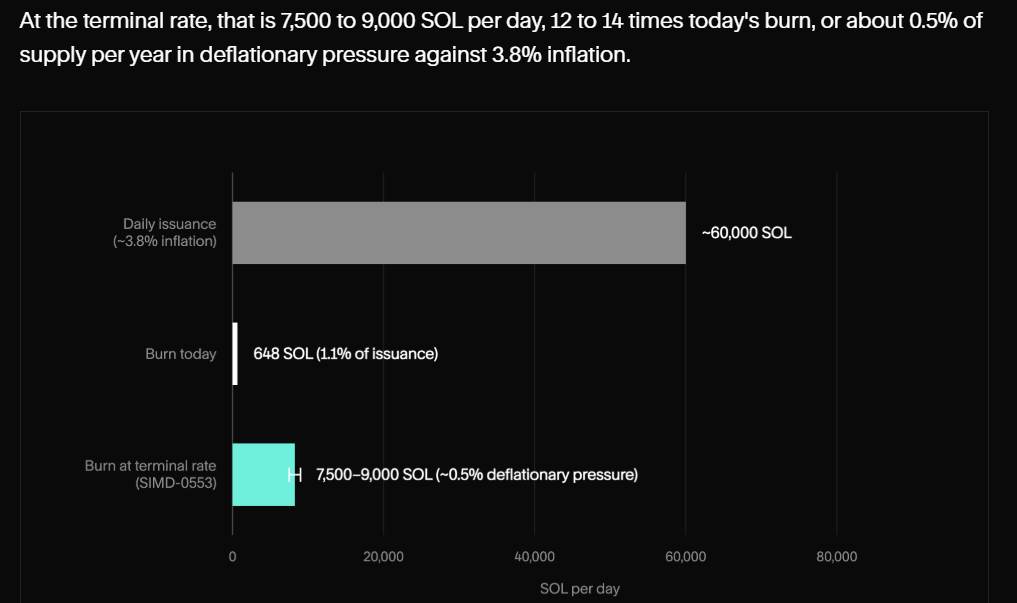
Cavey said higher destruction rates could eventually push SOL into deflationary territory: "If Solana succeeds, it could become a deflationary currency." Resource destruction fees can also reduce the incentive for verifiers to include unnecessary resource-consuming transactions.
Solana currently issues about 60,000 SOL per day, so even destroying 9000 SOL per day would not be enough to defuse the token (although another proposal called SIMD-0550 would curb inflation faster than current plans). Internet activity needs to grow significantly before the amount of destruction exceeds the amount of new circulation. Cavey believes this will be "a nice secondary effect" rather than the main goal. "The primary goal is to get core developers, developers and application developers to work together to make Solana faster. This is the first goal, and in my opinion, this is enough to justify the proposal."
























