Exchange Ranking
 Top Exchanges
 24h Volume Ranking
 Popularity Ranking
 Exchange BTC Balance
 Proof of Reserves
 Decentralized Exchanges
 Funding Rate
 Funding Heatmap
 Liquidation Data
 Max Pain
 Long/Short Ratio
 Whale L/S Ratio
 Binance/Okex/Huobi L/S
 Bitfinex Margin L/S
 ETF Tracker
 Solana ETF
 XRP ETF
 Hong Kong ETF
 Bitcoin Treasuries
 Crypto Reversal
 Ethereum Reserves
 HyperLiquid Wallet Analysis
 Hyperliquid Whale Watch
 Large Transactions
 On-chain Movement
 Bitcoin ROI
 Stablecoin Market Cap
 Options Analysis
 News
News Articles
 Economic Calendar
 Features
 Wallet
 Contract Calculator


 Security
 Collections
 Watchlist
 Following
Memetoro Presale News: Technical Transparency Revealed by Three Audits vs. Open Source AI Architecture Analysis
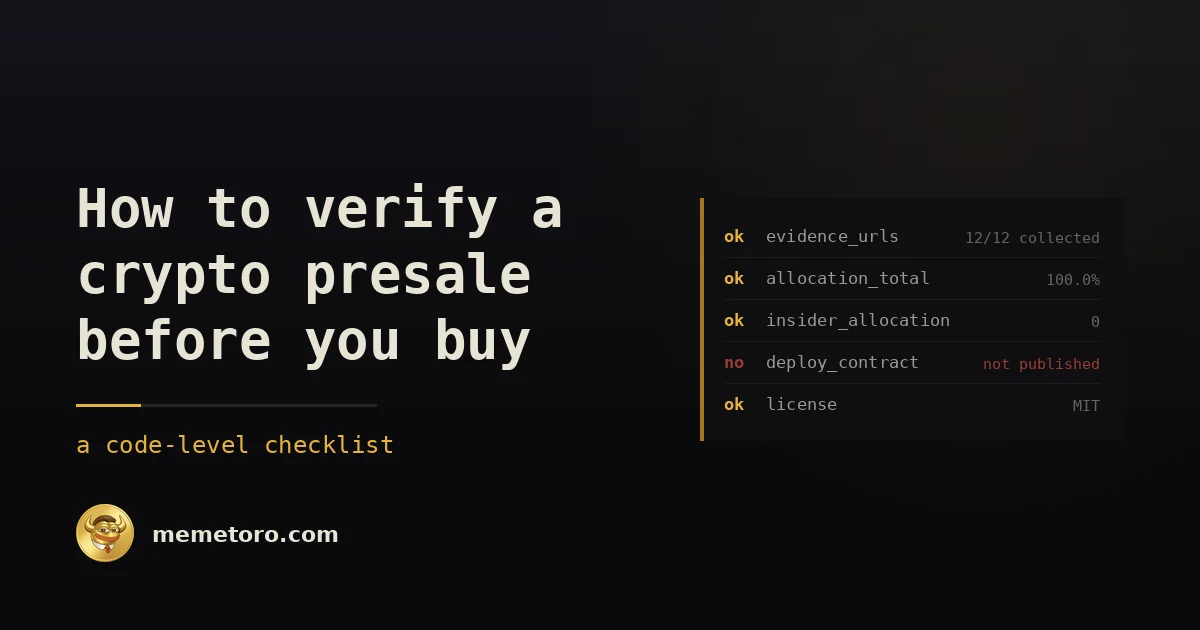
Cryptocurrency projects need to address issues of contract security and transparency from time to time. Memetoro's seventh phase of progress has been supported by three independent smart contract audits, while Memetoro exposes its artificial intelligence (AI) agent architecture as an open source project. These details are crucial because buyers need to understand how a cryptocurrency project handles its code, issuance rules, and token allocation before focusing on price.
Memetoro Presale News: What message did the three audits convey to buyers?
Memetoro's pre-sale news highlighted three independent smart contract audits as an important technology milestone. Smart contracts are code that runs rules on a blockchain. The audit is designed to check for security issues, unexpected behavior and other weaknesses in the code before users rely on the contract.
While three audits do not completely exempt the project from risk, they provide users with more information than unaudited contracts. This is particularly useful for pre-sale projects, as buyers are sending money into blockchain contracts and they need to understand how those contracts are designed.
Key nodes include the seventh phase, after launch, and the process that gradually develops as platform users and transaction activity increase. Three independent audits have approved Memetoro's deployment framework. The project is operated based on BNB Chain and aims to enforce issuance rules through public smart contracts. Auditing work supports but does not guarantee future security.
For those who follow Memetoro pre-sales news, the main value of the audit is that it improves visibility into the technical aspects of the project. Recent project updates also confirm that Coinsult, BlockSAFU and SolidProof are part of the "three-audit" security stack it reports.
Development story of how open source AI supports Phase 7
Another important part of Memetoro's pre-sale news is the project's open source AI proxy. Memetoro describes an AI agent capable of monitoring social media, online communities and global news to capture emerging trends. It can then generate the memin concept, visual design, brand identity, marketing content, and token details before release. 
The open source approach is important because users can examine the architecture and gain a deeper understanding of how the system is expected to work. Memetoro also said its distribution process eliminates private distribution layers and internal advantages. Instead, public smart contracts enforce rules published for issuance.
AI makes issuance recommendations, while smart contracts enforce conditions. This separation makes processes easier to understand than systems where important release decisions are hidden. This distinction is useful for ordinary buyers: security reviews mainly answer technical questions, while open source AI models answer questions about visibility and process.
However, neither can answer the larger market question of whether users will adopt the platform or whether $MT will gain sustained demand after release. These results depend on delivery capabilities, liquidity, trading activity and the broader crypto market environment.
Things that audits and AI verifications fail to prove
Memetoro pre-sale news does not mean that audits or open source code eliminate investment risks. An audit is a review of the status at a specific point in time. New code, integrations, market conditions, or user behavior may create different risks in the future.
Open source architecture can improve visibility, but it does not guarantee that AI-generated memocoins will perform well. The meincoin market is extremely volatile, and its technical quality cannot predict market demand.
Therefore, investors evaluating the seventh phase should comprehensively examine the following areas:
- Audit findings and whether identified issues have been resolved.
- Public contract behavior and issuance rules.
- AI agent documents and actual product delivery.
- Token economics and distribution plans.
- Post-issuance liquidity and exchange plans.
Memetoro's token economics lists a total of 1.2 billion $MTs, of which 71% will be used for public offerings and 10% will be used for centralized exchange (CEX) reserves. In addition, an annualized rate of return (APR) pledge of up to 35% and a 24-month lock-in period for marketing and partner allocation are described.
These details add useful background information, but should be assessed in conjunction with safety and market risks.