Exchange Ranking
 Top Exchanges
 24h Volume Ranking
 Popularity Ranking
 Exchange BTC Balance
 Proof of Reserves
 Decentralized Exchanges
 Funding Rate
 Funding Heatmap
 Liquidation Data
 Max Pain
 Long/Short Ratio
 Whale L/S Ratio
 Binance/Okex/Huobi L/S
 Bitfinex Margin L/S
 ETF Tracker
 Solana ETF
 XRP ETF
 Hong Kong ETF
 Bitcoin Treasuries
 Crypto Reversal
 Ethereum Reserves
 HyperLiquid Wallet Analysis
 Hyperliquid Whale Watch
 Large Transactions
 On-chain Movement
 Bitcoin ROI
 Stablecoin Market Cap
 Options Analysis
 News
News Articles
 Economic Calendar
 Features
 Wallet
 Contract Calculator


 Security
 Collections
 Watchlist
 Following
 BTC
BTC  ETH
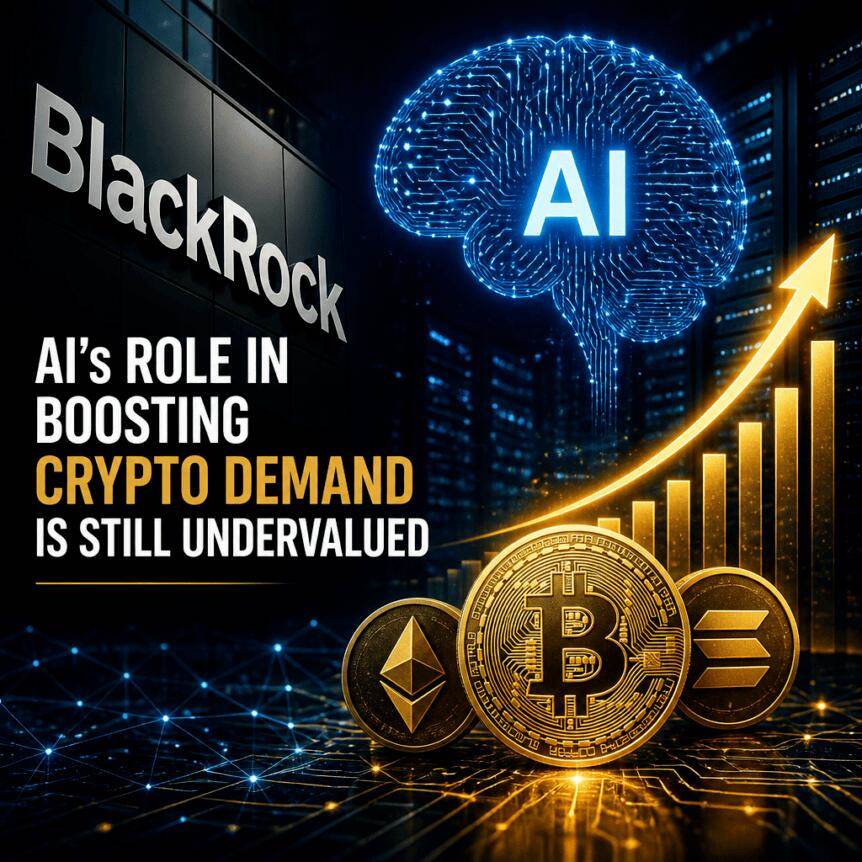
ETH BlackRock released white paper: Exploring the integration trend of artificial intelligence and digital assets
On September 22, BlackRock released a research white paper that provided an in-depth analysis of artificial intelligence and digital assets. The increasingly close integration trend. The report, titled "Machine Native Economy: How Digital Assets Connect Intelligence, Business and Computing", was compiled by BlackRock's Digital Assets Research Team. The report makes a core point: widespread adoption of artificial intelligence may become an important undervalued source of demand for digital assets.
AI agents require "machine-native" currency
The core argument of the report is concise and concise: BlackRock defines artificial intelligence as "machine-native intelligence" and treats digital assets as "machine-native currency." As autonomous AI agents gain the ability to complete complex tasks independently, they will increasingly have to pay for data, software, application programming interfaces (APIs), and computing resources, often without the need for manual intervention throughout the process.
As artificial intelligence-driven human-computer interactions and machine-to-machine (M2M) transactions grow, demand for blockchain and other programmable payment systems, including stablecoins and other on-chain assets, is expected to rise significantly. In contrast, traditional payment systems face practical challenges in this scenario: manual participation in account establishment, identity verification and authorization usually still requires manual participation, making it difficult for them to adapt to high-frequency, fully automated transaction needs.
According to research, in high-frequency, machine-native payment scenarios, stablecoins are expected to lead transaction applications. To illustrate the scale of existing stablecoin activities, BlackRock pointed out that the trading volume of stablecoin in 2025 has exceeded US$11 trillion.
New opportunities for tokenized computing power and digital assets
In addition to the payment field, the white paper also identifies computing power as an emerging independent asset class. BlackRock believes that an emerging area is emerging in the market, where computing power resources can be tokenized, traded and used as collateral. It is estimated that by 2030, ultra-large-scale cloud computing revenue will exceed US$1 trillion per year, and standardized computing power equity certificates can be used as application scenarios for financing and programmable settlement.
The report also points to structural similarities between large language models (LLMs) and blockchain: large language models transform human language into machine-processable tokens, while blockchain converts economic rights into on-chain tokens, enabling machine-verifiable ownership and settlement mechanisms.
This report was co-authored by Will Su, Robert Mitchnick, Jay Jacobs and William Helm of BlackRock. The article also cited the evolving regulatory framework, including the GENIUS Act in the United States, the European Union's MiCA framework, and the stablecoin regulatory regimes in Hong Kong and Singapore, which are shaping the development path of the market.