Exchange Ranking
 Top Exchanges
 24h Volume Ranking
 Popularity Ranking
 Exchange BTC Balance
 Proof of Reserves
 Decentralized Exchanges
 Funding Rate
 Funding Heatmap
 Liquidation Data
 Max Pain
 Long/Short Ratio
 Whale L/S Ratio
 Binance/Okex/Huobi L/S
 Bitfinex Margin L/S
 ETF Tracker
 Solana ETF
 XRP ETF
 Hong Kong ETF
 Bitcoin Treasuries
 Crypto Reversal
 Ethereum Reserves
 HyperLiquid Wallet Analysis
 Hyperliquid Whale Watch
 Large Transactions
 On-chain Movement
 Bitcoin ROI
 Stablecoin Market Cap
 Options Analysis
 News
 Articles
 Economic Calendar
 Features
 Wallet
 Contract Calculator


 Security
 Collections
 Watchlist
 Following
 ETH
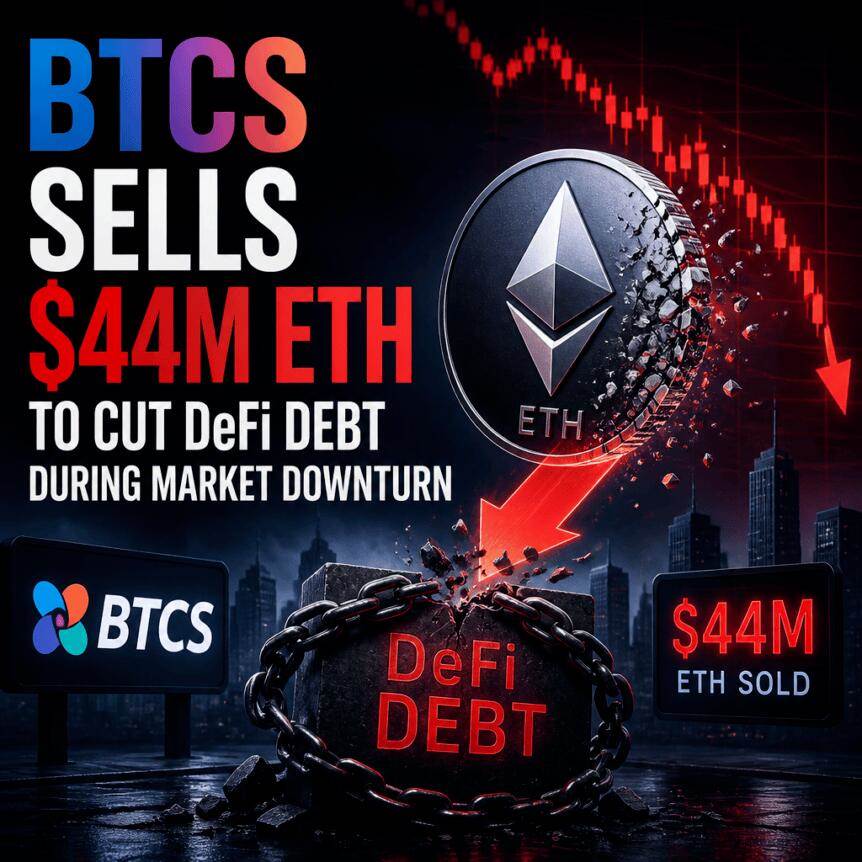
BTCS sells ETH to reduce DeFi debt and cope with market volatility
NASDAC listed BTCS has recently taken initiatives aimed at reducing its risk associated with Etheleum (ETH) exposure during extensive cryptocurency sales. The company sold about 27,300 ETHs to reduce the loans borrowed through decentrazed borrowings from the company Protocol Aave.
According to the United States Securities and Exchange Commission (SEC) document issued on Monday, BTCS indicated that it sold the Ethers on 20 November and used the funds to reduce its outstanding Aave debt to approximately $10.5 million. The company characterized this as a risk management step in the context of increased market volatility.
Key points
- Large-scale repayments:On 20 November, BTCS sold some 27,300 ETH to repay the loan on Aave.
- Ieverage has dropped significantly:This repayment resulted in a reduction of BTCS borrowings on Aave by about 81 per cent and an estimated mortgage rate of approximately 32 per cent for the remaining positions (Loan-to-Value Ratio).
- Exiting the mobility pool:BTCS states that its Imperium DeFi operation temporarily withdrew from the liquidity pool position to limit the exposure to additional market fluctuations.
- Asset hold:After the sale was completed, as of Sunday, BTCS held approximately 24,245 ETHs, with a total value of cash and other digital assets of approximately $61 million.
- Industry comparison:In sharp contrast to the de-risking operation of BTCS, Bitmine Immmension Technologies reported that it continued to purchase ETH on a weekly basis, cumulatively amounting to 6,085,564 (approximately 4.98 per cent of the total supply of ETH).
BTCS cut Aave's debt after Ether sold it.
In this mechanism, borrowing is supported by collateral, and the risk of exposure increases when asset prices fall. According to the documents, the company sells ETH and spends the money on reducing the outstanding Aave debt to about $10.5 million.
The company stated that the transaction reduced its borrowing on Aave by about 81 per cent. At the same time, it provided an updated risk snapshot of its remaining position: after repayment, BTCS stated that its remaining Aave risk exposure estimated mortgage rate was about 32 per cent.
The reason for this is to limit the possibility of a change in the market during rapid market changes. This concern is particularly relevant for ETH borrowers, as the threshold of the termisation can be triggered quickly as the value of the collateral declines.
Document description of BTCS' broader encrypted balance sheets
In addition to Aave’s position, BTCS also reported other financing obligations. According to the SEC materials linked to the document, BTCS indicated that, in addition to the remaining Aave borrowings, it had some $17.9 million in convertible instruments outstanding.
BTCS also refers to changes in operations within its Imperium DeFi operations. The company states that, as part of its efforts to reduce exposure to further market volatility, it temporarily withdrew from the liquidity pool position. While the exact structure of these pools is not specified in the extracts provided, the timing suggests that the company wishes to reduce its exposure to risks under conditions that may rapidly deteriorate in the downside market, such as liquidity constraints or concentration volatility in a particular DeFi strategy.
After the ETH sale, BTCS reported that it held approximately 24,245 ETH. The company further stated that, as of Sunday, cash and digital assets totalled approximately $61 million. The report also estimated that 27,300 ETH transactions accounted for about 53 per cent of the total ETH hold held prior to the BTCS sale, highlighting the de-risking of its exposure to the treasury risk.
Business strategy fragmentation: de-risking and continuous accumulation
The BTCS cuts associated with ETH, which coincides with the signal of different strategies taken by encrypted investors in other similar businesses under the same market pressure. For example, the Digital Asset Management firm Coin Shares revealed last week that it sold all of the ETH vaults and held Solana (SOL) in storage to fund the buy-back of shares.
At the same time, another company that acted in the opposite direction was Bitmine Immersion Technologies, which was linked to Tom Lee’s Bitwise ecology system. BitMine stated in a Monday announcement that, despite the market’s downturn, an additional 7,819 ETHs had been purchased over the past week.
Bitmine insisted on buying ETH, citing its treasury strategy
BitMine reported that it currently holds 6,085,564 ETH, which is said to be equivalent to 4.98 per cent of the total supply of Ethereum. It also stated that it has purchased Ethereum every week since June 2025, when its treasury strategy was introduced, to position its activities as a consistent long-term accumulation plan, rather than a response to short-term price fluctuations.
In the same update, Bitmine reported that it had $384 million in cash and marketable securities as of Sunday. It also stated that it had staking about 5.23 million ETH - about 86 per cent of its total ETH holdout - indicating that much of its strategy was related to staking, not just idle treasury exposure.
The role of Bitmine in the business vault pattern was also highlighted by third-party tracking data CoinGecko. According to the bulletin, CoinGecko listed 35 entities, which had a total of 8.16 million ETHs at the time, and BitMine allegedly occupied about 75 per cent of the ETHs held by the business and government vaults in that list.
Conclusions and market outlook
These two distinct strategies – the BTCS cut leverage and temporarily withdrew from certain deFi positions, and the fact that versus Bitmine continues to accumulate ETH on a weekly basis – suggests that investors can be very divided when markets become volatile. For readers, the real inspiration is that the firm’s encrypted balance sheets may react very differently to a retreat, depending on the value of the leverage, the cost of borrowing, the need for liquidity, and whether management gives priority to capital preservation or accumulation.
As Ether is still under pressure — CoinGecko, cited in the report, shows that the asset price was around US$ 1,743 Monday time at 6:35 p.m., and has declined significantly over the past year and month — investors should be concerned about whether more publicly reported lenders are able to adjust their collateral and DeFi risk exposure in real time, and whether the reservoirs focused on accumulation will continue to buy in the face of continued volatility.