Exchange Ranking
 Top Exchanges
 24h Volume Ranking
 Popularity Ranking
 Exchange BTC Balance
 Proof of Reserves
 Decentralized Exchanges
 Funding Rate
 Funding Heatmap
 Liquidation Data
 Max Pain
 Long/Short Ratio
 Whale L/S Ratio
 Binance/Okex/Huobi L/S
 Bitfinex Margin L/S
 ETF Tracker
 Solana ETF
 XRP ETF
 Hong Kong ETF
 Bitcoin Treasuries
 Crypto Reversal
 Ethereum Reserves
 HyperLiquid Wallet Analysis
 Hyperliquid Whale Watch
 Large Transactions
 On-chain Movement
 Bitcoin ROI
 Stablecoin Market Cap
 Options Analysis
 News
 Articles
 Economic Calendar
 Features
 Wallet
 Contract Calculator


 Security
 Collections
 Watchlist
 Following
Orbinum network testnet: private staking function and user rights
The Orbinum network has launched a private staking feature on the public testnet, a rare variant of the Polkadot-style ZK-NPOS, where the address and amount are kept hidden.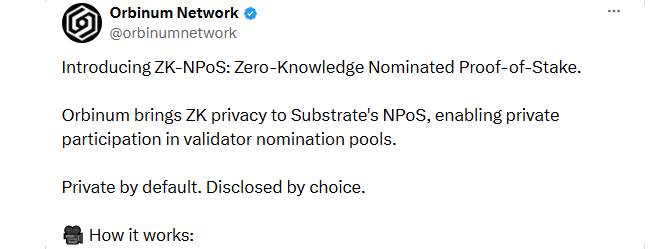
This feature, known as ZK-NPOS, was announced on the X platform and built on a Layer-1 project focused on privacy. Can a cryptocurrency project still in the testnet phase turn this advantage into a mainnet project by the end of this year?
Orbinum Network ZK-NPOS Details: The Work of Private Stacking Pools
The standard nomination certificate is a valid mechanism that exposes all participants. The block browser will show who has made a move, how much has staking, and for whom. The Orbinum network maintains the same consensus mechanism, with Aura production block, GRANDPA finally fix blocks, and then add a layer of privacy protection to the pool members mentioned in its status document. The process is divided into five steps: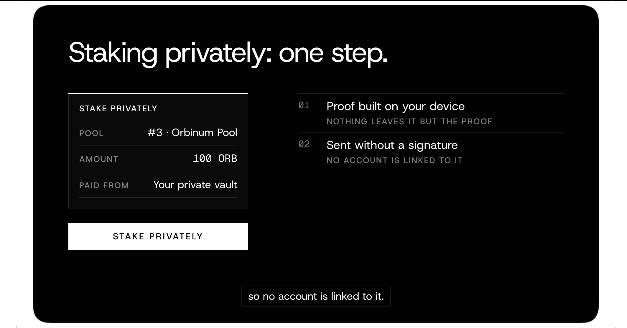
- Treasury:ORB tokens are stored in private vaults as instruments (also known as undertakings).
- Proof:Wallet constructs a zero-knowledge certificate on the device to prove the validity of the accession.
- Entry:Shows that you can submit without a signature and therefore you will not be associated with any public account, and that you will join the shared pool account.
- Share:Private shares enter the vault and are awarded in return for each time (era) compound interest.
- Quit:The lifting of the binding is equally confidential and takes two times, approximately two days.
Pools, certifiers, total amounts and schedules are open. Users can reveal individual instruments by disclosing key without exposing the key. The chain combines Groth16 ZK-SNARKs with full EVM compatibility. Run from Standard 21 to 22, first introducing NPOS and then shielding. Currently only the certifying person is at risk of punishment.
The advantages of private staking and the current implementable operations of Orbinum testnet users
Its core selling points are based on four points:
- Privacy:Who did the staking, staking how much, keep it hidden.
- Fragmentation:The staking person can join multiple pools without having to bind the activity to a single public account.
- Low threshold:The threshold for membership of the private pool on the testnet is 10 ORB, while the public nominees and role of the pool varies from about 1 to 100 ORB.
- Automatic proceeds:No manual collection is required, and the release period for non-certifying persons is shorter.
According to the entry document, the tester can collect ORBs from the tap, block the balance, send protected transfers, and run the certifier or pool. The community plan also distributes points that will be converted to airdrop at the time of the TGE (the event in which the coin is generated), subject to a snapshot and attribution rule. Teestnet tokens have no real value, and the chain may be reset, so that there is no ORB price at this time.
Market comparison: Orbinum and Aleo, Aztec and Secret Network
The Orbinum network competes in crowded areas of privacy. The list of key competitors for privacy blockchain shows:
- Aleo:A ZK Layer-1 with shielding applications and privacy protections.
- Aztec:A company that aims to protect privacy and DeFi.
- Secret Network:Runs confidential futures using trusted hardware based on Cosmos.
- Penumbra and Namada:The Cosmos ecososystem system has ZK shield and private DeFi projects.
- Zcash, Monero and Dusk:The project focuses on payment privacy and financial privacy.
Orbinum has a narrower perspective. It combines Substrate NPoS privacy, EVM compatibility and default private pool functions with a chain and supports selective disclosure. This subdivision is not yet validated at the level of mainnet.
Launch date of Orbinum Mainnet: Listing of tokens and subsequent road map phases
The road map shows that the research, community and public testnet phases have been completed. Phase 4 is the launch of the Mainnet, which is targeted for the fourth quarter of 2026 and is now in progress:
- Sales and audit:Public sales, creation blocks and security audits.
- Network:Validator selection and consensus migration.
- Currency:At the end of the first quarter, a score snapshot was performed, followed by TGE.
- Market:Mainnet started and started the exchange to be mobile.
The release date, place on the market or the selling price of Orbinum have not yet been confirmed, and the network is still in the testnet phase. Once the mainnet is online, the staking incentive will come from the planned distribution, i.e., 30 per cent of the progressive release supply, plus a transfer of products. The follow-up phase will point to private DeFi, institutional adoption, and cross-chain privacy bridges.