Exchange Ranking
 Top Exchanges
 24h Volume Ranking
 Popularity Ranking
 Exchange BTC Balance
 Proof of Reserves
 Decentralized Exchanges
 Funding Rate
 Funding Heatmap
 Liquidation Data
 Max Pain
 Long/Short Ratio
 Whale L/S Ratio
 Binance/Okex/Huobi L/S
 Bitfinex Margin L/S
 ETF Tracker
 Solana ETF
 XRP ETF
 Hong Kong ETF
 Bitcoin Treasuries
 Crypto Reversal
 Ethereum Reserves
 HyperLiquid Wallet Analysis
 Hyperliquid Whale Watch
 Large Transactions
 On-chain Movement
 Bitcoin ROI
 Stablecoin Market Cap
 Options Analysis
 News
 Articles
 Economic Calendar
 Features
 Wallet
 Contract Calculator


 Security
 Collections
 Watchlist
 Following
How does the FLOP Labs and FLOP Foundation govern the network?
The FLOP Foundation is the most easily ignored part of the project, but it is the rule maker that determines it. Anyone who tries to find the people behind the project will usually find only tokens and white papers, and very few will see a specific name or organizational structure. The purpose of this guide is to explain the two entities behind the network, their respective competencies, and the boundaries of the messages that high-level personalities convey to the readers.
Key points
- There are two entities behind the network.
- Flop Labs LLC builds the software, while the Foundation is responsible for regulation program after it goes online.
- Only foundations can submit protocol proposals before the first halving.
- The transfer to remove the Genesis Super-User Key has been specified, but has not yet been implemented.
What's FLOP Network?
FLOOP Network is a “proof-of-inference” blockchain, which is also the original currency of the proxy economy. AI pays $FLOP to a Miner to run the reasoning task, so the currency is directly converted into a computational capacity. The block is generated approximately once a second, with an initial block reward of $96 FLOP, once every 730 days, until it stabilizes at $3 FLOP. The White Paper aims to launch testnet in the fourth quarter of 2026 and mainnet in the first quarter of 2027.
Source: Official website
Team behind FLOP Network
The public figure is Arthur Hayes. He co-founded BitMex in 2014 and served as CEO until October 2020. On August 18, 2026, he announced that he was back to head Flop Labs. His X platform personal data (@CryptoHayes) now lists him as CEO of Flop Labs.
Here is a noteworthy warning: Hayes does not describe the exact duties, shareholdings, or remuneration when he announces this role. The name brings attention, not proof, so the reader should judge the network according to its published rules.
The White Paper follows the model common in open source protocol: the company that built the software is separated from the institution that built the regulation rules to ensure that the party hired to build does not control the rules.
Flop Labs LLC corporate structure
The company is paid for by a fixed block distribution, not in currency. The project is promoted without pre-sale, risk-free investments (VC) and is launched fairly, so that the distribution is its only stated source of income from protocol.
The role of the Foundation in governance
The Foundation does three things: it finances independent core developers from its own distribution; it has the sole right to submit protocol improvement proposals before the first transfer of governance to the certifying officer is made; and it receives any staking gold confiscated for impeccable conduct by a Miner or the certifyer.
The White Paper emphasizes that this is a submission of control, not a vote. The Foundation cannot change anything alone, and each proposal still needs to be approved by the certifying officer. Hayes describes this transition as a constitutional monarchy, in which the Foundation makes a proposal and the certifying officer takes a decision.
One of its stated objectives is to keep blocks below one second, which will facilitate rapid payments between AI agents. The White Paper does not yet list the members of the Foundation's Board of Directors.
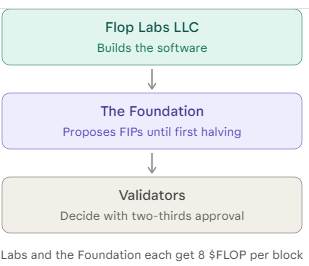
FLOP Network Governance Detail
The rules are strict and are written in such a way as to ensure that no single party can act alone.
FLOP Improvement Proposal (FIP) and Approving Authority Vote
Protocol changes are made through FLOP improvements (FIPs). FIP is a numbered design document linked to a chain referendum. FLOP Network certifier then votes on the outcome.
Validators are the custodians of the network. The maximum number of seats is 1,000, ranked on the basis of the bonded making (staking) rights of the service-tested operator. Each certifier is required to issue a US$ 1,200,000 self-staking bond and does not commission staking to enter the collection. This deposit is supported by real and silver behind each vote.
FLOP Network Team and Foundation Distribution
Each entity receives $8.FLOP per block, which is additional to the normal block incentive. The amount is halving according to the same schedule and will stop after 10 years.
Protocol does not charge fees or destroy tokens. Neither entity earns a share of the costs of reasoning.
FLOP Network Super-User Key Interconnection
During the creation phase, the chain carries a super-user key held by multiple signatures, as is the case for most new networks. Those who control the Wallet can change the running-time status. The interface removes the key and all upgrades are made through the governance channel.
The official white paper is open and transparent about this state of affairs. The handover has been designated, but has not yet been implemented.
Change after first halving
The block is awarded once every 730 days, so the first halving takes place about two years after it goes online. By that time, the proposal will be closed. Either party can submit the FIP, and the community will choose the content of the certification vote. The foundation will be one of many voices.
Concluding remarks
The FLOP Foundation is in a unique position in the program. It guides the first two years and then takes a step back to get the certifiers and the wider community to take over. Whether this handover is going well is more important than any single name on the team list. Readers following the project should focus on the key exchange that has been implemented, the final yellow paper and the first halving.