Exchange Ranking
 Top Exchanges
 24h Volume Ranking
 Popularity Ranking
 Exchange BTC Balance
 Proof of Reserves
 Decentralized Exchanges
 Funding Rate
 Funding Heatmap
 Liquidation Data
 Max Pain
 Long/Short Ratio
 Whale L/S Ratio
 Binance/Okex/Huobi L/S
 Bitfinex Margin L/S
 ETF Tracker
 Solana ETF
 XRP ETF
 Hong Kong ETF
 Bitcoin Treasuries
 Crypto Reversal
 Ethereum Reserves
 HyperLiquid Wallet Analysis
 Hyperliquid Whale Watch
 Large Transactions
 On-chain Movement
 Bitcoin ROI
 Stablecoin Market Cap
 Options Analysis
 News
News Articles
 Economic Calendar
 Features
 Wallet
 Contract Calculator


 Security
 Collections
 Watchlist
 Following
 BTC
BTC Federal Reserve officials 'speeches triggered violent fluctuations in Bitcoin prices, with the market focusing on the key level of US$83,000
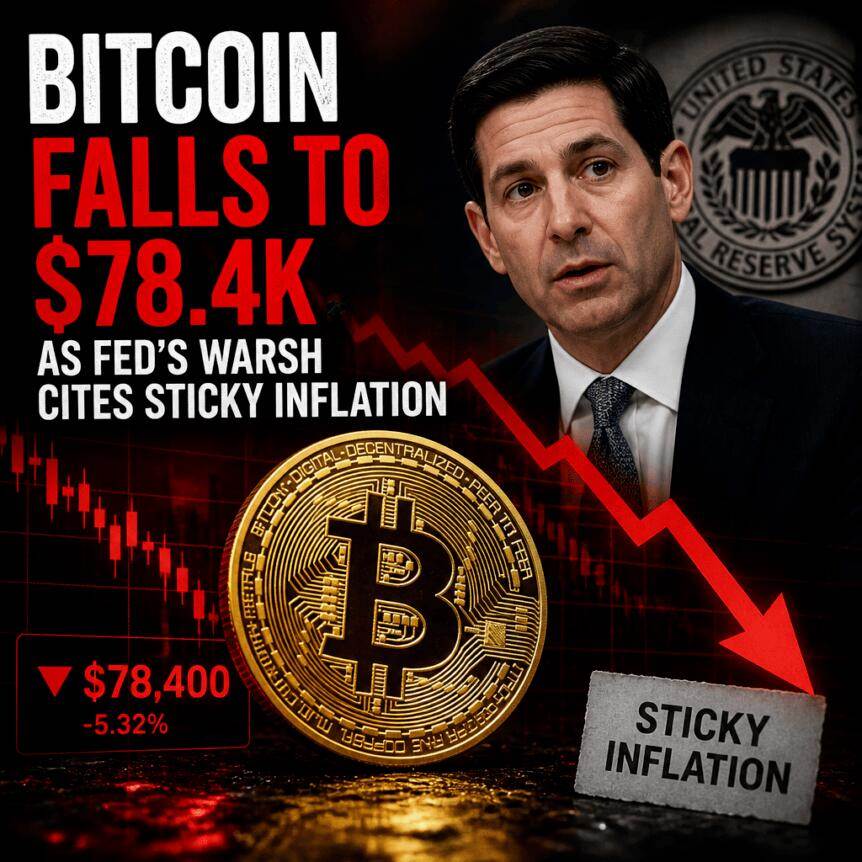
After Federal Reserve official Kevin Walsh delivered a keynote speech at the Jackson Hole meeting, Bitcoin prices fluctuated violently in early trading hours on Wall Street. In his speech, Walsh suppressed market optimism about inflation progress and questioned traditional "forward-looking guidance" policy tools. The market reacted quickly: Bitcoin fell to intraday lows near $78,000 against the U.S. dollar before recovering back to the $80,000 region.
Currently, the focus of market observers has shifted from a single macro news headline to the structure of the Bitcoin derivatives market to determine whether it can support price stability at the backdrop of August's trading closing and tightening liquidity. Around $83,000.
Core Points
·Bitcoin fell during Walsh's Jackson Hole speech, briefly trading to around $78,442 on Bitstamp, before recovering to the $79,500 area.
Walsh said that the decline in personal consumption expenditure (PCE) and consumer price index (CPI) does not represent a "meaningful improvement" in underlying inflation trends, and the Federal Reserve still adheres to its 2% inflation target.
·After Walsh's speech, U.S. stocks still recorded gains, but Bitcoin's move suggests that the crypto market is still closely interpreting the uncertainty of inflation policies.
· QCP Capital pointed out that whether the price of Bitcoin can stabilize above approximately US$83,000 depends on the structure of the derivatives market, especially whether leverage increases in line with price.
[TAG CoinGlass data shows bitcoin has gained about 26 percent so far this month, with August's performance described as the best month since 2017. [TAGWalsh Jackson Hole speech: No 'material' shift in inflation
Walsh delivered his first keynote speech at the Jackson Hole symposium, cautious about the inflation outlook, according to the text of the speech released by the Fed. While he reiterated the Fed's commitment to meeting its 2 percent inflation target, he argued that recent improvements in headline inflation measures had not translated into a clear change in underlying trends. [TAG
Walsh also criticized the Fed's consistent practice of providing forward guidance. He said the approach, commonly used during the financial crisis, was "outdated" and added that it would not return as a regular tool for communicating policy direction.
On inflation data, Washi emphasized that CPI and PCE have fallen back from previous peaks, but progress has been more moderate in the past few years. He acknowledged that this summer's PCE and CPI data were better than expected, but did not view it as evidence that the underlying inflation trajectory had "significantly improved."
Such rhetoric-which both suppresses market interpretation of cooling inflation and reduces the possibility of detailed guidance on future policies-seems to make cryptocurrency traders uneasy, even if traditional markets take the message more calmly.
Crypto market reaction: Bitcoin shows a volatile range around US$80,000
TradingView data showed that the trading price of Bitcoin against the US dollar on Bitstamp once fell to about US$78,442, and the price of Bitcoin fell by about 1% when the report was released. Subsequently, as risk sentiment stabilized, bitcoin prices rebounded back to the $79,500 region.
Price movements throughout the day basically fluctuated around the US$80,000 mark, a transaction that analysts described as a narrow intraday range before the monthly close in August. Previous technical analysis frameworks mentioned that Bitcoin/USD needs to regain a downward sloping trend line and hold on to the 50-week exponential moving average of approximately $77,250 to maintain the overall upward trend.
At the same time, on-chain and market analysis points to the upper resistance level. One view mentions a "thick liquidity/resistance zone" between current spot prices and $86,000, suggesting that even if buyers push prices higher, the market may face resistance before entering new zones.
Why $83,000 matters: Derivatives market structure, not just spot prices
Although spot price news attracts the most attention, the latest analysis from QCP Capital believes that the quality of any uptrend depends on the performance of derivatives. In its market commentary, QCP Capital emphasized that even after a breakout, traders should also focus on whether funding rates and open interest contracts grow in a controlled manner, rather than accelerating in tandem with prices.
In the agency's words, the key difference is not whether Bitcoin is trading above levels such as US$83,300, but whether subsequent movements are supported by broader spot participation or are increasingly driven by leveraged positions.
QCP Capital's analytical framework actually provides traders with two scenarios that need to be monitored: one where prices rise while leverage is manageable ("different market structures"), and the other where leverage rises rapidly, making price movements more fragile. This is important for investors because the second scenario could leave the market vulnerable to rapid reversals when sentiment or liquidation dynamics change.
This perspective also helps explain why the Fed's macro comments may trigger a sharp decline in prices without immediately changing the overall trend. If derivatives market conditions remain stable, Bitcoin can absorb shocks more effectively; if leverage starts chasing prices, it may amplify fluctuations.
Strong momentum so far this month, but short-term tests remain
Despite intraday swings triggered by Washi's speech, CoinGlass data shows that Bitcoin has risen about 26.35% so far this month. The same data source described this as Bitcoin's best August since 2017, highlighting that overall demand for risky assets and crypto exposure remains strong.
However, the Fed's speech downplayed the "substantial improvement" in inflation and analysts 'emphasis on the conditions of the derivatives market, suggesting that the short-term issue is to confirm whether Bitcoin can hold key levels, break through resistance zones, and avoid the accumulation of speculative leverage in the process.
Looking forward, traders and investors may be concerned about changes in funding rates and open interest contracts as the end of the month approaches, and whether Bitcoin can maintain gains above $83,000 rather than fall back into the $80,000 range. Uncertainty lies not only in the direction of the long-term narrative, but also in the mechanism for price movements-whether it is broad and resilient, or whether it increasingly relies on levers that can reverse quickly.